This article's table of contents introduction:
- Understanding the Spec: 38,000 m³/h
- The Critical Missing Parameter: Static Pressure (SP)
- Motor Power Estimation
- Fan Type Selection
- Key Design Considerations for Buying
- Typical Duct Size
- Summary for Procurement
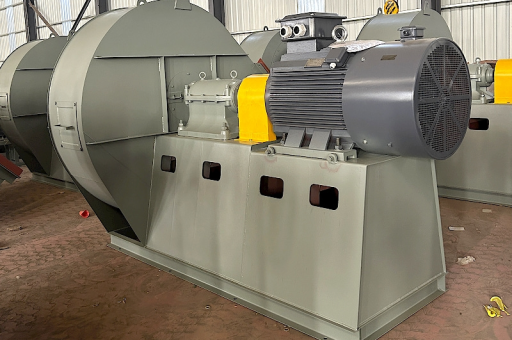
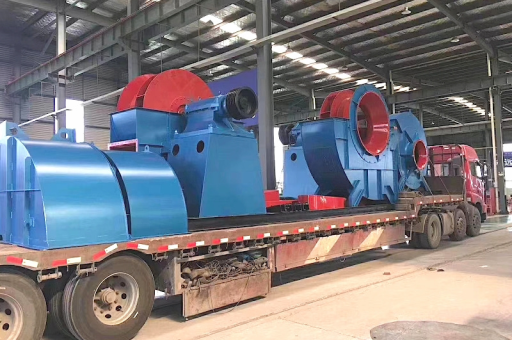
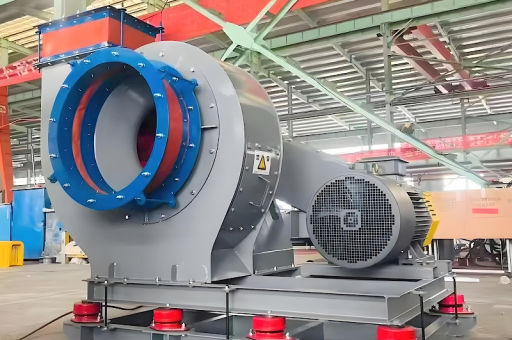
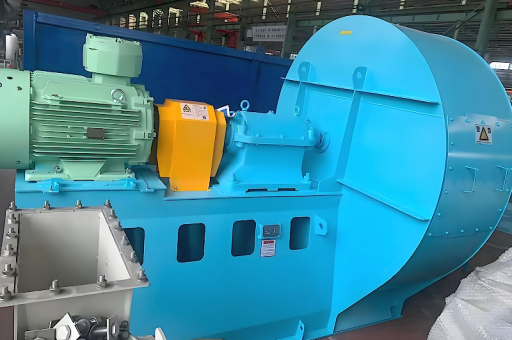
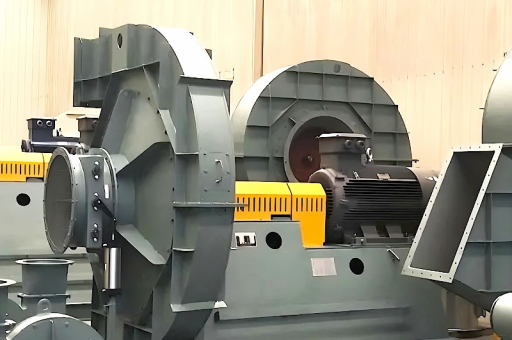
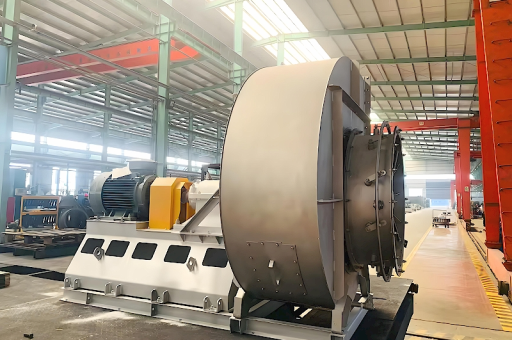
This is a specification for a large industrial exhaust fan, likely used in a dust collection system, a cement plant, a woodworking facility, or a steel mill.
Here is a detailed breakdown of what this specification means, key design considerations, and how to select the right fan.
Understanding the Spec: 38,000 m³/h
- Volume: 38,000 cubic meters per hour (m³/h).
- In CFM (Cubic Feet per Minute): $\approx$ 22,350 CFM. (Calculation: 38000 / 1.699 = 22,366 CFM).
- Context: This is a very large industrial fan. It is not for a small workshop. It moves roughly 10 tons of air per hour.
The Critical Missing Parameter: Static Pressure (SP)
The volume (38,000 m³/h) is only half the equation. The most important missing parameter is Static Pressure (Pa or mmWG).
The fan must overcome the resistance of:
- The Dust Collector (Baghouse/Cartridge): This is the biggest restriction (1,000 to 2,500 Pa typically).
- Ductwork: Length, diameter, bends, and branches (500 to 1,500 Pa).
- Hoods & Inlet: The capture velocity needed at the source (100 to 500 Pa).
Example Scenarios:
- Low Pressure (~1,500 Pa): A simple dust collector with short ductwork.
- Medium Pressure (~2,500 Pa): A standard baghouse with moderate duct runs.
- High Pressure (~3,500+ Pa): A pulse-jet cartridge collector with long, complex ducting.
Without knowing the pressure, you cannot select a motor (kW) or a fan type.
Motor Power Estimation
You can estimate the required motor power using the fan power equation.
$$P = \frac{Q \times p}{3600 \times \eta}$$
- $P$ = Power (kW)
- $Q$ = Flow Rate (38,000 m³/h)
- $p$ = Total Pressure (Pa)
- $\eta$ = Fan Efficiency (typically 0.65 to 0.80 for a decent industrial fan)
Estimates for 38,000 m³/h:
| Static Pressure | Estimated Power (kW) | Approx HP |
|---|---|---|
| 1,500 Pa | 22 kW | 30 HP |
| 2,500 Pa | 37 kW | 50 HP |
| 3,500 Pa | 52 kW | 70 HP |
Result: The motor will likely be between 22 kW and 55 kW.
Fan Type Selection
For this flow rate, two main fan types are used:
| Feature | Backward Curved (BIC) | Radial / Paddle Wheel |
|---|---|---|
| Efficiency | High (Very energy efficient) | Low (Less efficient) |
| Dust Handling | Low (Non-clogging, but blade can wear) | Excellent (Handles heavy dust & abrasives) |
| Typical Use | Clean air, wood dust, light loading | Heavy dust, grain, cement, metal shavings |
| Cost | Higher initial cost, lower operating cost | Lower cost, higher operating cost |
Recommendation:
- For wood dust: Choose a Backward Curved (Aerofoil) fan.
- For heavy industrial dust (steel, cement, mining): Choose a Radial (Paddle Wheel) fan.
Key Design Considerations for Buying
If you are ordering this fan, you must specify:
- Flow Rate: 38,000 m³/h (Confirmed).
- Static Pressure: Pa (Most critical).
- Air Density / Temperature: Is the air hot? (e.g., 80°C factory vs. 20°C ambient). Hot air requires a different motor rating.
- Explosion Proofing: Does the dust present an explosion risk? If yes, you need a Stainless Steel fan and an ATEX / CE certified motor.
- Location: Indoor or outdoor? (Dictates enclosure protection - IP55 / IP65).
- Drive Type:
- Direct Drive: Reliable, fixed speed.
- Belt Drive: Allows for speed changes (via pulley) and uses a VFD (Variable Frequency Drive) for precise control.
Typical Duct Size
For 38,000 m³/h, the main duct diameter is approximately:
- Velocity: 15-20 m/s for dust transport.
- Duct Diameter: 800 mm to 900 mm (32" to 36").
Summary for Procurement
Minimum Spec for a Quotation:
"Exhaust Fan for Dust Collector. Volume: 38,000 m³/h. Static Pressure: 2,500 Pa. Material: Mild Steel (MS) with Epoxy coating. Motor: 37 kW, 1450 RPM, IE3 Premium Efficiency, IP55. Drive: Belt driven with adjustable pulley. Noise: < 85 dB(A) at 1 meter."
Final Advice: If you do not know the pressure, do not buy the fan yet. You will either buy a motor that is too small (fan won't work) or too large (wasting electricity and money). Measure the pressure drop across your current filter system or get a ductwork consultant to calculate it.