
This article's table of contents introduction:
- Table of Contents
- Introduction: The Challenge of Handling Extreme Heat
- What Defines a 600℃ High Temperature Fan?
- Core Engineering: Materials, Cooling, and Motor Isolation
- Primary Industrial Applications
- Common Technical Questions (Q&A)
- Comparison: Centrifugal vs. Axial High-Temperature Fans
- Future Trends: Material Science and Smart Monitoring
- Conclusion: The Backbone of High-Heat Operations
*The Critical Role of 600℃ High Temperature Fans in Extreme Industrial Processes: Design, Applications, and Future Trends*
Table of Contents
- Introduction: The Challenge of Handling Extreme Heat
- What Defines a 600℃ High Temperature Fan?
- Core Engineering: Materials, Cooling, and Motor Isolation
- Primary Industrial Applications
- Common Technical Questions (Q&A)
- Comparison: Centrifugal vs. Axial High-Temperature Fans
- Future Trends: Material Science and Smart Monitoring
- Conclusion: The Backbone of High-Heat Operations
Introduction: The Challenge of Handling Extreme Heat
In industries ranging from steel manufacturing to cement production and even renewable energy systems like concentrated solar power (CSP), moving air or gas at temperatures exceeding 500℃ is a daily necessity. Standard fans fail at these temperatures: blades warp, bearings seize, and motors burn out. This is where the 600℃ High Temperature Fan becomes an irreplaceable component.
Unlike conventional ventilation fans, a 600℃ High Temperature Fan is specifically engineered to withstand continuous operation in environments where the gas temperature reaches the melting point of aluminum. Without these specialized fans, critical processes such as flue gas recirculation, kiln exhaust, and heat treatment would be impossible or dangerously inefficient.
What Defines a 600℃ High Temperature Fan?
A "600℃ fan" does not simply mean the fan can survive 600°C for a few minutes. It must maintain structural integrity, aerodynamic efficiency, and mechanical reliability for thousands of hours at that temperature.
Key specifications that distinguish it:
- Maximum continuous operating temperature: 600℃ (with peak short-term exposure up to 650℃)
- Blade tip speed: Often limited to prevent creep deformation
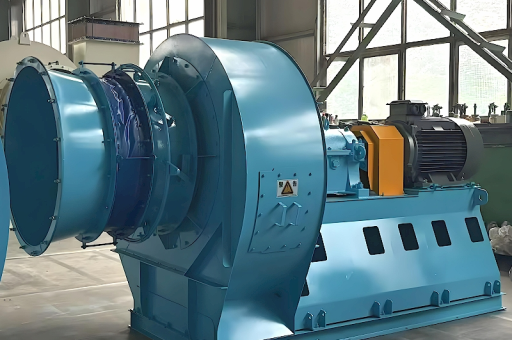
- Housing classification: Typically Casing type with insulated outer shell
- Drive configuration: Often belt-driven or direct-drive with extended shaft cooling
What it is NOT:
A 600℃ fan should not be confused with a "high-temp kitchen exhaust fan" which rarely exceeds 80℃. The industrial variant must handle corrosive, abrasive, and high-velocity gas streams.
Core Engineering: Materials, Cooling, and Motor Isolation
The failure of a standard fan at 600℃ is caused by three factors: thermal expansion, oxidation, and loss of material strength. Engineers solve these through:
A. Blade Material Selection
- Nickel-based superalloys (e.g., Inconel 718 or Hastelloy X) are common. They retain strength up to 700℃.
- Some designs use ceramic-coated stainless steel for cost reduction, though ceramic coatings are prone to cracking under thermal shock.
B. Shaft Cooling System
- The motor cannot survive at 600℃. Therefore, the fan shaft is extended and often includes forced air cooling or water jackets.
- A heat slinger (cooling disc) mounted on the shaft near the housing creates an air barrier, reducing heat transfer to the bearings.
C. Bearing and Lubrication
- High-temperature fans use grease with molybdenum disulfide or synthetic ester oil.
- Some designs place bearings in a separate pedestal housing isolated from the main fan casing by a cooling chamber.
D. Casing Design
- Casings are typically made of thick carbon steel with internal refractory lining (e.g., ceramic fiber or castable refractory).
- Expansion joints are mandatory to accommodate thermal growth without warping the housing.
Primary Industrial Applications
| Industry | Specific Use | Why 600℃ Needed |
|---|---|---|
| Cement | Pre-heater tower exhaust | Clinker burning releases gases at 800-900℃; fan upstream draws 600℃ gases |
| Steel | Annealing furnace recirculation | Uniform temperature requires movement of gases at 600-700℃ |
| Power Generation (CSP) | Heat transfer fluid air cooling | Molten salt systems operate near 565℃; backup fans handle 600℃ HTF leaks |
| Chemical/Petrochemical | Reformer furnace waste gas | Syngas production involves high-temp flue extraction |
| Renewable Energy (Wind Turbine) | Note: Not primary use, but some wind turbine nacelles use 600℃ fans for emergency battery thermal runaway venting | In case of lithium battery fires inside the turbine, fans must survive extreme temperatures to extract smoke |
Common Technical Questions (Q&A)
Q1: Can I run a 600℃ fan at 700℃ for 1 hour?
A: No. Most 600℃ fans have a safety factor of 10-15% (up to 680℃), but sustained 700℃ will cause irreversible blade creep and bearing failure. Never exceed rated temperature without manufacturer approval.
Q2: How do I prevent condensation damage when starting a cold fan into hot gas?
A: Use a pre-heat cycle. Slowly ramp the gas temperature while the fan rotates at low RPM. Sudden thermal shock can crack the refractory lining or warp blades.
Q3: What is the typical lifespan of a 600℃ fan?
A: With proper maintenance (bearing re-greasing every 500 hours, blade inspection every 3000 hours), most industrial fans last 5-8 years. In continuous 600℃ service, blade replacement may be needed every 3 years.
Q4: Is a belt drive or direct drive better for 600℃?
A: Belt drive is safer because the motor can be placed farther from the heat source. Direct drive requires an expensive high-temp motor or advanced shaft cooling.
Q5: Can I use a standard fan with thermal paint for 600℃?
A: No. Paint does not prevent material creep or bearing failure. A genuine 600℃ fan uses special alloys and cooling design, not coatings.
Comparison: Centrifugal vs. Axial High-Temperature Fans
- Centrifugal (Radial) Fans: Most common choice for 600℃ applications. The impeller design can handle high static pressure (needed for kiln or furnace ducts). The heavy casing easily accommodates refractory lining.
- Axial Fans: Not recommended for 600℃. Blades cannot be thick enough for high-temp alloys, and motor placement near the airstream causes failure. Exception: Some custom designs for wind turbine nacelle fire exhaust use axial fans with water-cooled motors, but the operating time is limited.
Future Trends: Material Science and Smart Monitoring
- Ceramic Matrix Composites (CMCs): These can withstand over 1200℃ but remain too expensive for mainstream adoption (current cost ≈ $5,000/kg). Research is focused on cost reduction.
- Additive Manufacturing (3D printing): Complex cooling channels inside blades are now possible using Inconel powder, improving heat dissipation by 15%.
- IoT Vibration Monitoring: Sensors embedded in bearing housings allow predictive maintenance. A fan that loses 0.1mm of blade tip due to oxidation will show a specific vibration signature before failure.
- Hybrid Cooling: New designs combine water-cooled shaft jackets with air-cooled heat slingers, reducing the need for separate cooling fans.
For wind turbine applications, manufacturers are exploring modular 600℃ fans that can be quickly swapped out when internal battery systems overheat, minimizing turbine downtime.
Conclusion: The Backbone of High-Heat Operations
The 600℃ High Temperature Fan is far more than a fan—it is a meticulously engineered system balancing material science, thermodynamics, and mechanical reliability. It enables industries to run processes that are dangerous, dirty, and blisteringly hot. Without it, cement plants, steel mills, and chemical refineries would shut down.
As renewable energy systems like CSP and advanced wind turbines adopt thermal storage and battery systems, the demand for 600℃ fans will grow. New materials and smart monitoring will make them more efficient and longer-lasting. But the core principle remains: move heat safely, or don't move it at all.
When you see a 600℃ fan in operation, you are watching the quiet victory of engineering over entropy.





