
This article's table of contents introduction:
- Critical Components & Materials
- Cooling & Lubrication
- Key Application Types (Where you find 800°C fans)
- Performance & Engineering Considerations
- Common Pitfalls & Failures
- Leading Manufacturers & How to Buy
- Summary Table
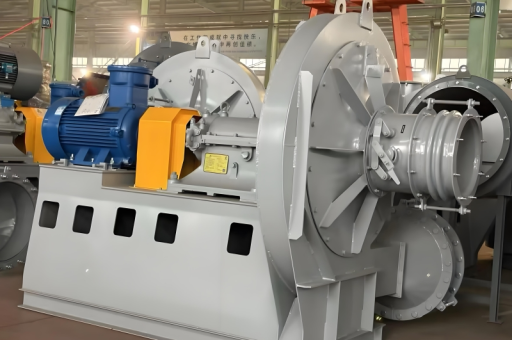
An 800°C (1472°F) high-temperature fan is a specialized piece of industrial equipment. At this extreme temperature, standard fans (which typically fail above 200-400°C) would melt or warp instantly.
These fans are used in processes where materials are combusted, dried, or chemically transformed at very high heat. They operate beyond the limits of typical stainless steel and require exotic alloys, specialized motors, and unique cooling methods.
Here is a comprehensive breakdown of what defines, builds, and uses an 800°C fan.
Critical Components & Materials
To survive 800°C, the fan cannot be made of standard steel.
- Impeller (Wheel):
- Material: Inconel® 600, 601, or 625 (Nickel-Chromium superalloys) or Hastelloy X. These alloys maintain structural strength and resist oxidation (scaling) at red-hot temperatures.
- Design: Usually radial (paddlewheel) or radial-tip. The blades are thick, often straight or slightly backward-curved, to withstand thermal expansion and stress.
- Housing (Casing):
- Material: Same high-grade alloys (Inconel, Hastelloy) or heavy-gauge stainless steel (310S or 253MA) for lower-stress areas.
- Feature: A thick, insulated outer shell is common to protect personnel and reduce heat loss.
- Shaft:
- Material: Large diameter, high-strength alloy. It is often hollow to allow for internal cooling via air or water.
- Bearings:
- Critical: Bearings cannot survive 800°C directly.
- Solution: The shaft is extended so bearings are mounted outside the airstream in a cool area. They are housed in a "bearing pedestal" with a thermal break (e.g., a ceramic or air-gap insulator) and often have passive or active cooling fins.
- Motor:
- Motor Type: Almost always TEFC (Totally Enclosed Fan Cooled) or C-Face.
- Configuration:
- Direct Drive: The motor is isolated from the gas stream by a long shaft and a cooling fan on the motor shaft that pulls ambient air over the motor fins.
- Belt Drive: The motor is mounted far from the heat source. Belts are heat-resistant (e.g., Gates Predator or Kevlar-reinforced).
- VFD Ready: They are almost always paired with a Variable Frequency Drive to control speed and airflow.
Cooling & Lubrication
This is the most critical engineering challenge.
- Shaft Cooling:
- Ambient Air: A small fan or "blow wheel" is mounted on the shaft near the housing to draw cool ambient air over the shaft.
- Water Cooling (Jacket): For the most extreme 800°C applications, the bearing housing is surrounded by a water jacket (a sealed cavity where cold water circulates). This requires a constant water supply and a temperature sensor to prevent boiling.
- Lubrication:
- Grease: High-temperature synthetic grease (e.g., based on PFPE – perfluoropolyether). Requires frequent re-lubrication.
- Oil Mist / Oil Bath: A circulating oil system with a heat exchanger is used for larger fans. Oil is cooled before entering the bearings.
Key Application Types (Where you find 800°C fans)
- Industrial Furnaces & Kilns: (Cement, lime, ceramics, steel heat-treating) – For combustion air supply or exhaust of flue gases.
- Cement Plant Preheater Towers: Handling hot exhaust gas from the calciner (often 800-1000°C).
- Glass Manufacturing: Exhausting hot gases from glass melting furnaces.
- Metal Melting & Reverb Furnaces: For secondary combustion air or fume extraction.
- Waste-to-Energy / Incinerators: Handling hot flue gas from the primary combustion chamber.
- Chemical & Petrochemical: For high-temperature reactor off-gas or catalyst regeneration.
- Biomass / Coal Power Plants: Primary air fans for pulverized coal boilers (though often lower temp).
Performance & Engineering Considerations
- Thermal Growth: The shaft and housing expand significantly when heated. The bearing pedestal base must be designed to allow for axial and radial thermal expansion (e.g., using slotted bolt holes or linear bearings on the motor base).
- Vibration Monitoring: These fans are expensive and critical. RTDs (temperature sensors) and accelerometers (vibration sensors) are often hard-wired to a control system.
- Airflow: Because the air is very hot (low density), the mass flow (actual weight of gas moved) is much lower than the volume flow (CFM). A fan rated for 10,000 CFM at 20°C might only move 1,500 CFM at 800°C for the same horsepower. The motor must be sized for the hot, dense condition.
Common Pitfalls & Failures
- Over-Speeding in a Cold Condition: Starting the fan when the system is cold can overload the motor because cold air is much denser. Dampers must be partially closed during cold starts.
- Bearing Failure from Heat Migration: Poor insulation on the thermal break allows heat to "walk" down the shaft and cook the grease, causing seizure.
- Thermal Stress Cracking: Rapid temperature changes (e.g., cold air blowing on a hot impeller) can crack the Inconel blades.
- Corrosion/Erosion: 800°C gases often contain HCl, SOx, or fly ash. This causes high-temperature corrosion (e.g., sulfidation) or erosion, eating away the impeller.
Leading Manufacturers & How to Buy
You won't find these on Amazon. You need to contact specialized industrial fan OEMs.
- North America: Robinson Fans, Howden, New York Blower, Chicago Blower.
- Europe: Korf, FläktGroup, Pollrich (Pelzer), Cattin Filtration.
- Asia: (Various specialized foundries and fan houses).
Quoting a project requires telling the supplier:
- Max operating temperature (800°C).
- Gas composition (clean air, corrosive, dusty?).
- Volume flow (CFM or m³/hr) at 800°C.
- Pressure (static pressure) needed.
- Ambient temperature for the motor.
Summary Table
| Feature | Standard Fan | 800°C High-Temp Fan |
|---|---|---|
| Impeller Material | Mild Steel / Aluminum | Inconel / Hastelloy |
| Max Temp (Short) | 120°C (250°F) | 850°C (1560°F) |
| Bearing Location | In airstream (close) | Remote, water/air cooled |
| Cooling Method | None | Water jacket / air purge |
| Motor | Standard | VFD-rated, large frame |
| Cost | $500-$5,000 | $25,000 - $150,000+ |
Bottom line: An 800°C fan is a high-stakes, capital-intensive piece of equipment. It requires exotic metallurgy, smart thermal management, and precise process control. If you need to specify one, work directly with an experienced fan engineer from a reputable supplier.





