
This article's table of contents introduction:
- What is a 900°C High-Temperature Fan?
- Key Design & Material Differences
- Typical Specifications (Example)
- Common Applications
- Critical Selection & Sizing Criteria (For a Quote)
- Major Manufacturers (for reference)
- Important Note on Safety & Cost
This is a request for a specific industrial product: a 900°C High-Temperature Fan.
This is a highly specialized piece of equipment, typically custom-engineered for extreme environments like industrial furnaces, kilns, and exhaust systems. Standard fans cannot handle temperatures above ~300°C-500°C, so a 900°C fan requires exotic materials and specific design features.
Here is a detailed breakdown of what a 900°C fan is, its key specifications, applications, and critical selection criteria that you would need to know to specify or purchase one.
What is a 900°C High-Temperature Fan?
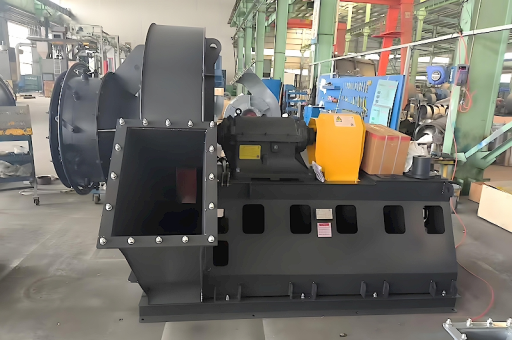
A 900°C fan is a heavy-duty industrial fan designed to move or circulate air, flue gas, or process gasses continuously at an operating temperature of 900°C (1652°F) .
At this temperature, standard steel becomes plastic (soft and weak) and oxidizes (rusts) almost instantly. Therefore, the construction is completely different from a standard fan.
Key Design & Material Differences
-
Impeller (Fan Wheel):
- Material: High-nickel, superalloy stainless steels are mandatory. Common grades include Inconel 601, Inconel 625, Hastelloy X, or RA330. These alloys maintain their strength and resist oxidation at red-hot temperatures.
- Design: The blades must be designed to withstand thermal expansion. High-stress welds are avoided. Sometimes, a "star" or radial blade design is used for strength.
-
Shaft:
- Material: Also made from high-nickel alloys like Inconel.
- Cooling: The in-shaft cooling system is critical. The shaft is often hollow, and cooling air is forced through the center to prevent the heat from traveling into the motor bearings and destroying them.
-
Bearings:
- Location: The bearings are always mounted outside of the hot gas stream.
- Cooling: They are mounted on a robust bearing pedestal or baseplate with a heat shield and often have a forced air cooling system (a blower pushing air over the bearing housing) or a water-cooled jacket to keep the bearings below 80°C (175°F).
-
Housing (Scroll):
- Insulation: The housing is usually fabricated from carbon steel for strength but is lined on the inside with a thick layer (100-250mm) of high-temperature ceramic fiber insulation.
- Liner: A thin inner liner (made of stainless steel) holds the insulation in place. This protects the outer housing from the direct heat.
-
Motor:
- Mounting: The motor is mounted on a separate baseplate, far from the fan housing, and connected via a flexible coupling.
- Open Drip Proof (ODP) or TEFC: A standard motor can be used because it is isolated from the fan heat by the long shaft, cooling system, and shaft cooler.
Typical Specifications (Example)
| Parameter | Specification |
|---|---|
| Max Operating Temp | 900°C (Continuous) |
| Max Peak Temp | 950°C (Short term, e.g., 1 hour) |
| Impeller Material | Inconel 601 / 625 |
| Shaft Material | Inconel 601 |
| Cooling Method | In-shaft cooling fan + Forced air on bearings |
| Insulation Thickness | ~150mm - 200mm Ceramic Fiber |
| Pressure Range | Medium pressure (e.g., 1000 - 3000 Pa) |
| Flow Rate | Custom (e.g., 5,000 - 200,000 m³/h) |
Common Applications
- Heat Treatment Furnaces: Recirculating hot air for uniform heating.
- Glass Manufacturing: Exhaust from melting furnaces.
- Cement & Lime Kilns: Induced draft (ID) fans for secondary air.
- Waste Incineration: Moving hot combustion gasses.
- Foundries: Core drying ovens and cupola furnaces.
- Chemical Processing: Catalytic crackers and high-temp reactors.
Critical Selection & Sizing Criteria (For a Quote)
If you need to buy one, you cannot just say "I need a 900°C fan." You must provide this information to a manufacturer (e.g., Howden, New York Blower, Cincinnati Fan, Robinson Fans, or a specialized Asian manufacturer like Zhejiang Shuangyang or Shenyang Blower Works):
- Operating Temperature: Is it continuous 900°C? Are there temperature spikes (e.g., 950°C)?
- Gas Composition: Is it clean air, or does it contain corrosive gases (e.g., SO2, HCl, Cl2) or abrasive dust (e.g., cement, sand)? This changes the inner liner material.
- Airflow (CFM or m³/h): How much gas needs to be moved?
- Static Pressure (in. wg. or Pa): How much resistance is in the ductwork/furnace?
- Density: The gas density at 900°C is very low (about 1/5th of room air). This affects the motor power calculation.
- Duty Cycle: Is it continuous 24/7 or intermittent operation?
- Power Supply: Voltage, phase, frequency (e.g., 400V/3ph/50Hz).
- Mounting: Needs a specific orientation (e.g., horizontal, vertical, flanged).
Major Manufacturers (for reference)
- US/Europe: Robinson Fans, New York Blower, Cincinnati Fan, Howden, Korf, Munters (for corrosion).
- Asia (High-Temp Specialists): Zhejiang Shuangyang, Shenyang Blower Works, Wuxi Huadong Blower, Shandong Zhangqiu Blower.
Important Note on Safety & Cost
- Cost: These fans are very expensive (often $15,000 - $100,000+) depending on size and alloy content (Inconel is very costly).
- Safety: Running a standard fan at 900°C is extremely dangerous. The impeller can deform, contact the housing, create sparks, and fail catastrophically, spraying molten metal.
- Start-Up: The fan must be started with the damper fully closed to prevent the motor from overloading (due to low gas density).
If you are looking to buy one, you should contact an industrial fan engineering company directly with the sizing criteria listed above. You cannot buy a 900°C fan "off the shelf."





