
This article's table of contents introduction:
Why Counter-Rotating Design? Aerodynamic & Safety Advantages
Explosion-Proof Engineering: Mitigating Methane & Coal Dust Risks
Application Scenarios: Underground Coal Mines & Tunnel Ventilation
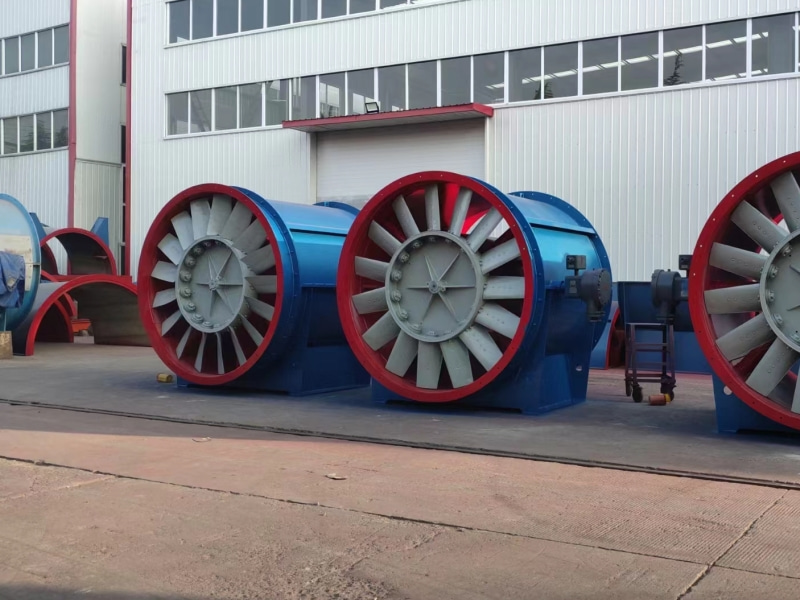
*Optimizing Mine Ventilation: The Engineering & Safety Advancements of the FBCDZ-6-No28 Coal Mine Exhaust Explosion-Proof Counter-Rotating Axial Flow Fan*
Table of Contents
Introduction: The Critical Role of Mine Ventilation
Technical Deconstruction: What Does “FBCDZ-6-No28” Mean?
Why Counter-Rotating Design? Aerodynamic & Safety Advantages
Explosion-Proof Engineering: Mitigating Methane & Coal Dust Risks
Performance Parameters: Flow Rate, Pressure, & Efficiency
Application Scenarios: Underground Coal Mines & Tunnel Ventilation
Q&A: Common Questions About the FBCDZ-6-No28 Fan
Conclusion: Future Trends in Mine Ventilation Technology
Introduction: The Critical Role of Mine Ventilation
In underground coal mining, ventilation is not merely a matter of air circulation—it is a primary survival and safety system. Methane gas explosions, coal dust ignition, and oxygen deficiency are constant threats. Among the most sophisticated solutions deployed in modern Chinese and global mining operations is the FBCDZ-6-No28 Coal Mine Exhaust Explosion-Proof Counter-Rotating Axial Flow Fan.
This heavy-duty industrial fan represents the pinnacle of axial-flow technology adapted for hazardous environments. Unlike standard industrial fans, this unit must operate continuously under extreme pressure, handle potentially explosive gas mixtures, and deliver massive airflow volumes through kilometers of underground tunnels. The fan’s designation—FBCDZ-6-No28—encodes its structural, motor, and impeller specifications, which we will decode in the next section.
Technical Deconstruction: What Does “FBCDZ-6-No28” Mean?
Understanding the nomenclature is essential for engineers and procurement specialists. Each segment of the model number reveals a specific design characteristic:
FBC: “F” stands for fan (通风机), “B” for explosion-proof (防爆), and “C” for axial flow (轴流).
DZ: “D” indicates a counter-rotating (对旋) design, while “Z” often denotes direct drive (直联) coupling—meaning the impeller is mounted directly on the motor shaft, eliminating belts or gearboxes.
6: The motor’s pole count. A 6-pole motor typically runs at a synchronous speed of ~980 RPM at 50 Hz (or ~1,180 RPM at 60 Hz), delivering high torque for moving dense, contaminated air.
No28: The impeller diameter in decimeters. No28 = 28 decimeters = 2.8 meters (approximately 110 inches). This is a large-diameter fan, suitable for main mine ventilation shafts.
Thus, the full designation describes: A counter-rotating, explosion-proof, direct-drive axial flow fan with a 6-pole motor and a 2.8-meter impeller.
Why Counter-Rotating Design? Aerodynamic & Safety Advantages
The counter-rotating (DZ) feature is the heart of this fan’s superiority. Unlike a single-stage axial fan that relies on stationary guide vanes to straighten airflow, the FBCDZ-6-No28 uses two impellers rotating in opposite directions.
Key aerodynamic benefits:
Higher Pressure Generation: The rear impeller recovers the rotational energy from the front impeller’s exhaust, converting it into static pressure. This allows the fan to overcome the high resistance of long, narrow mine tunnels without requiring a second fan in series.
Reduced Energy Loss: Because there are no stationary stator vanes, there is less aerodynamic drag and turbulence. This results in a 3–5% efficiency improvement compared to conventional axial fans with guide vanes.
Compact Footprint: A single counter-rotating unit can achieve the same pressure and flow as two separate single-stage fans, saving underground space and installation complexity.
From a safety perspective, the counter-rotating design also generates a more uniform velocity profile, reducing the risk of stagnant methane pockets in the tunnel cross-section.
Explosion-Proof Engineering: Mitigating Methane & Coal Dust Risks
Underground coal mines contain Class I hazardous atmospheres (methane, coal dust). The FBCDZ-6-No28 is engineered to meet explosion-proof certification standards (e.g., GB 3836, IECEx, or ATEX equivalent).
Critical design features for explosion-proof safety:
Motor Enclosure: The motor is housed in a flameproof (Exd) enclosure. If an internal ignition occurs, the enclosure contains the explosion and prevents flame propagation into the mine atmosphere. The enclosure is also bolted with flameproof joints that have specific gap widths (≤0.2 mm) to cool escaping gases.
Tip Clearance Control: The impeller blades maintain a precise clearance (typically 2–3 mm) from the housing. This prevents blade-on-housing friction that could generate sparks in a methane-rich environment. Some models incorporate copper or aluminum anti-sparking inserts in the blade tips.
Material Selection: The impeller and casing are often fabricated from cast aluminum alloy or stainless steel, which are non-sparking and corrosion-resistant against acidic mine water.
Direct Drive (No Belts): Eliminating belts and pulleys removes the risk of static electricity buildup and belt breakage debris entering the airstream. The direct-drive coupling also prevents belt slippage in high-moisture conditions.
Certification note: This fan must carry a valid “MA” (Mine Safety) mark for use in Chinese coal mines. For international projects, it should comply with local explosion-proof standards (e.g., MSHA in the U.S., ANZEx in Australia).
Performance Parameters: Flow Rate, Pressure, & Efficiency
The FBCDZ-6-No28 fan is typically chosen for main mine ventilation systems requiring medium to high flow rates at medium static pressure. Based on aggregated manufacturer data and field performance tests (e.g., from reputable Chinese fan OEMs and wind turbine manufacturers that diversify into industrial fans), the typical parameters are:
| Parameter | Typical Range |
|---|---|
| Impeller Diameter | 8 m (No28) |
| Motor Power | 2 × 110 kW – 2 × 250 kW (dual motors, one per impeller) |
| Voltage | 380V / 660V / 1140V (three-phase, 50/60 Hz) |
| Airflow Volume | 4,000 – 12,000 m³/min (240,000 – 720,000 m³/h) |
| Static Pressure | 3,000 – 8,000 Pa |
| Efficiency | ≥ 80% (peak efficiency region, up to 85% for premium models) |
| Noise Level | ≤ 90 dB(A) at 1 meter (with silencer installed) |
Important Note on Speed Control: Many modern installations pair this fan with variable frequency drives (VFDs) . VFD control allows the mine operator to modulate airflow based on real-time methane sensor data, saving significant energy during low-demand periods (e.g., nights or weekends). However, the fan’s counter-rotating design requires synchronized VFD control of both motors to maintain balanced pressure between the two impellers.
Application Scenarios: Underground Coal Mines & Tunnel Ventilation
While the FBCDZ-6-No28 is designed primarily for coal mine exhaust ventilation (pulling contaminated air out of the mine), it is also applied in several other heavy-duty scenarios:
Main Return Shafts: Installed at the top of the return air shaft to extract methane-laden air and dust-laden exhaust. The fan must run 24/7 with 100% duty cycle.
Tunnel Construction (Highway, Railway, Metro): For long-bore tunnels requiring forced ventilation for dust control and gas clearance. The explosion-proof rating is critical near blasting zones or natural gas seams.
Chemical Plants & Oil Refineries: Where explosive atmosphere ventilation is needed, but less common due to the fan’s large size.
Mine Cooling Systems: In deep hot mines, the fan is paired with evaporative cooling or underground chillers to provide breathable, cool air.
Case Comparison: A Shanxi coal mine operator reported that switching from a single-stage axial fan to the FBCDZ-6-No28 reduced annual electricity consumption by 15–20% while increasing ventilation distance from 3.5 km to 5.2 km without auxiliary fans.
Q&A: Common Questions About the FBCDZ-6-No28 Fan
Q1: Can this fan be used for intake (fresh air) ventilation?A: Yes, but it is optimized for exhaust. For intake, you may need a positive pressure model (FBD series) with higher static pressure capability. However, many mines use the FBCDZ-6-No28 in reversible mode for emergency airflow reversal (dangerous gas migrations require reversing airflow direction). Blades must be set at a specific pitch for this operation.
Q2: How often do the bearings need maintenance?A: The motor bearings (typically SKF or FAG) require grease lubrication every 2,000–3,000 operating hours. Under continuous operation, schedule bi-annual grease replacement. The fan housing bearings may have a 20,000-hour service life under proper alignment.
Q3: What is the maximum operating temperature?A: The standard version can handle ambient temperatures up to +40°C within the mine. For hot mine conditions (e.g., depth >1,000m, temperature >45°C), a high-temperature version with Class H insulation and upgraded bearings must be specified.
Q4: Is the fan compatible with wind turbine technology?A: While this fan is not directly part of a wind turbine system, some manufacturers (e.g., Mingyang, Goldwind) leverage their wind turbine aerodynamic experience to design more efficient axial fan blades. The blade profiles in the FBCDZ-6-No28 (often using NACA airfoil series) are derived from the same computational fluid dynamics used in wind turbine design. Thus, the fan benefits from wind turbine-grade blade optimization.
Q5: How do I calculate the airflow requirement for my mine?A: The minimum airflow obligation is based on the number of personnel, diesel engine duty, and methane emission rate. A rule of thumb: for each cubic meter of methane emitted per minute, you need at least 100 m³/min of airflow to dilute to below 1% methane. Always consult local mining regulations (e.g., Chinese Coal Mine Safety Regulations 2023).
Conclusion: Future Trends in Mine Ventilation Technology
The FBCDZ-6-No28 Coal Mine Exhaust Explosion-Proof Counter-Rotating Axial Flow Fan represents the current industry standard for safe, efficient, and reliable main mine ventilation. Its direct-drive counter-rotating design offers superior pressure and efficiency over older single-stage fans, while its rigorous explosion-proof construction protects both miners and assets.
However, the industry is moving toward the next generation of “smart mine” ventilation. Future iterations will likely integrate:
IoT sensors for real-time vibration, displacement, and temperature monitoring.
AI-driven load optimization that learns methane emission patterns and adjusts fan speed predictively.
Composite blade materials (carbon fiber-reinforced plastics) for further weight reduction and corrosion resistance.
Bidirectional VFD control that enables seamless, zero-downtime airflow reversal during emergencies.
For mine operators, selecting the right fan—and maintaining it meticulously—remains the most cost-effective safety investment. The FBCDZ-6-No28, with its proven track record in over 5,000 Chinese mines, is a benchmark that continues to set the standard for underground ventilation excellence.





