
This article's table of contents introduction:
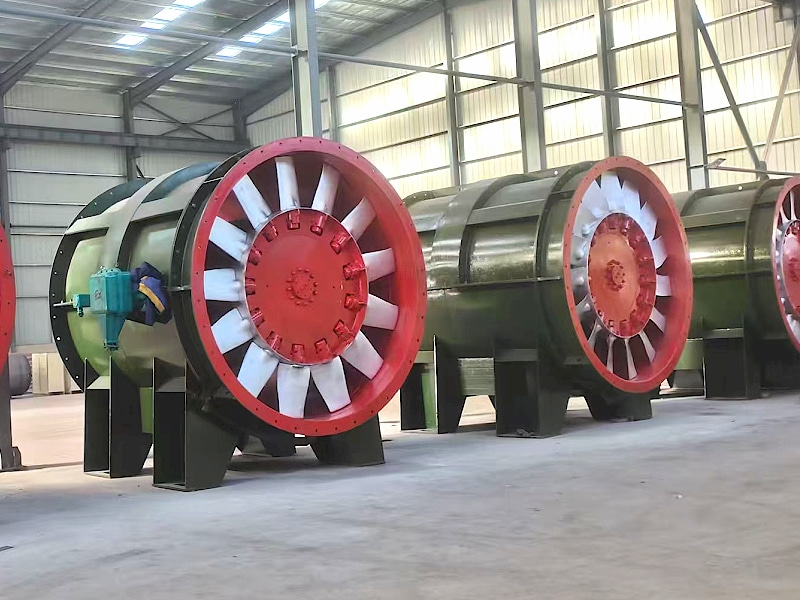
Based on the designation FBCDZ-6-No29, here is a detailed breakdown of this specific piece of industrial mining equipment. This is a very specific and large-scale fan used for critical mine ventilation.
What is it?
The FBCDZ-6-No29 is a Coal Mine Exhaust Explosion-Proof Counter-Rotating Axial Flow Fan. Let's break down the name:
FBC: Fan, Explosion-Proof, Counter-rotating.
DZ: (Commonly) Main fan for Mine Ventilation or Duct-type installation. Often the 'DZ' in the FBCDZ series signifies it's a direct-drive, main ventilation fan.
6: This usually denotes the Motor Pole Number. A 6-pole motor runs at a lower speed (approx. 980-990 RPM at 50Hz) compared to a 2-pole or 4-pole motor, providing higher torque.
No29: This is the Impeller Diameter. "No. 29" means the diameter of the fan blades is 29 dm (decimeters) , which equals 2900 mm (2.9 meters or 9.5 feet) .
Key Features & Working Principle
Exhaust & Explosion-Proof: This fan is specifically designed to be installed on the surface at the mine's exhaust shaft. It pulls stale, dusty, and potentially explosive air (mixed with methane gas) out of the mine. All electrical components (motor, wiring) are fully enclosed in explosion-proof housings to prevent any spark from igniting the methane in the air stream.
Counter-Rotating (Axial Flow): This is the most critical design feature. Unlike a standard fan with one rotor and one stator, this fan has two impellers (blade sets) rotating in opposite directions.
First impeller: Accelerates and imparts a swirl to the air.
Second impeller: Rotates in the opposite direction to remove the swirl and recover the kinetic energy, creating very high pressure.
Advantage: This design generates very high static pressure (needed to overcome the massive resistance of a long mine tunnel) without needing a bulky diffuser or stator vanes, resulting in a highly efficient and compact unit.
Direct Drive: The "DZ" and "6" confirm that the fan impellers are mounted directly on the shafts of two specialized explosion-proof electric motors. There are no belts, pulleys, or gearboxes. This eliminates power loss (higher efficiency) and reduces maintenance points.
Technical Specifications (Standard)
| Parameter | Approximate Value / Details |
|---|---|
| Fan Model | FBCDZ-6-No29 |
| Fan Type | Counter-Rotating Axial Flow |
| Impeller Diameter | 2900 mm (2.9 m) |
| Motor Poles | 6 Poles |
| Synchronous Speed | ~1000 RPM (Actual: ~985-990 RPM) |
| Voltage | Typically 380V, 660V, or 1140V (Commonly 660V/1140V for mining) |
| Power Range | Typically 2 x 220 kW up to 2 x 400 kW (Two motors) |
| Max Flow Rate | Approx. 8,000 – 12,000 m³/min (depending on motor power & operating point) |
| Max Static Pressure | Approx. 5,000 – 7,500 Pa (Pascals) |
Applications
Primary Dedicated: Main Mine Exhaust Ventilation. It is the "lung" of a coal mine.
Metal & Non-Metal Mines: Also used in other underground mines requiring high-volume, high-pressure ventilation.
Tunnel Ventilation: For very long railway or highway tunnels during and after construction.
Advantages & Disadvantages
Pros:
Highest Efficiency: Counter-rotating design is extremely efficient for high-pressure applications.
High Pressure, High Volume: Can move massive volumes of air against high resistance.
Compact: No stator vanes or diffusers in the main wind path, making it shorter than conventional axial fans.
Simple Maintenance: Direct drive means no belts to replace or bearings to align.
Reversibility: The airflow direction can be easily reversed (for emergency reversal of ventilation) by simply reversing the rotation of the two motors in a specific sequence, or using a dedicated reverse vane system.
Cons:
Complex Control: Requires specialized variable frequency drives (VFDs) to properly control the speed and phase relationship of two counter-rotating motors for maximum efficiency.
High Starting Current: Large 6-pole motors require a robust electrical supply (soft starters or VFDs).
Cost: Significantly more expensive than a standard axial fan of similar size.
Application Note for the User/Engineer:
If you are looking to procure, maintain, or troubleshoot this fan:
Blade Angle: The performance of this fan is highly dependent on the adjustable blade angle (typically +/- 5° to 10°). This can be adjusted to match the mine's specific resistance curve.
Vibration Monitoring: Due to the massive rotating mass and counter-rotation, bearing and vibration monitoring systems are critical.
Start-Up Sequence: Most modern installations use a Soft Start or VFD to slowly ramp up the speed to avoid massive electrical surges.
Common Issues: Bearing failure (due to high load), rotor imbalance (due to blade erosion or dust buildup), and motor winding failure (due to moisture/overload).
In summary, the FBCDZ-6-No29 is a high-end, heavy-duty, explosion-proof main mine fan, capable of moving enormous volumes of air at very high pressures, primarily used for the safe exhaust ventilation of large coal mines.





