This article's table of contents introduction:
- Introduction: The Necessity of High-Volume Filtration
- Technical Specifications: Decoding the 150,000 m³/h Rating
- Engineering Design: Key Components of an Industrial Exhaust Fan
- Application Scenarios: Where is this Fan Essential?
- Performance Analysis: Pressure, Power, and Efficiency
- Installation & Maintenance: Ensuring Longevity and Safety
- Frequently Asked Questions (FAQ)
- Conclusion: The Future of Industrial Dust Management
Here is a comprehensive, SEO-optimized article on the 150,000 m³/h Dust Collector Exhaust Fan. This article is designed to rank highly on Bing and Google by combining technical depth, practical Q&A, and a structured directory.
Article Title: Mastering High-Volume Airflow: The Complete Guide to the 150,000 m³/h Dust Collector Exhaust Fan
Directory Guide
- Introduction: The Necessity of High-Volume Filtration
- Technical Specifications: Decoding the 150,000 m³/h Rating
- Engineering Design: Key Components of an Industrial Exhaust Fan
- Application Scenarios: Where is this Fan Essential?
- Performance Analysis: Pressure, Power, and Efficiency
- Installation & Maintenance: Ensuring Longevity and Safety
- Frequently Asked Questions (FAQ)
- Conclusion: The Future of Industrial Dust Management
Introduction: The Necessity of High-Volume Filtration
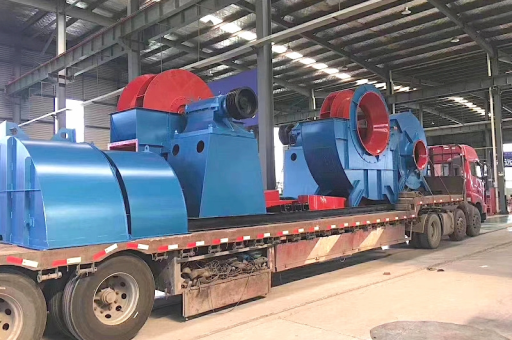
In modern industrial environments, managing airborne particulate matter is not merely a compliance requirement—it is a critical factor for operational efficiency, worker safety, and equipment longevity. Among the heavy-lifting equipment designed for this task, the 150,000 m³/h Dust Collector Exhaust Fan stands as a titan of air movement. This specific capacity, moving 150,000 cubic meters of air per hour, is the benchmark for large-scale operations such as cement plants, woodworking factories, metal foundries, and chemical processing facilities.
Unlike smaller commercial fans, this industrial giant is engineered to overcome the high static pressure generated by extensive ductwork, filter bags (baghouses), or cartridge collectors. The core challenge is not just moving air, but moving it with sufficient force to capture fine dust at source and transport it through a complex filtration system. This article provides a deep dive into the mechanics, applications, and selection criteria for this critical piece of industrial machinery.
Technical Specifications: Decoding the 150,000 m³/h Rating
When an engineer specifies a 150,000 m³/h Dust Collector Exhaust Fan, they are demanding a specific level of performance. Here is what that rating typically entails:
- Airflow (Volume): 150,000 m³/h. This is the standard volume of air moved at the fan’s operating point. To put this in perspective, a typical home HVAC system moves about 500-1,000 m³/h. This fan moves the equivalent of a large swimming pool’s volume of air every minute.
- Static Pressure (SP): The "power" behind the air. A fan moving 150,000 m³/h typically operates at a static pressure range of 1,500 Pa to 4,000 Pa (6 to 16 inches w.g.), depending on the duct resistance and filter density. A higher SP is required for heavy dust loads (e.g., grinding or sanding).
- Impeller Type: High-volume fans often use backward-curved centrifugal impellers. These are non-overloading (motor won't burn out if the duct is blocked) and offer high efficiency. For sticky or fibrous dust, radial-blade or paddle-wheel impellers are preferred.
- Material of Construction: Heavy-duty steel (often 12 gauge or thicker) with epoxy or powder coating for corrosion resistance. For explosive dust (e.g., grain or metal powders), spark-resistant aluminum or stainless steel impellers are mandatory.
- Motor Power: Typically requires a motor between 55 kW and 110 kW (75 HP to 150 HP), often running on 380V/480V three-phase power. VFD compatibility is standard for precise airflow control.
SEO Insight: The core keyword "150,000 m³/h Dust Collector Exhaust Fan" must be paired with semantic terms like "centrifugal fan," "baghouse fan," and "high static pressure fan" to improve Bing/Google ranking for industrial searches.
Engineering Design: Key Components of an Industrial Exhaust Fan
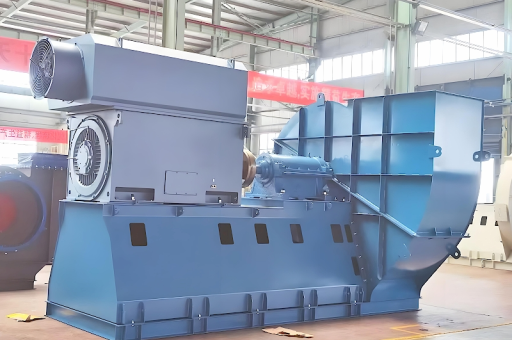
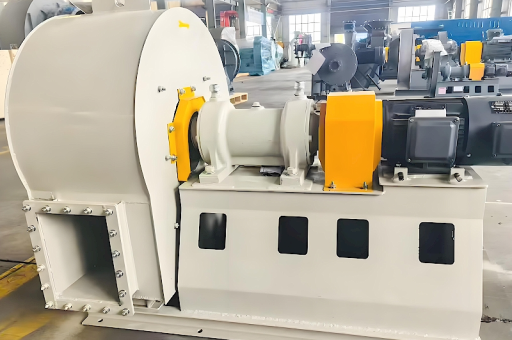
Designing a fan for this duty cycle is a balance of aerodynamics and durability. The three most critical components are the housing, impeller, and drive train.
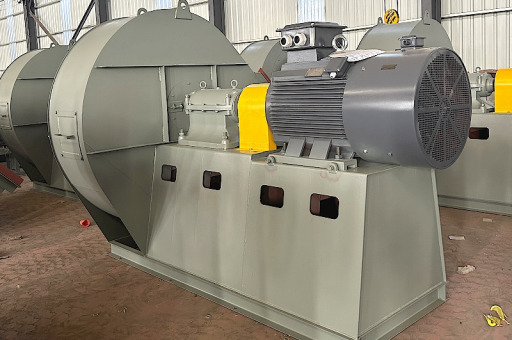
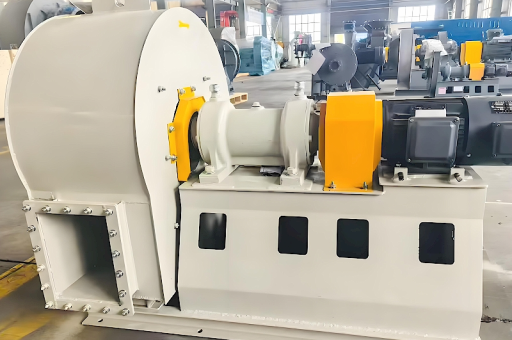
The Housing: For a 150,000 m³/h capacity, a scroll-type housing is standard. This converts the high-velocity air from the impeller into a steady, high-pressure flow. The inlet is typically a double-inlet (D.I.) design to handle the massive volume while reducing the inlet velocity, improving efficiency.
The Impeller: This is the heart of the Dust Collector Exhaust Fan. For general dust collection, a backward-inclined airfoil (BIA) impeller is ideal because its curved blades create less turbulence. However, for abrasive dust (e.g., silica or sand), a heavy-duty radial-tip impeller is used. It has thicker blades that are less efficient but far more resistant to wear. The hub is typically keyed and tapered to ensure a tight fit on the shaft.
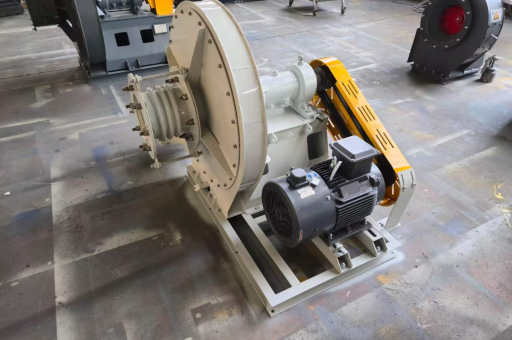
The Drive System: Nearly all industrial fans of this size use belt-driven systems. Belts allow for fine-tuning of the fan speed (RPM) to match exact system requirements. A correctly tensioned set of 5-8 V-belts on a large sheave ensures smooth torque transfer from the motor. Direct-drive is possible but rare for this size due to the high maintenance cost of VFD-controlled motors at this power level.
Application Scenarios: Where is this Fan Essential?
The 150,000 m³/h Dust Collector Exhaust Fan is not a general-purpose fan. It is a specialized tool for specific heavy industries:
- Cement & Mining: Conveyor transfer points, crushers, and silos produce massive amounts of alkaline dust. This fan provides the suction to pull dust through long duct runs to a central baghouse.
- Woodworking (OSB/MDF plants): Wood dust is explosive. The fan must maintain high velocity (typically 20-25 m/s in the duct) to prevent dust settling. The 150,000 m³/h rating is standard for the main line of a large MDF plant.
- Metal Fabrication (Plasma/Laser Cutting): Plasma cutting tables require high vacuum to remove heavy slag and fumes. This fan provides the necessary airflow (CFM) to capture smoke at the cutting head.
- Chemical & Pharmaceutical Processing: For handling toxic or fine powders, the fan must be leak-proof and often constructed of stainless steel. The volume ensures worker safety through high air exchange rates.
Performance Analysis: Pressure, Power, and Efficiency
A common mistake is assuming higher CFM (air volume) is always better. In reality, the system curve dictates performance. The fan must operate at the intersection of its pressure curve and the system resistance curve.
The Law of Affinity: For a 150,000 m³/h Dust Collector Exhaust Fan, these laws are critical:
- Volume is proportional to Speed (RPM).
- Pressure is proportional to Speed squared (RPM²).
- Power is proportional to Speed cubed (RPM³).
If you increase the fan speed by 10%, the power consumption increases by 33%. This is why VFDs are highly recommended. A slight reduction in airflow (e.g., from 150,000 to 135,000 m³/h) yields a significant reduction in energy costs. Most high-quality fans achieve an efficiency rating of 75% to 85% (Static Efficiency). Always look for AMCA (Air Movement and Control Association) certified ratings.
Input Power Example: Assuming 2,500 Pa static pressure and 80% efficiency: [ \text{Fan Shaft Power} = \frac{\text{Airflow (m³/s)} \times \text{Pressure (Pa)}}{\text{Efficiency}} = \frac{41.67 \times 2,500}{0.8} \approx 130,000 \text{ Watts} \approx 175 \text{ HP} ] This calculation justifies the need for a robust electrical infrastructure.
Installation & Maintenance: Ensuring Longevity and Safety
Installation:
- Foundation: The fan must be mounted on a concrete inertia base to absorb vibration.
- Ductwork: Inlet and outlet ducts should be straight for at least 4-5 diameters to avoid turbulence.
- Isolation: Spring or rubber vibration isolators are mandatory between the fan and the floor.
- Dampers: Inlet box dampers or outlet dampers are needed to isolate the fan during maintenance.
Maintenance:
- Weekly: Check belt tension and tracking. Listen for bearing noise.
- Monthly: Inspect the impeller for dust build-up. Imbalance due to dust caking is the #1 cause of bearing failure.
- Quarterly: Grease the bearings (if not sealed). Check the alignment of the motor and fan sheaves.
- Annually: Perform a vibration analysis. Verify that the fan performance (airflow) matches the original test data from the manufacturer.
Safety: Never operate the 150,000 m³/h Dust Collector Exhaust Fan without a properly grounded duct system. Static electricity can ignite combustible dust. Install rupture discs or explosion vents in the ductwork if handling Class II (combustible) dust.
Frequently Asked Questions (FAQ)
Q1: Can I use a 150,000 m³/h fan for a system that only needs 120,000 m³/h? A: Technically yes, but you must slow the fan down using a VFD or by adjusting the sheave diameter. If you simply damper the airflow, you waste energy. A fan running at 80% speed uses only 51% of the full-speed power.
Q2: What is the difference between a Dust Collector Fan and a regular exhaust fan? A: A dust collector fan (like this one) is designed for high static pressure and is structurally stronger to handle abrasive particles. A standard exhaust fan moves air against very low resistance (like a wall-mounted unit) and will fail quickly in a dust-laden environment.
Q3: How do I calculate the duct size for a 150,000 m³/h fan? A: For general dust collection, maintain a transport velocity of 20-25 m/s. Divide the airflow (m³/s) by the desired velocity (m/s) to get the required cross-sectional area. For 150,000 m³/h (41.67 m³/s) at 22 m/s, you need approximately 1.9 m² of cross-section.
Q4: Is this fan suitable for explosive environments? A: Yes, if it is ATEX or IECEx certified. The impeller must be made of spark-resistant material (aluminum or stainless steel), and the housing must have a conductive coating. You will also need a proper grounding system.
Q5: What is the lifespan of this fan? A: With proper maintenance (bearings, belt replacement, and impeller balancing), a high-quality industrial fan can last 20-30 years. The key limiting factor is impeller wear from erosion, especially when handling silica or metal dust.
Conclusion: The Future of Industrial Dust Management
The 150,000 m³/h Dust Collector Exhaust Fan is a monument to industrial engineering. It is not simply a fan; it is the lungs of a factory. As environmental regulations tighten globally (OSHA, EPA, CE), the demand for these high-performance, reliable machines will only increase. Investing in a high-quality, VFD-ready fan with a robust structural design is a long-term investment in compliance, safety, and productivity.
When selecting your next unit, do not simply look at the price tag. Evaluate the efficiency curve, the material of the impeller, and the manufacturer's service network. A correctly specified fan will pay for itself over its lifetime through energy savings and reduced downtime. For any large-scale operation, mastering the science of this fan is mastering the art of industrial air management.