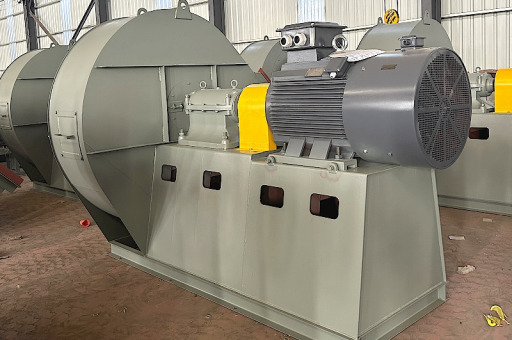
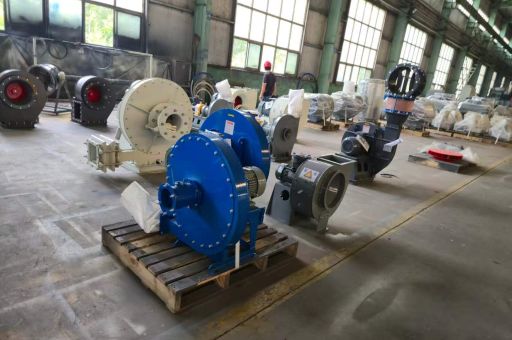
** The Ultimate Guide to the 160,000 m³/h Dust Collector Exhaust Fan: High-Volume Industrial Airflow Solutions
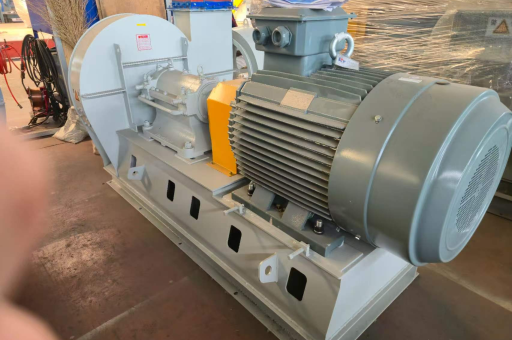
Table of Contents / Directory Guide
- Introduction: The Critical Role of High-Volume Dust Collection
- Technical Breakdown: What Does 160,000 m³/h Mean for Your Facility?
- Key Design Features of a 160,000 m³/h Dust Collector Exhaust Fan
- Performance Parameters: Static Pressure, Power, and Efficiency
- Application Scenarios: Where Do You Need This Fan?
- Installation Best Practices for Maximum Airflow
- Maintenance & Longevity: Ensuring 10+ Years of Service
- Frequently Asked Questions (FAQ)
- Conclusion: Selecting the Right Fan for Your Operation
Introduction: The Critical Role of High-Volume Dust Collection
In modern industrial environments—whether woodworking, mining, cement processing, or chemical manufacturing—air quality is not merely a compliance issue; it is a direct factor in worker safety, equipment lifespan, and production efficiency. At the heart of any effective dust collection system lies the exhaust fan, the motive force that creates negative pressure, captures airborne particulates, and expels filtered air or directs it back into the workspace.
The 160,000 m³/h Dust Collector Exhaust Fan represents a significant threshold in industrial ventilation. To put this into perspective: 160,000 cubic meters per hour equates to approximately 94,000 cubic feet per minute (CFM). This is a massive volume of air movement, typically required by large-scale facilities with multiple dust-generating sources, such as central baghouse systems or cartridge collectors. Without a fan of this caliber, dust accumulation would exceed safe thresholds, leading to health hazards (silicosis, asthma), fire/explosion risks (combustible dust), and costly downtime.
This guide will dissect every aspect of this high-performance fan, from aerodynamics to electrical consumption, ensuring facility managers, engineers, and procurement teams have the data needed to make an informed investment.
Technical Breakdown: What Does 160,000 m³/h Mean for Your Facility?
The rating “160,000 m³/h” is the volumetric flow rate at a specific operating point, typically measured under standard air density (1.2 kg/m³ at 20°C, 101.325 kPa). However, real-world conditions vary. Key considerations include:
- Air Density Correction: High-altitude facilities or high-temperature processes reduce air density, requiring a larger fan or higher motor power to achieve the same mass flow.
- System Resistance: The fan must overcome static pressure from ducts, filters, dampers, and hoods. A typical 160,000 m³/h fan is paired with a static pressure range of 2,000 to 4,000 Pa (8 to 16 inches w.g.).
- Velocity: At this flow rate, duct diameter must be substantial. For example, a main duct of 1,200 mm diameter yields an average velocity of ~39 m/s—adequate for horizontal transport of dust but requiring proper erosion-resistant linings.
Real-world example: A wood panel manufacturer with four sanding lines, two sawing stations, and one planer may require a central system with this exact capacity to keep respirable dust below 1 mg/m³.
Key Design Features of a 160,000 m³/h Dust Collector Exhaust Fan
For reliable, continuous operation (24/7 duty cycle), manufacturers incorporate several industrial-grade features:
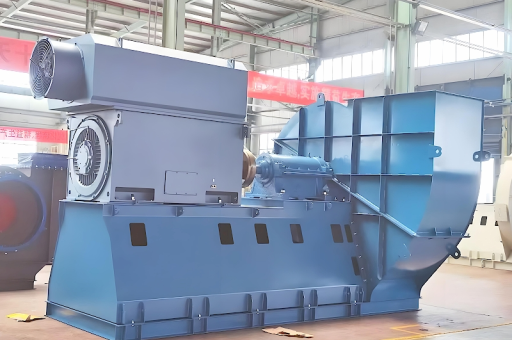
- Impeller Type: Backward-curved centrifugal blades are standard for efficiency and non-overloading power characteristics. Unlike forward-curved fans, they prevent motor burnout if the filter becomes clogged.
- Housing Material: Heavy-gauge carbon steel (min. 6 mm) with welded reinforcement ribs. Abrasive dust applications (e.g., sand, glass fibers) require AR400 or 16MnCr5 wear plates at the inlet and cut-off.
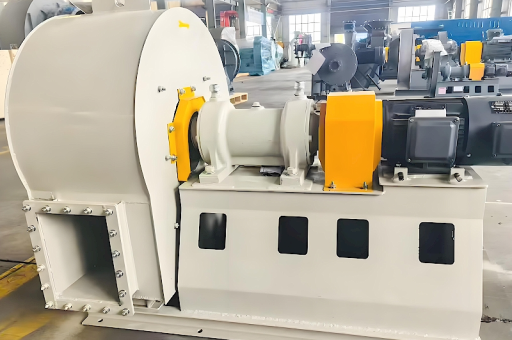
- Shaft Seal: Labyrinth or air purge seals prevent dust ingress into bearings, a primary cause of premature failure.
- Vibration Monitoring: Embedded accelerometer ports for predictive maintenance, reducing catastrophic unplanned downtime.
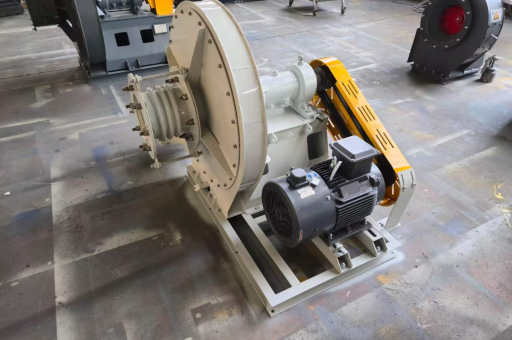
- Direct Drive vs. Belt Drive: Direct drive offers higher efficiency (no belt losses) and lower maintenance. However, belt drive allows speed adjustment (via sheave change) to fine-tune airflow if system conditions change.
Performance Parameters: Static Pressure, Power, and Efficiency
A table of typical specifications for a 160,000 m³/h dust collector exhaust fan:
| Parameter | Typical Value | Notes |
|---|---|---|
| Flow Rate | 160,000 m³/h (94,200 CFM) | At fan inlet, standard density |
| Static Pressure | 3,000 Pa (12 in w.g.) | Design point for medium-dust load |
| Motor Power | 150–200 kW (200–270 HP) | Inverter-duty, IE4 efficiency |
| Fan Speed | 900–1,200 RPM | Direct drive typical for this size |
| Efficiency (Static) | 82–87% | Backward-curved, uncoated wheel |
| Noise Level | 85–92 dB(A) | At 1 m, free field; silencer recommended |
Energy Insight: At 0.15 EUR/kWh, operating 8,000 hours/year, a 200 kW motor costs ~240,000 EUR annually. A 2% efficiency improvement (from 83% to 85%) saves ~4,800 EUR/year. Thus, investing in a premium-efficiency fan and motor pays back in under 2 years.
Application Scenarios: Where Do You Need This Fan?
- Woodworking & Panel Processing: Central vacuum systems for MDF lines, sawdust extraction, and chip conveying. The 160,000 m³/h capacity matches a combined hood open area of ~10 m² at 20 m/s capture velocity.
- Cement & Minerals: Baghouse exhaust for kilns, crushers, and screens. Requires 350–400°C high-temperature variant with heat-sink cooling fins.
- Metalworking & Welding: Large welding booths or laser cutting stations, where fume extraction demands high volume to maintain below permissible exposure limits (PELs).
- Chemical & Pharmaceutical: Explosion-proof construction (ATEX Zone 22) with spark-resistant aluminum impellers and conductive coatings.
Installation Best Practices for Maximum Airflow
- Ductwork Sizing: Friction loss should not exceed 0.5 Pa/m for economic operation. For 160,000 m³/h, a main duct of 1,400 mm diameter is optimal. Sharp elbows increase pressure drop; use 3D radius bends instead of 1.5D.
- Foundation Isolation: A 200 kW fan generates significant vibration. An inertia base (concrete or steel) with spring isolators (90% isolation efficiency at 1,000 RPM) is mandatory.
- Access Platforms: Install walkways around the fan for bearing lubrication, belt tensioning, and vibration probe access. OSHA-compliant guard rails on elevated surfaces.
- Drainage & Weather Protection: For outdoor installations, include a drain plug at the lowest point of the housing to prevent moisture accumulation, plus a rain hood over the inlet.
Maintenance & Longevity: Ensuring 10+ Years of Service
- Weekly: Listen for bearing noise (grinding or high-pitched squeal); check belt tension and tracking; inspect V-belt sheaves for wear.
- Monthly: Measure vibration velocity (mm/s RMS) and log values. Trending an increase of more than 1.5 mm/s from baseline indicates imbalance or bearing deterioration.
- Quarterly: Lubricate bearings with the correct grease (e.g., NLGI #2 lithium complex) per manufacturer interval. Over-greasing is nearly as harmful as under-greasing.
- Annually: Check impeller for wear or dust buildup—weld repairs may be needed. Verify belt alignment with a laser tool. Replace belts if they show cracks or glazing.
- Major Overhaul (5-year): Replace bearings, seals, and V-belts regardless of apparent condition. Rebalance the fan wheel to ISO 1940 G6.3 or better.
Frequently Asked Questions (FAQ)
Q1: Can a 160,000 m³/h fan be used with a baghouse instead of a cartridge collector? Yes. Both systems rely on a fan to pull air through filter media. However, baghouses typically operate at a lower pressure drop (1,500–2,000 Pa) compared to cartridge collectors (2,500–3,500 Pa). Ensure the fan’s performance curve matches the system resistance at the desired flow rate. Over-sizing the fan leads to high filtration velocity and reduced filter life.
Q2: What is the difference between a dust collector fan and a regular industrial exhaust fan? Dust collector fans are designed to handle particulate-laden air. They feature erosion-resistant materials (wear plates), heavier construction, and non-clogging impeller profiles (usually backward-curved). Standard HVAC fans lack these features and would fail quickly under abrasive dust loads.
Q3: How do I reduce noise without reducing airflow? Install a cylindrical silencer (packed with mineral wool) on the outlet. For silencers with a 1,400 mm diameter and 3 m length, expect 15–25 dB(A) attenuation. Additionally, use flexible connectors (fabric or rubber) at fan inlet and outlet to break vibration transmission.
Q4: What electric motor options are available for this fan? The most common choices are: (a) Squirrel-cage induction motor with VFD (IE4 or IE5 efficiency) for variable speed control; (b) Two-speed motor (e.g., 1,200/900 RPM) for reduced flow during low production periods; (c) Explosion-proof motor (Ex d or Ex e) for hazardous areas. Always match motor service factor (1.15 or 1.25) to potential overload from filter loading.
Q5: How do I calculate the actual operating cost? Energy cost = Power (kW) × Operating hours × Utility rate. Example: 200 kW × 8,000 h × 0.12 $/kWh = $192,000/year. If you run at 80% speed (VFD), power drops to 0.512 × 200 kW = 102 kW, reducing cost to ~$98,000/year. This illustrates the high payback of variable-speed control.
Q6: Is a 160,000 m³/h fan suitable for a negative-pressure cleanroom? Not directly. Cleanrooms require high-efficiency particulate air (HEPA) filtration and precise airflow uniformity. Dust collector fans create turbulence. Instead, use a specialized plenum fan with airfoil blades and a HEPA filter bank. A dust collector fan is best for pre-filtration or exhaust to outside.
Conclusion: Selecting the Right Fan for Your Operation
The 160,000 m³/h Dust Collector Exhaust Fan is a workhorse for heavy industry. From sawdust to cement dust, this capacity level ensures your facility meets regulatory limits—OSHA PELs, EPA emission standards, and NFPA 652 combustible dust requirements—while maintaining high production throughput.
When selecting your fan:
- Prioritize total cost of ownership—not just initial price, but energy consumption, maintenance intervals, and replacement parts availability.
- Specify the exact point of operation on the fan curve, including safety margin (typically +10% in flow or pressure).
- Partner with a reputable OEM that offers computational fluid dynamics (CFD) analysis for your duct system, preventing field retrofits.
Remember: A poorly selected or undersized fan leads to dust leakage, filter blinding, and production bottlenecks. A correctly integrated 160,000 m³/h fan, maintained with discipline, will serve your facility for over a decade with minimal interruption.
For specific technical documentation or to request a customized fan performance curve matching your system, consult with an authorized industrial fan manufacturer.