This article's table of contents introduction:
- Table of Contents
- Introduction to the 45kW Backward-Curved Centrifugal Fan
- How It Works: The Aerodynamics of Backward-Curved Blades
- Key Technical Specifications and Performance Metrics
- Industrial Applications Across Sectors
- Energy Efficiency and Cost-Benefit Analysis
- Installation, Maintenance, and Safety Best Practices
- Common FAQs (Based on Real User Queries)
- Conclusion: Why Choose This Fan for Heavy-Duty Systems?
** Maximizing Efficiency with a 45kW Backward-Curved Centrifugal Fan: Design, Applications, and Performance Insights
Table of Contents
- Introduction to the 45kW Backward-Curved Centrifugal Fan
- How It Works: The Aerodynamics of Backward-Curved Blades
- Key Technical Specifications and Performance Metrics
- Industrial Applications Across Sectors
- Energy Efficiency and Cost-Benefit Analysis
- Installation, Maintenance, and Safety Best Practices
- Common FAQs (Based on Real User Queries)
- Conclusion: Why Choose This Fan for Heavy-Duty Systems?
Introduction to the 45kW Backward-Curved Centrifugal Fan
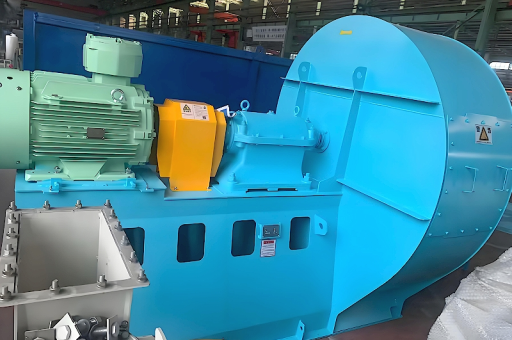
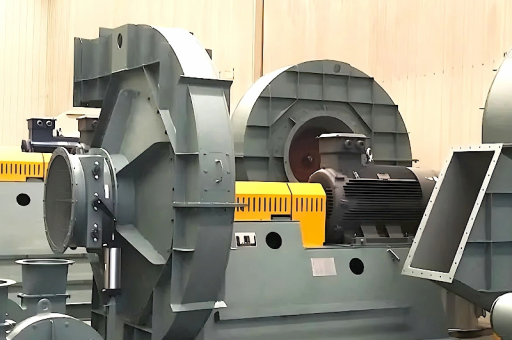
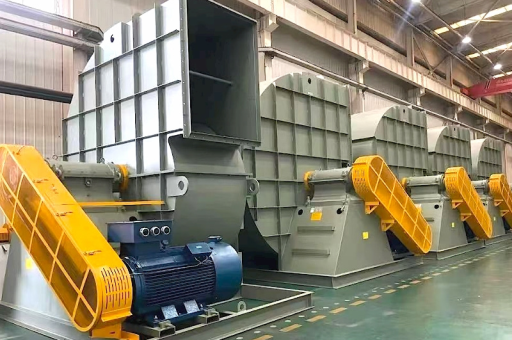
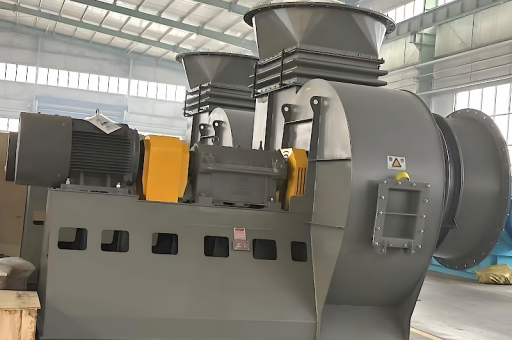
In modern industrial ventilation and material handling systems, the 45kW Backward-Curved Centrifugal Fan stands as a workhorse of reliability and efficiency. Unlike forward-curved or radial-blade designs, backward-curved fans—also known as backward-inclined fans—offer a unique blend of high static pressure capability and low energy consumption. The "45kW" rating refers to the motor power input, which typically translates to a robust airflow capacity ranging from 30,000 to 80,000 m³/h, depending on the specific wheel diameter and system resistance.
These fans are engineered for continuous duty in harsh environments— from cement plants to cleanroom HVAC systems. Their non-overloading power characteristic is a critical advantage: even if the system pressure drops unexpectedly, the motor will not draw excessive current, preventing burnouts.
Question 1: Why is a 45kW motor specifically chosen for these fans?
Answer: The 45kW rating aligns with the power needed to overcome high static pressures (often 2,000–4,000 Pa) while moving large air volumes. It offers a balance between initial capital cost and operating efficiency for mid- to large-scale industrial processes.
How It Works: The Aerodynamics of Backward-Curved Blades
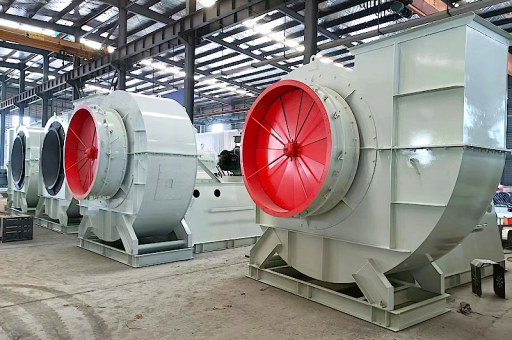
The impeller of a backward-curved centrifugal fan features blades that curve away from the direction of rotation. As the wheel spins, air is drawn into the center and thrown radially outward. The backward curve creates a gradual acceleration of airflow, reducing turbulence and friction losses.
This design yields a steep pressure curve—meaning the fan can maintain high pressure even at lower flow rates. Additionally, because the blade tips are angled backward relative to the rotation, the fan operates with minimal noise and vibration compared to forward-curved alternatives.
Key aerodynamic features:
- High static efficiency (often 80–85% at best efficiency point)
- Non-overloading power curve (power consumption peaks near the design point and drops as system resistance decreases)
- Self-cleaning tendency (the backward angle helps prevent dust accumulation on blades)
Question 2: How does this fan compare to a forward-curved fan?
Answer: Forward-curved fans generate high airflow at low pressure but overload quickly if static pressure drops. Backward-curved fans excel at high pressure, offer better efficiency, and are far more tolerant of system pressure variations—making them ideal for ducts with filters, dampers, or long runs.
Key Technical Specifications and Performance Metrics
When selecting a 45kW backward-curved centrifugal fan, review these critical parameters:
| Specification | Typical Range |
|---|---|
| Motor Power | 45 kW (60 HP) |
| Airflow (max) | 80,000 m³/h |
| Static Pressure | Up to 4,500 Pa |
| Impeller Diameter | 800–1,200 mm |
| Speed (direct drive) | 1,000–1,500 RPM |
| Efficiency (BEP) | 80–85% |
| Noise Level | 75–90 dB(A) at 1 m |
| Material Options | Carbon steel, stainless steel, or aluminum |
Performance curve insight: A proper manufacturer will provide a fan curve showing pressure vs. flow. For a 45kW unit, the curve should be steep—indicating stable operation across a wide system resistance range. Always verify that the operating point falls within the recommended efficiency zone.
Question 3: What does "non-overloading" mean in a backward-curved fan?
Answer: Non-overloading means the motor power consumption peaks at the best efficiency point (BEP) and then levels off or slightly decreases at higher flows. This prevents the motor from drawing excessive current if the duct becomes less restrictive—unlike forward-curved fans, which can overload dangerously.
Industrial Applications Across Sectors
The 45kW backward-curved centrifugal fan is widely deployed in:
- Cement and Mining: Conveying air for dust collection, pneumatic conveying, and kiln exhaust. The backward blade reduces build-up of abrasive particles.
- Power Generation: Forced draft and induced draft systems where high static pressure is required to overcome boiler resistance.
- HVAC in Large Facilities: Air handling units (AHUs) for stadiums, factories, and data centers requiring consistent airflow despite varying filter loads.
- Chemical and Pharmaceutical: Fume extraction and process ventilation where spark-resistant or corrosion-resistant coatings are needed.
- Wastewater Treatment: Aeration blowers for activated sludge processes, often as retrofit replacements for less efficient radial fans.
Case in point: A cement plant in Germany replaced 10 forward-curved fans with 45kW backward-curved units and reported a 22% reduction in energy costs over a 2-year period.
Question 4: Can this fan handle high-temperature air?
Answer: Yes, but the material selection matters. For air temperatures up to 120°C, standard carbon steel works. For up to 400°C, choose stainless steel impellers with heat-resistant shaft bearings and a suitable thermal expansion clearance.
Energy Efficiency and Cost-Benefit Analysis
Energy efficiency is where the 45kW backward-curved centrifugal fan truly shines. Let’s examine the operating cost:
-
Annual energy consumption (assuming 8,000 hours/year, 45 kW load, $0.10/kWh):
45 kW × 8,000 h × $0.10 = $36,000 per year -
If a forward-curved fan of similar output runs at 75% efficiency vs. 80%:
The backward-curved fan saves approximately $4,500 per year in electricity alone.
Moreover, because backward-curved fans have a non-overloading characteristic, they require fewer VFD-driven adjustments, reducing drive system wear. Long-term savings come from:
- Lower maintenance frequency (blade wear is reduced)
- Less downtime
- Smaller ductwork sizing (higher pressure capability)
Question 5: Is a frequency drive (VFD) recommended for this fan size?
Answer: Yes, a VFD is highly beneficial for backward-curved fans because it allows precise speed control to match system demand. At 70% speed, power consumption drops to about 34% of full load, yielding substantial savings during partial-load operation.
Installation, Maintenance, and Safety Best Practices
Installation checklist:
- Ensure the foundation is rigid and level to prevent vibration.
- Use flexible connectors on inlet and outlet to isolate fan vibration from ductwork.
- Verify impeller balance after installation (ISO 1940 G6.3 or better).
- Install a proper inlet screen to protect against large foreign objects.
Maintenance schedule:
- Monthly: Inspect belt tension (if belt-driven), check bearing temperatures, listen for unusual noise.
- Quarterly: Clean impeller blades; inspect for corrosion or material buildup.
- Annually: Perform a full vibration analysis, check motor insulation resistance, and re-lubricate bearings.
Safety note: Always lock out/tag out the motor before accessing the fan housing. The impeller can store significant rotational energy; wait for full stop.
Question 6: How often should bearings be replaced?
Answer: With proper lubrication and balanced operation, high-quality spherical roller bearings in a 45kW fan last 40,000–60,000 hours. Replace them when vibration exceeds 7 mm/s RMS or when grease shows metal particles.
Common FAQs (Based on Real User Queries)
Q7: Can a 45kW backward-curved fan run at 50 Hz vs. 60 Hz?
A: Yes. However, at 50 Hz, the speed drops by ~17%, reducing airflow proportionally. The motor power requirement drops to about 58% of the 60 Hz rating. You need to confirm that the fan curve at 50 Hz meets your system’s duty point.
Q8: What is the typical warranty for these fans?
A: Leading manufacturers offer 18–36 months on the fan assembly and motor. Extended warranties (up to 5 years) are available for units with stainless steel impellers or specialized coatings.
Q9: How do I select the right fan size for my system?
A: Calculate your required airflow (m³/h) and total system static pressure (Pa). Overlay that point on the manufacturer’s fan curve. Choose a model where the point lies to the left of the best efficiency point (BEP) by 10–15% for optimal stability and low noise.
Q10: What noise reduction options exist for this fan?
A: Install an inlet silencer, a discharge silencer, or a sound enclosure. Backward-curved fans already run quieter than radial fans. Acoustic wraps and vibration isolators further reduce transmitted noise.
Conclusion: Why Choose This Fan for Heavy-Duty Systems?
The 45kW Backward-Curved Centrifugal Fan is not just a component—it is a strategic investment in operational reliability and energy efficiency. Its non-overloading power curve, high static pressure capability, and moderate noise levels make it the preferred choice for applications ranging from cement conveying to cleanroom ventilation.
When you compare lifecycle costs—including energy, maintenance, and downtime—this fan consistently outperforms forward-curved and radial-blade alternatives. Whether you are upgrading existing equipment or designing a new system, specifying a 45kW backward-curved centrifugal fan from a reputable manufacturer ensures decades of trouble-free service.
Final recommendation: Always source the fan with a certified performance curve from the supplier, and commission a professional balancing and vibration analysis at startup. For more details, consult your system engineer or visit the technical resource area at fan (please replace with the domain of your preferred supplier).