This article's table of contents introduction:
- Table of Contents
- Introduction to High-Pressure Centrifugal Induced Draft Fans
- Technical Breakdown: 15000Pa Static Pressure & 1600m³/h Airflow
- Core Design Features and Working Principle
- Key Application Industries
- Common Installation and Maintenance Considerations
- Frequently Asked Questions (FAQ)
- Conclusion: Why This Fan Model Stands Out
Unmatched Industrial Airflow: The 15000Pa 1600m³/h High-Pressure Centrifugal Induced Draft Fan Blower Explained**
Table of Contents
- Introduction to High-Pressure Centrifugal Induced Draft Fans
- Technical Breakdown: 15000Pa Static Pressure & 1600m³/h Airflow
- Core Design Features and Working Principle
- Key Application Industries
- Common Installation and Maintenance Considerations
- Frequently Asked Questions (FAQ)
- Conclusion: Why This Fan Model Stands Out
Introduction to High-Pressure Centrifugal Induced Draft Fans
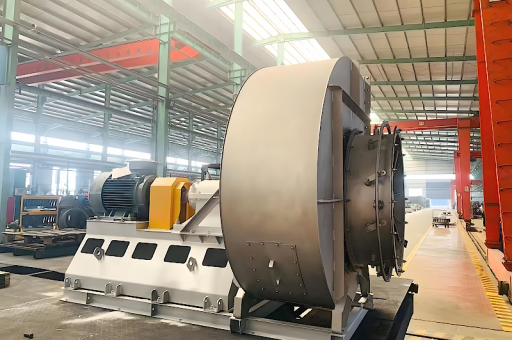
Industrial ventilation and pneumatic conveying systems rely on robust, high-performance fan units to maintain operational safety, efficiency, and environmental compliance. Among the most powerful configurations is the 15000Pa 1600m³/h High-Pressure Centrifugal Induced Draft Fan Blower. This equipment is engineered to move large volumes of air against significant system resistance, making it indispensable in heavy industries such as cement, steel, chemical processing, and power generation.
Unlike standard axial fans, a high-pressure centrifugal induced draft fan uses a rotating impeller to accelerate air outward by centrifugal force. The “induced draft” designation means it draws air through the system, creating negative pressure that extracts fumes, dust, or hot gases from enclosed spaces. The combination of 15000 Pa static pressure and 1600 cubic meters per hour airflow positions this fan as a specialized solution for demanding extraction and ventilation tasks.
Technical Breakdown: 15000Pa Static Pressure & 1600m³/h Airflow
Static Pressure (15000 Pa):
Static pressure is the resistance the fan must overcome to move air through ducts, filters, heat exchangers, and other system components. 15000 Pa (approximately 60 inches of water gauge) is considered very high. It allows the fan to push air through long, narrow duct runs or dense filter banks without significant performance loss.
Airflow (1600 m³/h):
1600 m³/h equals roughly 941 CFM (cubic feet per minute). While not the highest airflow on the market, the combination with extreme static pressure makes this fan unique. It delivers concentrated, high-velocity air movement suitable for local exhaust ventilation, pneumatic conveying, or dust collection in tight spaces.
Performance Curve:
At 15000 Pa, the fan operates near its peak pressure capability. This ensures that even with filter clogging or duct fouling, the system maintains sufficient negative pressure for safe operation. The impeller design typically features backward-curved blades, which offer higher efficiency and lower noise than forward-curved alternatives at high pressure.
Core Design Features and Working Principle
Centrifugal Impeller:
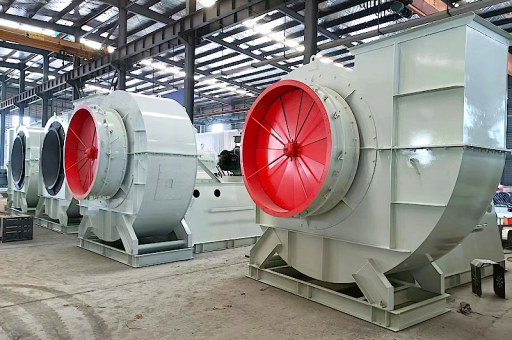
The heart of this fan is a heavy-duty, dynamically balanced impeller made from carbon steel or stainless steel, depending on the gas composition. Backward-curved blades reduce turbulence and minimize energy loss, achieving up to 82% static efficiency.
Housing & Inlet:
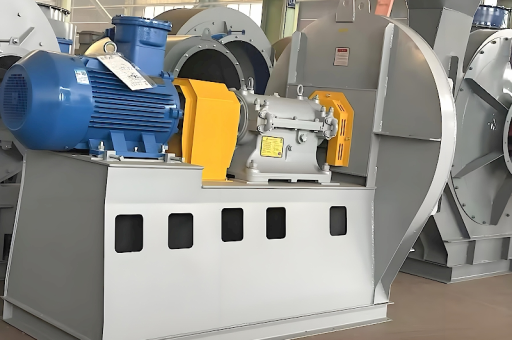
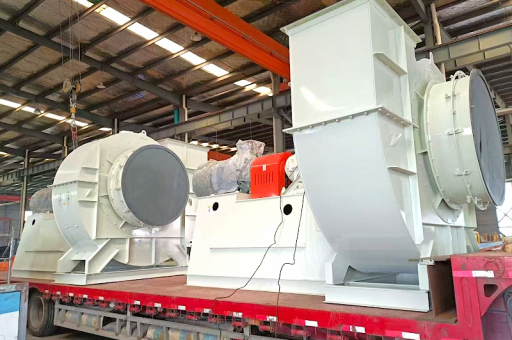
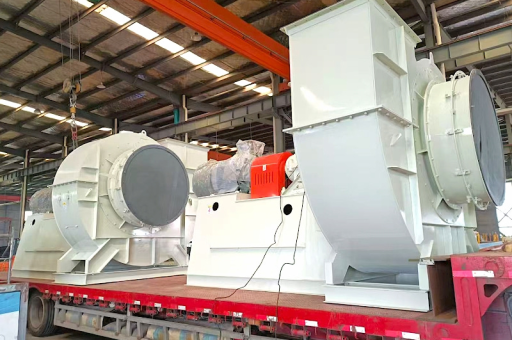
The fan housing is spiral-shaped (volute), which converts kinetic energy into static pressure efficiently. The inlet is equipped with a bell-mouth nozzle to reduce inlet losses and improve flow uniformity.
Drive System:
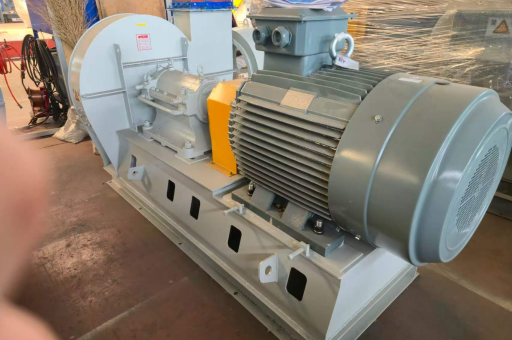
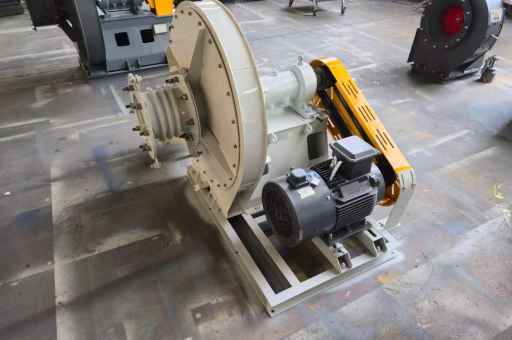
Most 15000 Pa 1600 m³/h models use a belt-driven configuration with oversized bearings. Belt drive allows speed adjustment by changing pulley ratios, giving operators flexibility to match exact system requirements. Direct-drive versions are available for constant-speed applications where reliability is prioritized.
Working Principle:
Air enters the impeller axially through the inlet. As the impeller rotates, centrifugal force throws the air outward toward the volute housing. The volute gradually expands, slowing the air and converting its velocity into static pressure. The high-pressure air then exits through the discharge duct, creating suction at the inlet for continuous extraction.
Key Application Industries
- Cement & Mining: Extraction of fine dust from grinding mills and conveyor transfer points.
- Chemical Processing: Forced removal of corrosive fumes, solvent vapors, and reaction byproducts.
- Steel & Foundries: Cooling of molten metal and removal of hot gases from furnace areas.
- Power Plants: Induced draft for boiler flue gas systems, especially in smaller biomass or coal-fired units.
- Woodworking & Biomass: Pneumatic conveying of wood chips, sawdust, or pellets.
- Environmental Systems: Baghouse dust collectors and scrubbers where high differential pressure is required.
Real-World Example: In a cement plant’s baghouse filter, this fan maintains 14000–15000 Pa negative pressure, ensuring dust-laden air passes through filter bags at optimal velocity for collection.
Common Installation and Maintenance Considerations
Installation:
- Ensure the foundation is rigid and vibration-isolated to prevent resonance.
- Use flexible connectors on inlet and discharge to reduce mechanical stress.
- Install a variable frequency drive (VFD) if flow adjustment is frequent.
Maintenance:
- Check belt tension monthly; replace belts every 6–12 months depending on runtime.
- Inspect impeller for dust buildup or corrosion every 500 operating hours.
- Lubricate bearings every 3 months with high-temperature grease.
- Monitor vibration levels to detect imbalance early.
Safety:
Because of the high static pressure, the fan housing must be rated for continuous operation above 15000 Pa. Overpressure scenarios can cause duct collapse or impeller damage. Install a pressure relief damper in extreme cases.
Frequently Asked Questions (FAQ)
Q1: What is the difference between a forced draft fan and an induced draft fan?
A forced draft fan pushes air into a system (positive pressure), while an induced draft fan pulls air out (negative pressure). This model is an induced draft fan, ideal for extraction.
Q2: Can this fan handle high-temperature gases?
Yes, if constructed with high-temperature bearings and a heat-resistant impeller (e.g., SS316). For continuous operation above 200°C, a cooling wheel or insulated housing may be required.
Q3: How much noise does this fan produce?
At 15000 Pa, sound levels typically range from 85 to 95 dB(A). Installing a silencer on the inlet or discharge can reduce noise by 10–15 dB(A). Always use hearing protection near the unit.
Q4: Is the airflow adjustable?
Yes, by using a VFD or adjustable pulley system. Reducing speed by 10% can lower pressure and flow proportionally, but the fan’s high-pressure capability remains available when needed.
Q5: What is the lifespan of this fan under continuous operation?
With proper maintenance (oil changes, belt replacements, bearing greasing), a well-built fan can last 10–15 years in moderate industrial environments. Corrosive or abrasive gases will shorten lifespan.
Q6: Can I use this fan for clean air ventilation?
It is overdesigned for clean air. Use it only where high static pressure is absolutely necessary, such as across dense filters or long duct runs.
Conclusion: Why This Fan Model Stands Out
The 15000Pa 1600m³/h High-Pressure Centrifugal Induced Draft Fan Blower fills a specific niche: high resistance, moderate flow. It is not a general-purpose fan, but for industries dealing with heavy dust, corrosive gases, or restrictive duct networks, it is a reliable workhorse. Its high static pressure ensures consistent performance even as filters load, and its moderate flow makes it suitable for point-source extraction in facilities with limited space.
When selecting a fan for your system, always match the fan curve to your actual system resistance. Overspecifying pressure wastes energy, but underspecifying leads to poor extraction and regulatory non-compliance. This model is a balanced solution for challenging industrial environments.
For more information on sizing, installation, or compatible accessories (silencers, VFDs, dampers), consult an industrial ventilation engineer or your trusted fan manufacturer’s technical support team.