This article's table of contents introduction:
- What Does “90 kW” Mean?
- What is a “Backward-Curved” (BC) Fan?
- Typical Applications for a 90 kW BC Fan
- Key Performance Parameters (Typical Range for a 90 kW Unit)
- Construction & Components for a 90 kW Fan
- Operational Considerations
- Summary Table
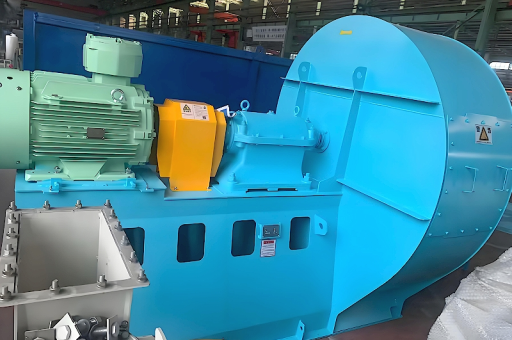
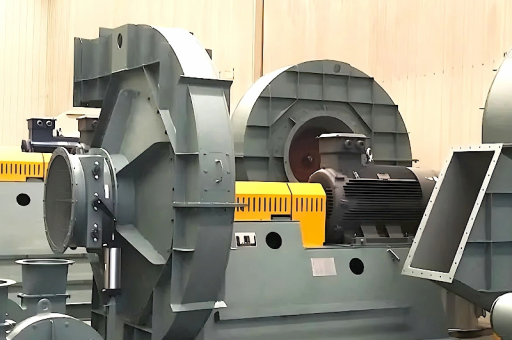
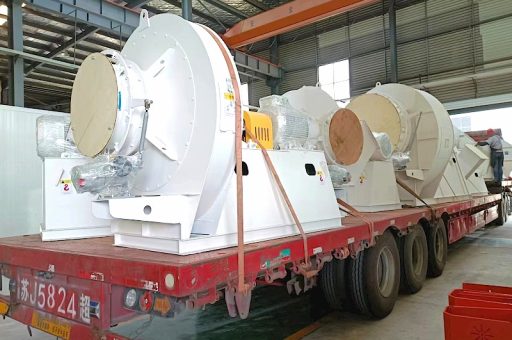
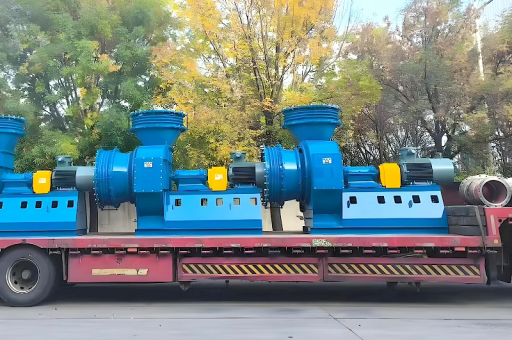
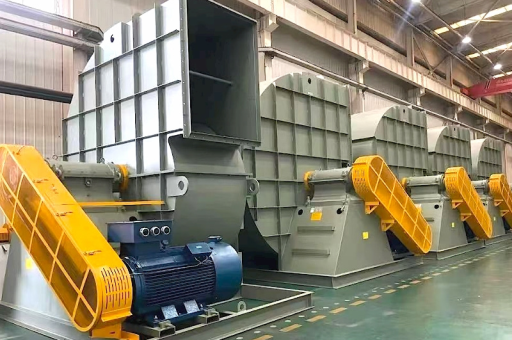
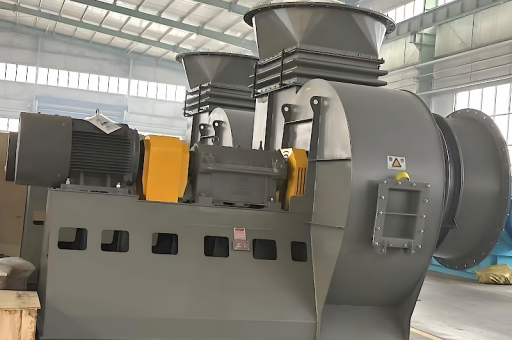
A “90 kW Backward-Curved Centrifugal Fan” is a specific type of industrial fan designed for high-efficiency, high-volume air movement. Here is a detailed breakdown of what this specification means, its typical applications, and key design parameters.
What Does “90 kW” Mean?
- Power Rating: The motor driving the fan is rated for 90 kilowatts (approximately 120 horsepower).
- Electrical Input: This is the power consumed by the motor from the electrical supply. At full load, a 90 kW motor will draw roughly 120-130 amps at 480V (3-phase), depending on efficiency.
- Shaft Power: The actual mechanical power delivered to the fan impeller will be slightly less (e.g., 85-88 kW) due to motor and drive losses (belt, coupling, or VFD).
- Scale: This is a very large industrial fan. For context, a typical home furnace fan is about 0.5 kW.
What is a “Backward-Curved” (BC) Fan?
This refers to the shape of the fan blades. The blades curve away from the direction of rotation.
Diagram of Blade Shape (Conceptual):
  |    |
  |    |
  |    |   <-- Blade curves backward relative to rotation
  |    |
  /    \
 /      \
/        \
(Viewed from the side, the blade tip points opposite to the direction of rotation)
Key Characteristics of Backward-Curved Fans:
- High Efficiency: BC fans are the most efficient type of centrifugal fan (typically 75-86% static efficiency). The air leaves the impeller at a higher velocity, creating more static pressure with less energy loss.
- Non-Overloading Power Curve: This is the most critical safety feature. As airflow increases, the power required by the fan peaks and then drops.
- Why it matters: If you block the outlet of a BC fan (high static pressure), the motor will draw less current. The motor can never be overloaded, even if the system resistance changes unexpectedly. This is a massive advantage over forward-curved fans.
- Medium to High Pressure: They generate medium to high static pressure (e.g., 2–12 inches of water column, or 0.5–3 kPa) at high volumes.
- Lower Noise: Generally quieter than forward-curved fans for the same duty.
- Robust Construction: Typically made from heavy-gauge steel, often with a bolted or welded housing.
Typical Applications for a 90 kW BC Fan
Given the power and efficiency, this fan is used in demanding, continuous-duty industrial and commercial applications:
- HVAC (Heavy Commercial/Industrial): Large central air handling units (AHUs) for factories, shopping malls, airports, or data centers.
- Industrial Exhaust Systems: Removing fumes, dust, or hot air from manufacturing processes (e.g., welding, painting, chemical processing).
- Mine & Tunnel Ventilation: Moving large volumes of air underground or through tunnels.
- Pollution Control: Induced draft fans for baghouses, scrubbers, or electrostatic precipitators.
- Process Air Supply: Drying systems, combustion air for large boilers, or pneumatic conveying (if low-density material).
- Power Plants: Forced draft or induced draft fans for boilers.
Key Performance Parameters (Typical Range for a 90 kW Unit)
These are rough estimates, as the exact performance depends on the fan's design speed and housing.
- Airflow (Volume): 50,000 to 150,000 CFM (Cubic Feet per Minute) — (approx. 85,000 to 255,000 m³/h)
- Static Pressure: 4 to 12 in. WG (inches of Water Gauge) — (approx. 1000 to 3000 Pa)
- Fan Speed: 700 to 1200 RPM (Revolutions per Minute) — The impeller is heavy and large, so it runs slower than a smaller fan.
- Impeller Diameter: 60 to 80 inches (1500 to 2000 mm)
- Inlet/Outlet Size: 48" x 48" or larger (1200 mm x 1200 mm)
Construction & Components for a 90 kW Fan
Because of the high power and forces involved, the fan is built very robustly:
- Impeller: Heavy-gauge steel or aluminum with a significant hub and heavy-duty shaft. The blades are typically welded to the backplate and shroud.
- Housing: Steel (often with stiffening ribs) or stainless steel for corrosive environments. The scroll (volute) is designed to convert velocity pressure into static pressure efficiently.
- Shaft & Bearings: Large diameter shaft, supported by heavy-duty, pre-lubricated rolling element bearings (pillow block or flanged). These bearings are critical and often have temperature/vibration sensors.
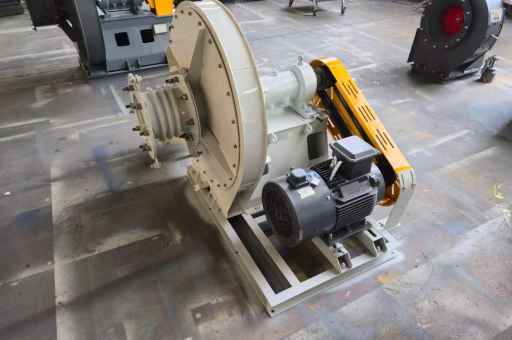
- Motor: 90 kW, 3-phase, 400V/480V, typically a TEFC (Totally Enclosed Fan Cooled) enclosure for industrial duty. The motor must be properly sized—a BC fan’s non-overloading curve prevents burnout, but a VFD (Variable Frequency Drive) is strongly recommended for control and soft-starting.
- Drive System:
- Direct Drive: The impeller is mounted directly on the motor shaft (most reliable, for fixed speed).
- Belt Drive: Allows speed changes by changing sheaves/pulleys. More common for flexibility.
- VFD: Variable Frequency Drive to electronically control the motor speed, offering precise flow control and significant energy savings.
Operational Considerations
- Starting Current: A 90 kW motor draws a very high inrush current (6-8x full load current). A VFD or soft-starter is essential to avoid tripping breakers and causing voltage dips on the electrical network.
- Vibration & Balancing: A large impeller must be dynamically balanced precisely. Out-of-balance forces can destroy the bearings and shaft quickly. Regular vibration monitoring is standard.
- Temperature & Moisture: If handling hot, wet, or explosive gases, special construction (coatings, spark-resistant materials, insulated housings) is required.
- Efficiency: BC fans are very efficient. A 90 kW fan running 8000 hours/year can cost $50,000+ per year in electricity (at $0.10/kWh). A VFD or high-efficiency motor can save thousands annually.
Summary Table
| Feature | Typical Value for 90 kW BC Fan |
|---|---|
| Power | 90 kW (120 HP) |
| Airflow | 50,000 – 150,000 CFM |
| Static Pressure | 4 – 12 in. WG |
| Blade Type | Backward-Curved (Non-overloading) |
| Efficiency | 75 – 86% Static |
| Noise | Relatively low (for this size) |
| Motor Required | 90 kW, 3-phase, VFD recommended |
| Cost | $15,000 – $40,000+ (fan only, excluding motor & electrical) |
In short, a 90 kW Backward-Curved Centrifugal Fan is a high-capacity, energy-efficient, and inherently safe industrial workhorse, ideal for applications requiring large volumes of clean or slightly dirty air at moderate to high pressure. If you need more specific details (e.g., fan curve, dimension, or model recommendation), please provide the required flow and pressure for your system.