
This article's table of contents introduction:
- The Core Components Defined
- Why "Backward Blade" for Rotary Kilns?
- Specific Fan Design Challenges in Kiln Service
- Common Application: Cement Kiln ID Fan
- Summary Table: Backward vs. Alternatives
- Conclusion
This is a highly specific and technical inquiry, likely related to industrial process engineering, cement production, or mineral processing.
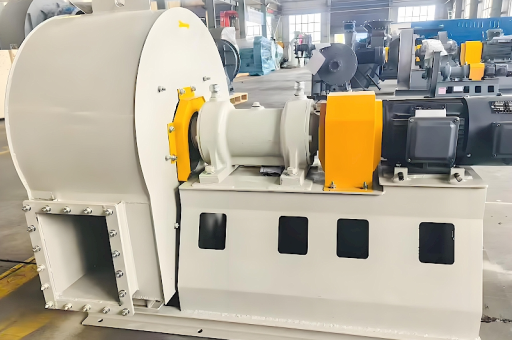
It appears you are asking about the type of centrifugal fan used in the exhaust or induced draft (ID) system for an industrial rotary kiln, specifically a heavy-duty, backward-blade design.
Here is a detailed breakdown of what this means, why it is chosen, and how it is applied.
The Core Components Defined
- Industrial Rotary Kiln: A large, cylindrical, rotating furnace used for high-temperature thermal processing (e.g., calcining limestone into lime, clinker for cement, or roasting ores).
- Heavy Duty Fan: Built with thicker materials, robust bearings, and larger shafts to handle high temperatures, particulate-laden gases, and continuous 24/7 operation.
- Centrifugal Fan: Moves air by accelerating it radially outward via a rotating impeller. The air enters axially and exits at a 90-degree angle.
- Backward Blade (Backward Curve): The fan blades curve away from the direction of rotation. This is the most efficient and robust blade type for dirty, high-temperature applications.
Why "Backward Blade" for Rotary Kilns?
In the context of a rotary kiln's thermal system, the fan is typically on the exhaust side (Induced Draft or ID Fan) pulling hot gases through the kiln, preheater, and pollution control equipment.
| Feature | Backward Blade Fan | Why it's Critical for Kilns |
|---|---|---|
| Efficiency | Highest efficiency among centrifugal fans (80-85%+). | Reduces power consumption (megawatts), a huge operational cost. |
| Power Curve | Non-overloading power curve. | As the gas density changes (e.g., colder startup air vs. hot process gas), the motor cannot be overloaded. This prevents motor burnouts. |
| Wear Resistance | Blade shape is less prone to erosion. | Kiln gases contain abrasive dust (e.g., cement clinker dust, fly ash). Backward blades cause fewer impacts and less erosion than radial or forward-curved blades. |
| Pressure | High static pressure capability. | Overcomes resistance from the kiln, preheater cyclones, baghouse filters, and ductwork. |
| Temperature | Can be designed for high temps. | Can be made from stainless steel (e.g., 316L, Haynes 230) for exhaust temps up to 400°C (750°F) and up to 1000°C (1800°F) with special alloys and shaft cooling. |
Specific Fan Design Challenges in Kiln Service
A "heavy duty" fan for a kiln is not just a standard fan. It must address:
- Buildup (Scaling): Dust can stick to the blades. Backward blades have a "self-cleaning" tendency compared to airfoil blades, which are hollow. Many kiln fans use single-thickness, backward-inclined (SISW) blades to prevent dust buildup that causes imbalance.
- Thermal Stability: The rotor and shaft must be designed to handle large temperature differentials. The shaft often has a fan-cooled extension (shaft cooling wheel) to protect the bearings.
- Vibration: Must be balanced to a high grade (e.g., ISO 1940 G2.5 or G6.3) because an imbalance from dust or temperature change can cause catastrophic failure.
- Variable Speed: Almost all modern kiln ID fans use a Variable Frequency Drive (VFD) or a hydraulic coupling. The backward blade fan responds excellently to speed control for precise kiln draft control.
Common Application: Cement Kiln ID Fan
- Location: After the preheater tower (cyclones) and before/sometimes after the baghouse (dust collector).
- Gas: Hot (300-400°C), dusty (50-100 g/Nm³), corrosive (NOx, SOx, HCl).
- Size: Impellers can be 3 to 5 meters (10-16 feet) in diameter.
- Motor: Typically 1,000 kW to 5,000 kW (1,300 HP to 6,700 HP).
Summary Table: Backward vs. Alternatives
| Fan Type | Kiln Suitability | Pros | Cons |
|---|---|---|---|
| Backward Blade | Excellent (Standard) | Non-overloading, highest efficiency, good for dust | Most expensive, careful design needed for very heavy dust loads |
| Radial Blade | Good (for high dust) | Very strong, handles extreme dust & debris | Low efficiency, high noise, overloading power curve |
| Airfoil Blade | Poor to Fair | Highest efficiency (up to 89%) | Hollow blades crack from dust erosion/thermal stress; very expensive to repair |
| Forward Curved | Very Poor | Compact, low speed | Overloads motor easily, terrible for dust, low pressure |
Conclusion
If you are specifying or troubleshooting a fan for a heavy-duty rotary kiln, the Industrial Centrifugal Fan with Heavy-Duty Backward Blades (Backward-Inclined, SISW) is the industry standard for the induced draft system. You would typically look for:
- Design: Single thickness, backward-inclined.
- Material: AR400 for wear plates, 316L or 309SS for hot gas path.
- Control: VFD driven.
- Accessories: Shaft cooling wheel, expansion joints, vibration sensors, and a large, robust bearing housing (often with split pillow block bearings and grease or oil lubrication).
If you have a more specific question (e.g., "How do I calculate the power draw?" or "Why is my fan vibrating?"), please provide the details.





