
This article's table of contents introduction:
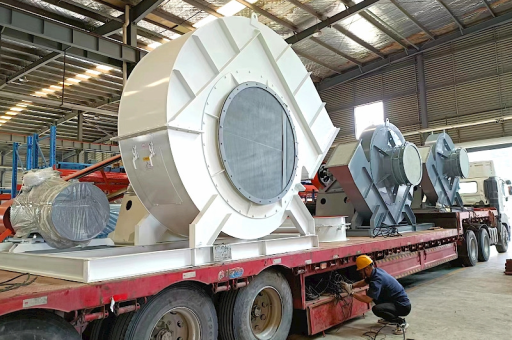
- What does "7.5kW" mean?
- Common Type: Forced Draft (FD) Fan
- Typical Applications for a 7.5kW Fan
- Key Technical Considerations & Data Sheet Values
- Potential Problems & Troubleshooting
- Summary: Is this fan for you?
A 5kW boiler combustion fan is a relatively large and powerful fan used in industrial or large commercial boiler systems to supply combustion air.
Here is a detailed breakdown of what this specification means, the type of fan it likely is, and key considerations.
What does "7.5kW" mean?
- Power Consumption: 7.5kW (kilowatts) refers to the power rating of the fan's electric motor. This is the electrical power the motor consumes under full load.
- Horsepower equivalent: 7.5kW ≈ 10 Horsepower (HP).
- Air Flow: The 7.5kW rating does not tell you the airflow (m³/hr or CFM). It tells you the energy required to move the air. The actual airflow depends on the fan design (centrifugal vs. axial) and the static pressure the fan needs to overcome (the resistance of the boiler, ductwork, and burner).
Common Type: Forced Draft (FD) Fan
In the context of a 7.5kW fan on a boiler, this is almost certainly a Forced Draft (FD) Fan (also called a combustion air fan).
- Function: It pushes air into the burner.
- Design: It is almost certainly a Centrifugal Fan (squirrel cage or radial bladed), not a simple axial fan (propeller type). Centrifugal fans are good at creating the high pressure needed to push air through a burner's air registers and furnace.
- Components: It will consist of:
- Motor: 7.5kW, typically 3-phase (400V/415V in Europe, 480V in N. America), common speeds are 1450 RPM or 2900 RPM (4-pole or 2-pole).
- Impeller: Backward curved, forward curved, or radial blades.
- Housing: Steel scroll housing with an inlet and outlet.
- Inlet Box / Damper: Often has a motorized damper or variable inlet vanes to control airflow.
- Baseplate: Mounted on a heavy steel base with vibration isolators (spring or rubber).
Typical Applications for a 7.5kW Fan
This size of fan is too large for a house boiler and too small for a power station boiler. It sits in the commercial / light industrial range.
- Large Commercial Boilers: Heating hospitals, universities, or large apartment blocks (e.g., a 1-3 MW boiler).
- Industrial Boilers: Process steam boilers in factories (food processing, breweries, textile mills).
- Waste Heat / Incineration Systems: For smaller waste-to-energy plants.
- Solid Fuel Boilers: Wood chip, pellet, or biomass boilers which require high pressure to push air through a fuel bed.
Key Technical Considerations & Data Sheet Values
When specifying or replacing a 7.5kW combustion fan, you must check these parameters:
| Parameter | Typical Value / Example | Why it Matters |
|---|---|---|
| Air Flow (Volume) | 5,000 – 15,000 m³/hr (~3,000 – 9,000 CFM) | The specific value depends on pressure. |
| Static Pressure | 2,000 – 5,000 Pa (8 – 20 inches w.g.) | This is crucial. A high-pressure burner needs a 5,000 Pa fan; a low-pressure one needs 2,000 Pa. |
| Motor Speed | 1450 RPM (4-pole) or 2900 RPM (2-pole) | Lower speeds (1450) are quieter, more reliable. Higher speeds (2900) can deliver higher pressure for a given size. |
| Electrical Supply | 3-phase, 400V / 480V, 50Hz / 60Hz | Check your local power. A 7.5kW motor on 400V draws ~14 Amps. |
| Ambient Temperature | -20°C to +80°C | The fan might be outside, near the boiler, or sucking hot air from the boiler house. |
| Impeller Material | Mild Steel (standard) or Stainless Steel (for corrosive flue gas or high humidity) | For standard natural gas/light oil, mild steel is fine. For heavy oil or biomass, SS is safer. |
Potential Problems & Troubleshooting
-
Low Airflow / Flame Instability:
- Cause: Dirty fan impeller (dust/fibers building up), blocked inlet filter, closed damper, or worn-out bearings causing the impeller to rub.
- Fix: Clean the blades, check damper position, lubricate or replace bearings.
-
Motor Overheating / Tripping:
- Cause: The fan is operating at a higher pressure than designed (e.g., a blocked filter creates high resistance, pushing the motor into overload). Or, the incoming voltage is too low.
- Fix: Check the actual motor current (Amps) with a clamp meter. It should be lower than the nameplate Full Load Amps (FLA). If it's higher, you have a blockage or the fan is too small for the job.
-
Vibration / Noise:
- Cause: Bearing failure (most common), imbalance due to dirt buildup on one blade, or loose mounting bolts.
- Fix: Check vibration levels. If high, clean the impeller first. If still high, replace bearings (and ensure dynamic balancing).
Summary: Is this fan for you?
- If you have a small domestic boiler (24kW): 7.5kW is grossly oversized. A domestic boiler fan uses 50-200 Watts.
- If you have a large commercial boiler (500kW - 2MW): 7.5kW is very typical.
- Key specification: Do not just buy a "7.5kW fan". You must know the required Static Pressure (Pa or in.w.g.) and Air Volume (m³/hr or CFM) to ensure it matches your burner.
Actionable next step: If you are replacing an existing fan, look for the model number on the fan housing (e.g., "Belt Driven" or "Direct Drive"). If it's a direct drive, the motor speed is critical. If it's a belt drive, you can change the pulleys to adjust speed/flow.





