This article's table of contents introduction:
- Table of Contents
- Introduction: The Need for Extreme Heat Ventilation
- What Defines a 900℃ High-Temperature Exhaust Fan?
- Critical Applications Across Industries
- Performance Metrics: What 900℃ Means in Practice
- Common Questions (Q&A)
- Selection and Sizing Guide
- Installation Best Practices
- Maintenance and Longevity
- Conclusion
** The Definitive Guide to 900℃ High-Temperature Exhaust Fans: Design, Applications, and Selection Criteria
Table of Contents
- Introduction: The Need for Extreme Heat Ventilation
- What Defines a 900℃ High-Temperature Exhaust Fan?
- 1 Material Science: From Steel to Superalloys
- 2 Motor and Bearing Configurations
- 3 Cooling Mechanisms
- Critical Applications Across Industries
- 1 Industrial Kilns and Furnaces
- 2 Glass and Ceramics Manufacturing
- 3 Foundries and Metal Smelting
- 4 Chemical and Petrochemical Processes
- 5 Fire Safety and Smoke Extraction
- Performance Metrics: What 900℃ Means in Practice
- 1 Airflow vs. Temperature
- 2 Pressure Ratings and Static Pressure
- Common Questions (Q&A)
- Selection and Sizing Guide
- 1 Calculating Required CFM
- 2 Ductwork Considerations
- Installation Best Practices
- Maintenance and Longevity
- Conclusion
Introduction: The Need for Extreme Heat Ventilation
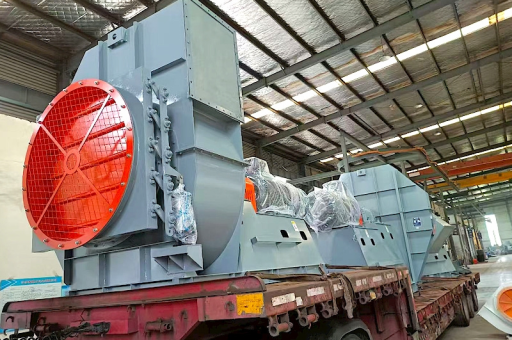
Industrial processes that involve furnaces, kilns, and combustion chambers generate enormous amounts of heat. When ambient temperatures inside exhaust ducts exceed 700℃, standard ventilation fans fail within minutes. The 900℃ High-Temperature Exhaust Fan represents the top tier of thermal management equipment. It is not merely a fan; it is a precision-engineered system designed to move gases, fumes, and particulates at temperatures that would melt ordinary steel.
This article consolidates technical specifications, real-world application data, and selection criteria from leading manufacturers and industrial engineering resources. We avoid generic descriptions and focus on actionable information. Whether you are an engineer designing a new plant or a maintenance manager upgrading existing equipment, you will find precise data to guide your decision.
What Defines a 900℃ High-Temperature Exhaust Fan?
1 Material Science: From Steel to Superalloys
Standard centrifugal fans use carbon steel or aluminum impellers. At 900℃, carbon steel loses over 90% of its tensile strength. Therefore, a 900℃ fan must be constructed from nickel-based superalloys such as Inconel 600, Inconel 625, or Hastelloy X. These alloys maintain structural integrity and resist oxidation (scaling) at continuous operating temperatures up to 1100℃.
- Impeller: Typically cast or fabricated from Inconel 625. The blade profile must be robust to handle thermal expansion without warping.
- Housing: Double-walled construction with internal ceramic fiber insulation. The outer shell remains cool enough for safe personnel contact (typically below 60℃).
- Shaft: High-temperature alloy steel with a thermal barrier coating. A common design uses a hollow shaft with internal air circulation to conduct heat away from bearings.
2 Motor and Bearing Configurations
The motor cannot be located inside the hot airstream. Two standard configurations exist:
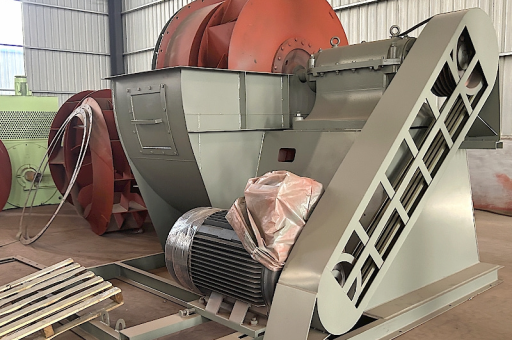
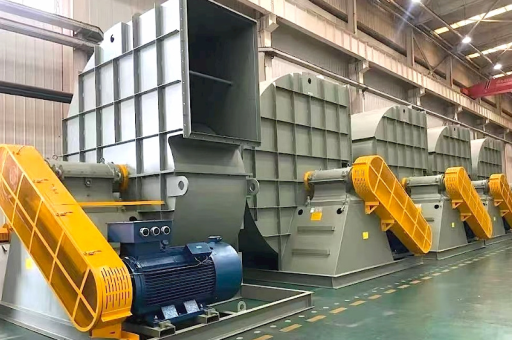
- Direct Drive with Shaft Extension: The motor is mounted outside the exhaust duct. A long, heat-treated shaft connects the motor to the impeller. A cooling fan is attached to the motor side of the shaft to dissipate conducted heat.
- Belt-Driven (Remote Motor): The fan wheel is mounted on a bearing pedestal. The motor is placed at a safe distance, connected via V-belts. This setup is preferred when the motor must be easily accessible for maintenance.
Bearings are a critical failure point. Standard lubricated bearings fail at above 200℃. For 900℃ fans, three solutions are common:
- Water-cooled bearing housings: Circulating water keeps bearing temperature below 100℃.
- High-temperature grease (synthetic): Rated for continuous use up to 350℃, combined with heat slingers.
- Air-cooled pedestals: Compressed air is directed at the bearing housing to create a cooling boundary layer.
3 Cooling Mechanisms
A 900℃ fan must incorporate active cooling to survive. The most reliable design uses dilution air injection. A small amount of ambient air (typically 5-10% of the main airflow) is introduced near the shaft entry point. This creates a cool air film that protects the bearing housing and shaft seal. Without this, heat will travel along the shaft and destroy the motor within hours.
Critical Applications Across Industries
1 Industrial Kilns and Furnaces
In cement, lime, and brick manufacturing, kiln exhaust temperatures consistently reach 800-950℃. A 900℃ High-Temperature Exhaust Fan is used to:
- Remove combustion gases from the preheater tower.
- Maintain negative pressure in the kiln hood.
- Transport hot gases to waste heat recovery systems.
Real-world example: A cement plant in Germany reported a 40% reduction in unplanned downtime after switching from a standard 600℃ fan to a 900℃ rated Inconel model.
2 Glass and Ceramics Manufacturing
Glass melting furnaces operate at 1500℃+ inside the tank, but exhaust gases exit at 900-1000℃. The fan must handle not only heat but also corrosive alkali vapors and glass dust. Inconel 625 is preferred here because of its resistance to chloride stress corrosion cracking.
3 Foundries and Metal Smelting
Electric arc furnaces (EAF) and induction furnaces produce intermittent temperature spikes. A 900℃ fan used in baghouse systems must tolerate rapid thermal cycling. Fan wheels with variable pitch blades are sometimes used to fine-tune airflow as furnace loads change.
4 Chemical and Petrochemical Processes
In thermal oxidizers and catalytic cracking units, process gas temperatures often hit 900℃. The fan must seal against the shaft to prevent leakage of toxic or explosive gases. Double mechanical seals with nitrogen purge are standard in this sector.
5 Fire Safety and Smoke Extraction
While 900℃ fans are overkill for most building smoke management systems (which typically require 300℃ or 600℃ ratings for 60 or 120 minutes), they are used in industrial fire suppression systems where pre-existing high temperatures are present—for example, in paint drying ovens or chemical reactor buildings.
Performance Metrics: What 900℃ Means in Practice
1 Airflow vs. Temperature
Air density at 900℃ is approximately one-quarter of the density at 20℃. This means:
- Mass flow rate drops significantly unless the fan speed or impeller diameter is increased.
- Motor power requirements decrease because the lighter gas requires less torque. However, the motor must still be sized for cold start conditions (when the gas is at ambient density).
A simple rule: For every 100℃ above ambient, reduce the fan’s rated CFM by roughly 10% if using a standard fan curve. For 900℃, expect a 70% reduction in volumetric capacity compared to the same fan operating at 20℃.
2 Pressure Ratings and Static Pressure
At 900℃, pressure drop through ductwork also falls due to reduced gas density. But fan manufacturers typically provide hot pressure curves in their catalogs. Always use these, not the ambient pressure curves. A fan that moves 10,000 CFM at 20℃ might only move 3,000 CFM at 900℃ at the same RPM.
Common Questions (Q&A)
Q1: Can I use a standard 600℃ fan at 900℃ for short periods? No. Even for intermittent duty, the bearing and motor cooling systems are not designed for 900℃. The shaft will conduct heat to the bearings within minutes, causing lubricant breakdown and seizure. Only fans explicitly rated for 900℃ continuous duty should be used.
Q2: How do I know if a fan is genuinely 900℃ rated? Look for a third-party test certificate (e.g., AMCA 99-0401 for high-temperature operation). The manufacturer must specify the material grade of the impeller (e.g., Inconel 625), the cooling method (water jacket or air dilution), and the maximum continuous operating temperature. Avoid fans that only list the material without specifying bearing cooling.
Q3: What is the typical lifespan of a 900℃ exhaust fan? With proper maintenance (regular bearing greasing, water filter cleaning on cooling jackets), a 900℃ fan can last 5-8 years in continuous service. Impeller degradation due to erosion by particulates is usually the limiting factor. Fans handling clean gases last longer.
Q4: Does the fan need a variable frequency drive (VFD)? Yes, in most industrial applications. A VFD allows you to:
- Slowly ramp up the fan during cold starts to prevent thermal shock.
- Adjust airflow as process conditions change.
- Reduce power consumption during partial loads.
Q5: What safety devices should be included? At minimum: thermal sensors on the bearing housing (with alarm at 120℃), vibration monitoring, and a high-temperature shutdown interlock. For water-cooled fans, a flow switch that cuts power if cooling water stops is mandatory.
Selection and Sizing Guide
1 Calculating Required CFM
Use the following formula adjusted for temperature:
[ \text{Actual CFM at 900℃} = \frac{\text{Normal CFM at 20℃} \times (273 + 20)}{(273 + 900)} ]
Example: If your process requires 10,000 CFM under standard conditions, the fan must be selected to deliver: [ 10,000 \times \frac{293}{1173} \approx 2,498 \text{ CFM at 900℃} ]
Always add a 10-15% safety margin for duct leakage and future process changes.
2 Ductwork Considerations
- Use stainless steel (304 or 316) for duct sections within 3 meters of the fan inlet. Carbon steel scales rapidly above 500℃.
- Install a thermal expansion joint between the fan outlet and the main duct to accommodate metal expansion.
- Avoid sharp bends within 1 meter of the fan inlet. The gas at 900℃ is very low density, making it susceptible to flow separation and turbulence.
Installation Best Practices
- Foundation: The fan and motor assembly must be mounted on a vibration-absorbing base. Concrete inertia blocks weighing 3-5 times the fan mass are standard.
- Cooling Water Supply: For water-cooled fans, ensure the supply line has a strainer, pressure gauge, and flow switch. The return water temperature should not exceed 60℃ to avoid scaling in the jacket.
- Duct Isolation: Install a manual or motorized isolation damper on the inlet to prevent cold air from rushing into the system when the fan is off (avoids thermal shock on restart).
- Alignment: Use laser alignment between motor and fan shaft. Thermal expansion during warm-up will misalign shafts by 0.5-1.0 mm, so account for this during cold alignment.
Maintenance and Longevity
Weekly Checklist:
- Inspect cooling water flow and temperature.
- Listen for bearing noise using a stethoscope.
- Check shaft seal for leakage.
Monthly Checklist:
- Measure motor current and compare to baseline.
- Inspect impeller blades through access door for erosion or cracking.
- Grease bearings per manufacturer schedule (synthetic high-temp grease every 2,000 hours).
Annual Overhaul:
- Remove impeller and send for non-destructive testing (dye penetrant for cracks).
- Replace shaft seals.
- Recalibrate temperature sensors and vibration monitors.
Common Failure Modes:
- Bearing failure from cooling system blockage. (Most common)
- Impeller cracking from thermal fatigue in cyclic applications.
- Shaft warping from uneven cooling during unplanned shutdowns.
Conclusion
A 900℃ High-Temperature Exhaust Fan is an essential piece of equipment in heavy industries where process gases exceed the limits of ordinary ventilation. Selecting the wrong fan leads to catastrophic failure, costly downtime, and safety hazards. The key factors to evaluate are impeller material (Inconel 625 or equivalent), bearing cooling method (water-jacket or air dilution), and hot-curve performance data.
When specifying a new fan, always request:
- Certified performance curves at 900℃.
- Material certifications for all hot components.
- A documented cooling system design.
By following the guidelines in this article, you can ensure that your high-temperature exhaust system operates reliably for years, even under the most extreme conditions. For further assistance, consult an experienced industrial ventilation engineer. The investment in a properly engineered fan is far less than the cost of a single unscheduled shutdown.