This article's table of contents introduction:
- The Core Components
- Typical Performance & Specifications (Example)
- Common Applications
- Key Advantages of Using a VFD
- Important Selection & Installation Considerations
- Summary Table
This is a specific piece of equipment combination. A "11kW variable frequency centrifugal fan" is a very common and robust solution for industrial ventilation, HVAC, and process air handling where variable air volume (VAV) is required.
Here is a breakdown of what this entails, its typical specifications, applications, and key considerations.
The Core Components
-
11kW Motor (Approx. 15 HP):
- Power: This is the motor's rated output power.
- Voltage: Typically 3-phase (e.g., 380V, 400V, 415V, or 480V depending on region).
- Efficiency: Usually IE3 (Premium) or IE4 (Super Premium) efficiency standard.
- Speed Range: A standard 4-pole motor runs at ~1450-1500 RPM (synchronous). With a VFD, you can typically run it from 0 to ~3000 RPM (or more with special bearings/motors).
-
Variable Frequency Drive (VFD) - 11kW:
- Function: Converts fixed frequency AC power to variable frequency and voltage to control the motor's speed.
- Benefits:
- Energy Savings: Fan power is proportional to the cube of the speed ($P \propto N^3$). Reducing speed by 20% can cut energy use by ~50%.
- Soft Start/Stop: Reduces mechanical stress and electrical inrush current.
- Precise Control: Allows for accurate pressure or flow control via feedback (e.g., from a pressure transducer).
- Brands: Siemens, Danfoss, ABB, Schneider, Mitsubishi, Yaskawa, Delta, etc.
-
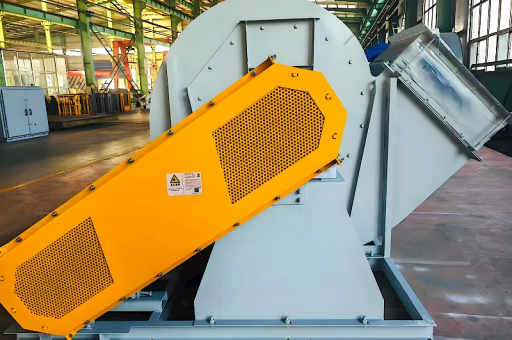
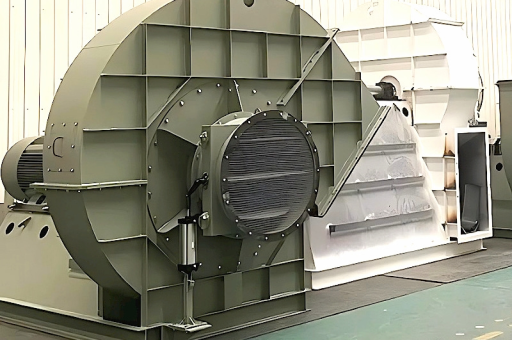
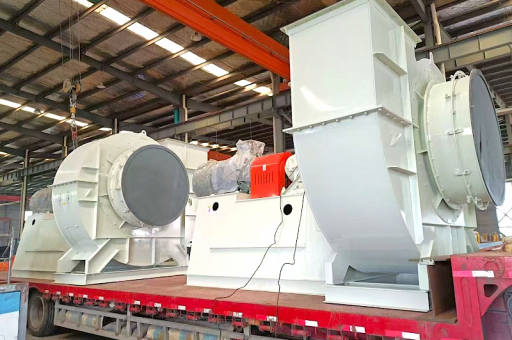
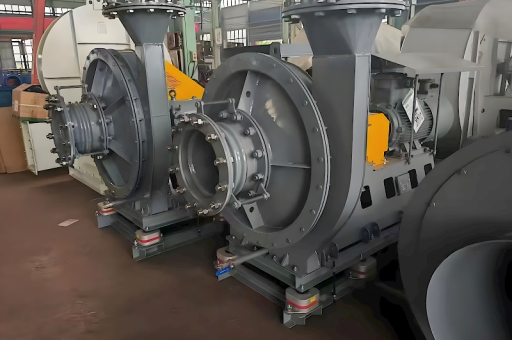
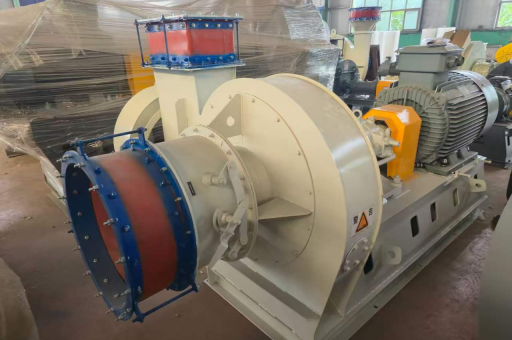
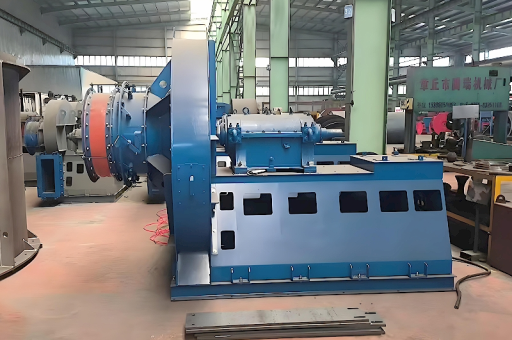
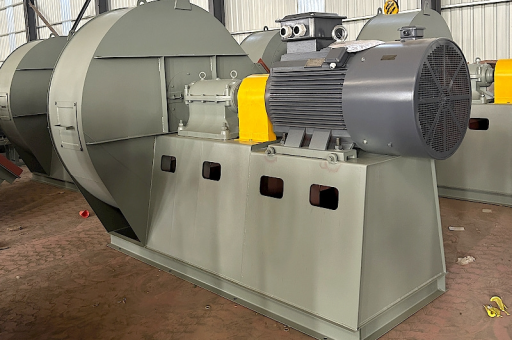
Centrifugal Fan:
- Principle: Uses a rotating impeller to increase air velocity, which is then converted to pressure by the fan housing (volute). Air enters axially and exits radially (90° turn).
- Impeller Types:
- Forward Curved (Squirrel Cage): High volume, low-medium pressure, common in HVAC.
- Backward Curved / Airfoil: High efficiency, medium-high pressure, good for industrial/process applications.
- Radial (Paddle Wheel): For heavy dust, sticky materials, or high pressure. Lower efficiency.
- Drive: Connected via a belt drive (common for flexibility) or direct drive (common for higher efficiency and lower maintenance).
Typical Performance & Specifications (Example)
- Power: 11 kW (15 HP)
- Airflow (CFM / m³/h): Highly variable based on design. A medium-pressure fan might move 8,000 - 15,000 CFM (13,600 - 25,500 m³/h) .
- Static Pressure (SP): Typically 500 - 2000 Pa (2 - 8 in. w.g.) .
- Speed: 800 - 1800 RPM (controlled via VFD).
- Control Mode: Constant pressure, constant flow (via feedback), or simple speed setpoint.
Common Applications
- HVAC: Air handling units (AHU) for large buildings, exhaust systems, clean rooms (where precise pressure is critical).
- Industrial Ventilation: Dust collection (with a radial wheel), welding fume extraction, general factory ventilation.
- Process Air: Drying systems, pneumatic conveying (low-pressure), oven air circulation.
- Agricultural: Grain drying, poultry house ventilation (large-scale).
Key Advantages of Using a VFD
- Energy Efficiency: The #1 reason. Running a fan at full speed and using dampers/vanes to control flow is hugely wasteful. VFD control is much more efficient.
- Reduced Wear & Tear: Soft starting eliminates belt slippage, bearing shock, and motor winding stress. Reduced speed also reduces bearing and belt wear.
- Lower Noise: Running the fan at lower speeds (e.g., at night or during low-demand periods) significantly reduces noise levels.
- Process Control: Can maintain precise static pressure in a duct system or maintain a specific air change rate.
- Motor Protection: VFDs typically protect against overcurrent, overvoltage, thermal overload, and phase loss.
Important Selection & Installation Considerations
- Harmonics: 11kW is a significant load. The VFD will generate harmonics. Check local grid requirements (e.g., IEEE 519). You may need a line reactor or DC choke.
- Cable Length: Long motor cables from the VFD can cause voltage spikes and bearing currents. Use shielded, VFD-rated cable and keep runs as short as possible (under 100m / 300ft is ideal; longer runs may need output reactors or filters).
- Motor Type: Ensure the motor is VFD-rated (insulation class F or H, shaft grounding brush to prevent bearing fluting).
- Environmental Conditions: The fan and VFD must be rated for the environment (e.g., IP55 for a dusty factory, IP65 for outdoor/washdown areas).
- Protection: Do not use a contactor between the VFD and the motor for routine starting/stopping. The VFD handles this. Also, a VFD is not a disconnect; an upstream safety disconnect (lockout/tagout) is mandatory.
- Control Signal: How will you control the speed? (e.g., 4-20mA analog signal, 0-10V, Modbus/RS485, BACnet, or simple potentiometer). Closed-loop control (e.g., pressure transducer in the duct) is highly recommended.
Summary Table
| Feature | Details |
|---|---|
| Power | 11 kW (15 HP) |
| Fan Type | Centrifugal (Single Inlet or Double Inlet) |
| Key Component | VFD (Inverter) - essential for control & efficiency |
| Primary Benefit | Massive energy savings, soft start, precise control |
| Typical Flow | ~8,000 - 15,000 CFM (depends on design & pressure) |
| Typical Pressure | ~500 - 2,000 Pa |
| Key Risk | Harmonics, bearing currents (motor), cable restrictions |
Bottom Line: This is a high-performance, energy-efficient industrial workhorse. When specified, installed, and commissioned correctly, it will provide excellent variable air volume control for years. The initial cost is higher than a simple fixed-speed fan, but the payback in energy savings is often very fast (1-3 years).