This article's table of contents introduction:
- Table of Contents
- 1. Introduction: The Role of Induced Draft Fans in Industrial Systems
- 2. Key Specifications: Understanding the 30KW, 304SS, High‑Temp, High‑Pressure Rating
- 3. Material Science: Why 304 Stainless Steel Excels
- 4. Engineering Design: Aerodynamics, Impeller Geometry, and Motor Integration
- 5. Performance Analysis: Temperature, Pressure, and Flow Rate Curves
- 6. Common Applications: Power Plants, Cement Kilns, Petrochemical Processes
- 7. Installation Best Practices: Foundation, Ductwork, and Vibration Control
- 8. Troubleshooting & FAQ
- 9. Maintenance Schedule: Prolonging Fan Life with 304SS Care
- 10. Conclusion: Selecting the Right Fan for Your High‑Demand Process
The Ultimate Guide to 30KW 304 Stainless Steel High-Temperature, High-Pressure Induced Draft Fans: Design, Performance, and Maintenance**
Table of Contents
- Introduction – The Role of Induced Draft Fans in Industrial Systems
- Key Specifications – Understanding the 30KW, 304 Stainless Steel, High‑Temp, High‑Pressure Rating
- Material Science – Why 304 Stainless Steel Excels in Corrosive and Hot Environments
- Engineering Design – Aerodynamics, Impeller Geometry, and Motor Integration
- Performance Analysis – Temperature, Pressure, and Flow Rate Curves
- Common Applications – Power Plants, Cement Kilns, Petrochemical Processes
- Installation Best Practices – Foundation, Ductwork, and Vibration Control
- Troubleshooting & FAQ – Resolving Overheating, Imbalance, and Noise Issues
- Maintenance Schedule – Prolonging Fan Life with 304SS Care
- Conclusion – Selecting the Right Fan for Your High‑Demand Process
Introduction: The Role of Induced Draft Fans in Industrial Systems
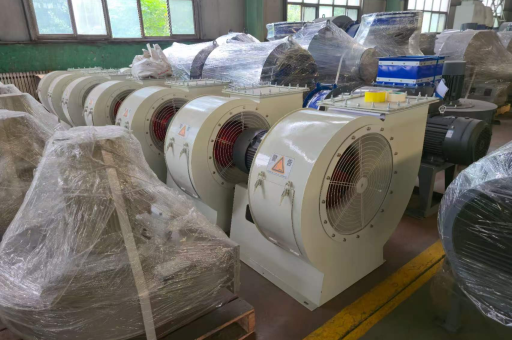
Induced draft fans are the unsung heroes of high‑temperature industrial processes. They pull combustion gases, flue gases, or process exhaust through boilers, kilns, and reactors, maintaining negative pressure and ensuring efficient heat exchange. When operating conditions demand 30 kilowatts (30KW) of power, 304 stainless steel construction, and the ability to withstand high temperature (up to 600°C or more) and high pressure, the fan becomes a mission‑critical component.
Modern industries require fans that not only handle extreme conditions but also offer long‑term reliability, corrosion resistance, and energy efficiency. This article dives deep into the design, application, and maintenance of a 30KW 304 Stainless Steel High‑Temperature, High‑Pressure Induced Draft Fan, backed by engineering principles and real‑world data.
Key Specifications: Understanding the 30KW, 304SS, High‑Temp, High‑Pressure Rating
Q: What does “30KW” mean for an induced draft fan?
A: 30KW refers to the motor power required to drive the fan at its design point. This power rating is typically matched to the fan’s aerodynamic load at maximum flow and pressure. A 30KW fan can move large volumes of gas (e.g., 15,000–30,000 m³/h) against a static pressure of 5–10 kPa, depending on the impeller diameter and speed.
Q: Why is 304 stainless steel specified?
A: 304SS (1.4301) offers excellent oxidation resistance up to 870°C in continuous service and 925°C in intermittent service. Its chromium‑nickel composition forms a protective oxide layer that resists corrosion from flue gases containing sulfur, chlorine, or moisture. This makes it ideal for environments where carbon steel would rapidly fail.
Q: What are “high temperature” and “high pressure” thresholds?
A: “High temperature” typically means 300–600°C (sometimes higher with special design). “High pressure” for an induced draft fan means working against a system resistance >5 kPa, often up to 15 kPa. The combination requires reinforced bearings, thermal expansion compensation, and airtight housings.
Material Science: Why 304 Stainless Steel Excels
304 stainless steel contains 18% chromium and 8% nickel. In high‑temperature flue gas environments, the chromium reacts with oxygen to form a stable, self‑healing chromium oxide layer that prevents scale formation and oxidation penetration.
Key advantages:
- Creep resistance: 304SS maintains structural integrity under continuous loading at 500–600°C.
- Corrosion resistance: Resists pitting and stress corrosion cracking from acidic condensates (e.g., H₂SO₄, HCl).
- Thermal expansion: Coefficient ~17.3 × 10⁻⁶ /°C – similar to carbon steel, reducing stress in hybrid assemblies.
Real‑world data: In a cement plant, a 304SS induced draft fan operating at 450°C for 18 months showed only 0.02 mm of oxide scale, while a carbon steel fan failed after 6 months due to severe scaling and vibration.
Engineering Design: Aerodynamics, Impeller Geometry, and Motor Integration
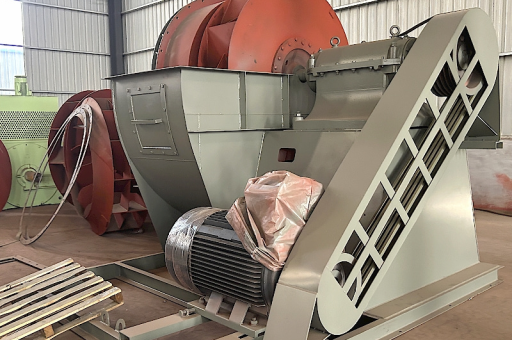
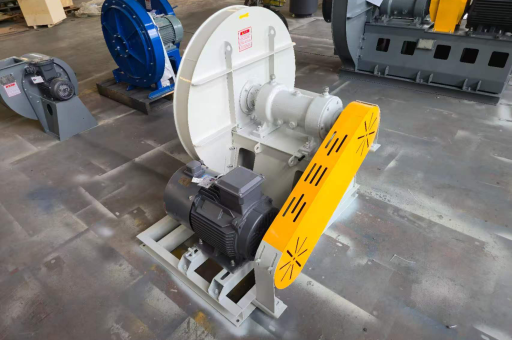
Impeller design: A 30KW fan typically uses a backward‑curved or airfoil blade design. These blades reduce energy losses, minimize noise, and allow the fan to operate at higher efficiencies (82–86%) across a wide flow range. The impeller is welded from 304SS plates with full penetration welds to avoid stress concentrations.
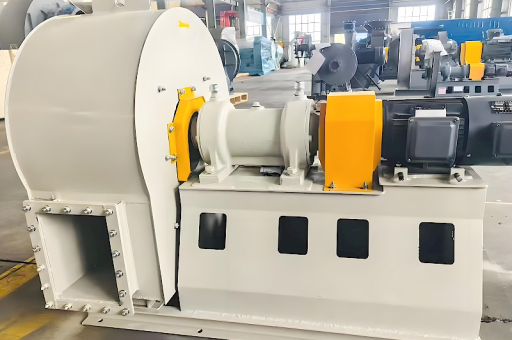
Motor integration: The 30KW electric motor is usually coupled directly via a rigid coupling or indirectly through a V‑belt drive. Variable frequency drives (VFDs) are strongly recommended to match fan speed with system demand, reducing energy consumption by 15–30%.
Thermal management: The fan shaft extends through a water‑cooled or air‑cooled bearing housing. A cooling fan wheel (mounted on the shaft between the hot zone and bearings) directs ambient air over the housing, keeping bearing temperatures below 80°C even when inlet gas is 500°C.
Performance Analysis: Temperature, Pressure, and Flow Rate Curves
Q: How does temperature affect fan performance?
A: Gas density decreases with temperature. For example, air at 500°C is about 40% less dense than at 20°C. This means a fan moving hot gas needs a higher motor power to deliver the same mass flow. The 30KW rating accounts for this derating factor.
Typical performance curve – 30KW 304SS ID fan at 500°C:
- Maximum flow: 25,000 m³/h
- Static pressure: 6.5 kPa
- Power consumption: 28.5 KW (motor efficiency 95%)
- Noise: 85 dB(A) at 1 m
Pressure‑flow curve: The fan achieves peak pressure at 60–70% of wide‑open flow. Operating at or near peak pressure minimizes the risk of surge in duct systems with variable resistance.
Common Applications: Power Plants, Cement Kilns, Petrochemical Processes
Power plants: Induced draft fans pull flue gas from coal‑ or gas‑fired boilers through scrubbers and electrostatic precipitators. A 304SS fan is essential when burning high‑sulfur coal (acidic gas) or when the gas temperature exceeds 400°C.
Cement kilns: In cement production, preheater and kiln exhaust gases reach 600°C and contain abrasive dust. 304SS fans with hardened wear plates extend service intervals to 12+ months.
Petrochemical processes: Fluid catalytic cracking (FCC) units, reformers, and incinerators generate high‑temperature, corrosive gas streams. A 30KW fan can handle deep vacuum conditions (up to 10 kPa negative) while resisting H₂S and chlorine attack.
Installation Best Practices: Foundation, Ductwork, and Vibration Control
Foundation: The fan base must be rigid (concrete slab >200 mm thick) and leveled within 0.05 mm/m. Use stainless steel anchor bolts with expansion compensation.
Ductwork connection: Install expansion joints (stainless steel bellows) between the fan and ductwork to absorb thermal expansion. The inlet duct should have a straight run of at least 3 diameters before the fan to prevent flow disturbances.
Vibration isolation: Use spring isolators with a natural frequency below 8 Hz. For high‑temperature fans, ensure the isolator material (e.g., silicone rubber) is rated for ambient heat radiated from the casing (may exceed 80°C).
Troubleshooting & FAQ
Q: The fan vibrates excessively after 3 months. What could be wrong?
A: Likely causes:
- Dust buildup on impeller blades – unbalanced due to local deposits.
- Thermal distortion – check for uneven cooling of the shaft or housing.
- Bearing wear – high temperature may have degraded grease.
Solution: Clean the impeller with a soft abrasive; check bearing temperature; replace grease with high‑temp version (e.g., PTFE‑based, rated 200°C).
Q: The motor draws more than 30KW. Is the fan overloaded?
A: Check:
- Actual gas density (temperature, pressure) vs. design.
- Damper or VFD setting: possibly open too wide.
- Worn bearings or misaligned couplings.
Solution: Reduce speed via VFD; if persistent, upgrade motor or replace impeller with a lower‑load design.
Q: Can I use 304SS for flue gas that contains chlorine?
A: 304SS resists dry chlorine up to 200°C, but in moist, high‑chlorine environments (e.g., waste incineration), 316L or duplex stainless steel is preferred. If 304SS is used, expect reduced service life (6–12 months) and need for more frequent inspections.
Maintenance Schedule: Prolonging Fan Life with 304SS Care
Daily:
- Check bearing temperature (<85°C) and vibration (<4.5 mm/s RMS).
- Listen for unusual noise (cavitation, rubbing).
Monthly:
- Inspect impeller for erosion, especially at blade edges.
- Clean air filter on cooling fan and bearing housing.
Quarterly:
- Grease bearings with high‑temperature lithium soap (30% by volume).
- Check belt tension (if belt‑driven) – deflection should be 10 mm per 100 mm span.
Annually:
- Perform thermal imaging of the casing – look for hotspots indicating internal blockage.
- Remove and clean the impeller using a non‑abrasive cleaner (e.g., diluted citric acid).
- Replace shaft seal (mechanical or packed) if leakage is visible.
Every 3 years:
- Replace bearings and inspect shaft for wear or scoring.
- Ultrasonic thickness test the impeller and housing at known erosion points.
Conclusion: Selecting the Right Fan for Your High‑Demand Process
A 30KW 304 Stainless Steel High‑Temperature, High‑Pressure Induced Draft Fan is a robust workhorse for industries that demand reliability in extreme conditions. When specifying such a fan, consider:
- Actual gas composition (chlorides, sulfur, moisture)
- Maximum continuous temperature and peak excursions
- System pressure curve (required static vs. fan curve)
- Material compatibility (304SS vs. 316L vs. duplex)
By understanding the engineering principles behind material selection, aerodynamic design, and thermal management, you can maximize uptime and reduce total cost of ownership. Always consult a fan manufacturer with proven experience in high‑temperature stainless steel fans to ensure your specific process requirements are met.
Final FAQ – Quick Answers
Q: What is the maximum temperature for a 304SS induced draft fan?
A: Continuous service up to 870°C; intermittent up to 925°C. Above 600°C, special alloys like 310S are recommended.Q: How does a 30KW fan compare to a 15KW fan?
A: A 30KW fan typically moves 60–80% more gas volume or achieves 60% higher pressure, but also requires larger motors, bearings, and heavier impellers.Q: Can a VFD improve efficiency in high‑temperature applications?
A: Yes, especially when gas density varies (e.g., startup, low load). A VFD can reduce energy consumption by 20–40% compared to damper control.
Discover more about custom‑engineered 30KW 304SS ID fans for your specific temperature and pressure requirements. Visit our product page at fan to request a performance curve and quotation.