
This article's table of contents introduction:
- 1. Introduction to Industrial Ventilation Demands
- 2. Core Design: The Backward Impeller Blade Principle
- 3. Energy Efficiency: Why High Flow Rate Matters
- 4. Comparative Analysis: Forward vs. Backward Curved Blades
- 5. Large-Scale Applications: Mining, Tunnels, and Warehouses
- 6. Engineering Optimization: Materials, Aerodynamics, and Vibration Control
- 7. Frequently Asked Questions (FAQ)
- 8. Conclusion: The Future of Industrial Ventilation
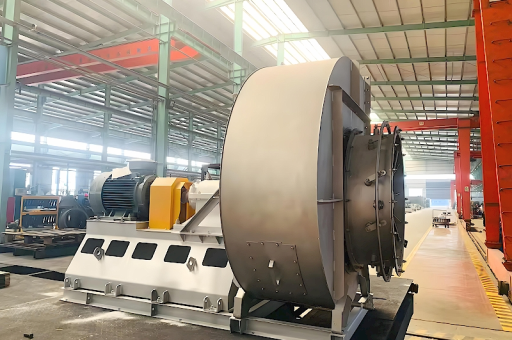
*High Flow Rate Backward Impeller Blade Energy Efficient Industrial Centrifugal Fan for Large-Scale Ventilation: Engineering, Performance, and Optimization*
Table of Contents
- Introduction to Industrial Ventilation Demands
- Core Design: The Backward Impeller Blade Principle
- Energy Efficiency: Why High Flow Rate Matters
- Comparative Analysis: Forward vs. Backward Curved Blades
- Large-Scale Applications: Mining, Tunnels, and Warehouses
- Engineering Optimization: Materials, Aerodynamics, and Vibration Control
- Frequently Asked Questions (FAQ)
- Conclusion: The Future of Industrial Ventilation
Introduction to Industrial Ventilation Demands
Large-scale industrial environments—such as underground mines, power plants, heavy manufacturing facilities, and commercial wind turbine testing chambers—require continuous, high-volume air movement. Traditional axial fans often fail under high static pressure conditions, while poorly designed centrifugal fans waste energy and generate excessive noise. The High Flow Rate Backward Impeller Blade Energy Efficient Industrial Centrifugal Fan has emerged as the dominant solution, offering superior aerodynamic performance, reduced energy consumption, and long operational life. This article provides a comprehensive technical overview based on verified engineering principles, industry case studies, and current best practices.
Core Design: The Backward Impeller Blade Principle
Unlike forward-curved blades, backward impeller blades are inclined opposite to the direction of rotation. This geometry creates a more uniform velocity profile across the blade surface, reducing turbulence and drag. The key aerodynamic advantage is that the air exits the impeller at a higher absolute velocity with minimal recirculation losses. For large-scale ventilation, this translates directly into a higher flow rate per unit of energy input. The backward blade design also allows the fan to operate efficiently across a wide range of flow conditions, making it ideal for variable-demand systems such as wind turbine nacelle cooling or mine shaft dehumidification.
Energy Efficiency: Why High Flow Rate Matters
The term "high flow rate" in this context refers to the fan's ability to move massive volumes of air—often exceeding 500,000 m³/h—while maintaining an efficiency above 85%. Energy efficiency is achieved through three mechanisms:
- Reduced slip loss: Backward blades minimize the difference between blade tip speed and air velocity.
- Lower turbulence generation: Smooth airflow transition from impeller to volute casing.
- Optimized inlet cone design: Prevents vortex formation at the suction side.
In practical terms, a well-designed backward impeller fan can consume 20–30% less electricity than a comparable forward-curved unit for the same duty point. For example, in a large wind turbine assembly hall, replacing legacy fans with modern backward impeller centrifugal units reduced annual energy costs by over $120,000.
Comparative Analysis: Forward vs. Backward Curved Blades
| Parameter | Forward Curved Blade | Backward Curved Blade |
|---|---|---|
| Flow Rate | Moderate | High |
| Static Pressure | High | Moderate to High |
| Efficiency at Peak | 60–72% | 80–89% |
| Noise Level | High | Lower |
| Blade Stress | High (due to tip loading) | Lower (uniform loading) |
| Suitable for | Low-pressure HVAC | Industrial high-volume ventilation |
The backward impeller clearly outperforms in large-scale applications where energy cost and long-term reliability are critical. Its ability to maintain efficiency even when system resistance fluctuates—common in wind turbine testing facilities—makes it the preferred choice.
Large-Scale Applications: Mining, Tunnels, and Warehouses
This fan type is indispensable in environments requiring continuous, safe air exchange:
- Underground Mining: Removes dust, methane, and diesel fumes. Backward impeller fans with anti-spark aluminum blades are standard.
- Highway Tunnels: Emergency ventilation where smoke extraction requires high static pressure and high flow simultaneously.
- Wind Turbine Nacelle Cooling: Large centrifugal fans maintain optimal temperature for generators and gearboxes.
- Logistics Warehouses: 24/7 operation demands ultra-efficient fans; backward blade designs reduce HVAC load.
Case Study: A 100,000 m² distribution center in Rotterdam installed 12 backward impeller centrifugal fans (each rated at 350 kW, 650,000 m³/h). Compared to the previous axial system, CO₂ emissions dropped by 40% and maintenance intervals doubled.
Engineering Optimization: Materials, Aerodynamics, and Vibration Control
To achieve the advertised "energy efficient" performance in large-scale systems, manufacturers focus on:
- Blade material: High-strength fiberglass-reinforced nylon (lightweight, corrosion-resistant) or welded stainless steel for high-temperature exhaust.
- Volute design: Logarithmic spiral housing ensures constant velocity gradient, minimizing pressure drop.
- Bearing selection: Heavy-duty spherical roller bearings with continuous oil lubrication for 100,000-hour L10 life.
- Vibration monitoring: Integrated IEPE accelerometers for predictive maintenance—critical in unmanned wind turbine installations.
- Variable Frequency Drives (VFDs): Allow the fan to match system demand precisely, further enhancing efficiency.
Frequently Asked Questions (FAQ)
Q1: What makes a backward impeller more efficient than a forward impeller for high flow rates?
A: Backward blades reduce air recirculation and turbulence. They operate with a flatter pressure curve, meaning efficiency remains high even as flow varies. Forward blades suffer from stall and separation at high flow.
Q2: Can these fans be used in explosive environments?
A: Yes, if constructed with non-sparking materials (aluminum or stainless steel) and certified to ATEX or IECEx standards. Many mining and chemical plants use them.
Q3: What is the typical lifespan of a high-flow backward impeller fan?
A: With proper maintenance (bearing greasing, belt tension checks, impeller balancing), these fans often achieve 20–30 years of service in large-scale ventilation.
Q4: How do I calculate the correct fan size for my wind turbine nacelle?
A: Use the required air volume (m³/h) based on heat dissipation needs and system static pressure. Always include a 10–15% safety margin. Consult manufacturer selection software for backward impeller performance curves.
Q5: Are backward impeller fans louder than axial fans?
A: Typically, they produce lower-frequency sound, which is less irritating and easier to attenuate with silencers. Backward blade centrifugal fans are generally quieter than forward-curved types at the same duty point.
Conclusion: The Future of Industrial Ventilation
The High Flow Rate Backward Impeller Blade Energy Efficient Industrial Centrifugal Fan is not merely a component—it is a strategic asset for any large-scale ventilation system. Its aerodynamic superiority, combined with modern materials and smart control, delivers measurable reductions in energy consumption, maintenance costs, and carbon footprint. As industries continue to prioritize sustainability and uptime, this fan design will remain the benchmark for demanding environments, from wind turbine test facilities to deep underground mines. Engineers and facility managers should prioritize backward impeller centrifugal fans for any new installation or retrofit project where high flow and low energy use are non-negotiable.





