This article's table of contents introduction:
- Introduction: Why 22000 m³/h Matters in Industrial Dust Control
- Technical Specifications: Understanding Airflow, Static Pressure, and Power
- Key Design Features: Impellers, Housings, and Motor Configurations
- Applications: Where This Fan Excels
- Energy Efficiency & Compliance: How to Reduce Operational Costs
- Installation Best Practices: Ductwork, Sound Dampening, and Safety
- Maintenance Guide: Extending Fan Life and Preventing Downtime
- FAQ: Common Questions Answered by Industry Experts
** The Ultimate Guide to 22000 m³/h Dust Collector Exhaust Fans: Efficiency, Design, and Industrial Applications
Table of Contents
- Introduction: Why 22000 m³/h Matters in Industrial Dust Control
- Technical Specifications: Understanding Airflow, Static Pressure, and Power
- Key Design Features: Impellers, Housings, and Motor Configurations
- Applications: Where This Fan Excels (Woodworking, Mining, Cement)
- Energy Efficiency & Compliance: How to Reduce Operational Costs
- Installation Best Practices: Ductwork, Sound Dampening, and Safety
- Maintenance Guide: Extending Fan Life and Preventing Downtime
- FAQ: Common Questions Answered by Industry Experts
Introduction: Why 22000 m³/h Matters in Industrial Dust Control
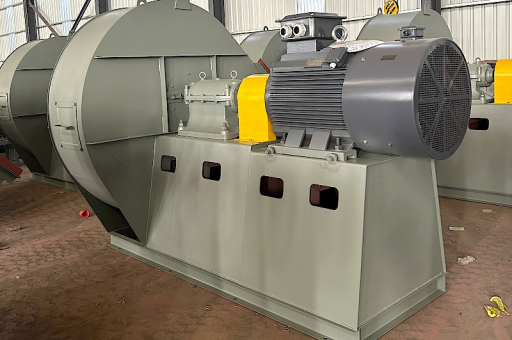
In heavy industries like woodworking, mining, and cement processing, airborne dust is not just a hygiene issue—it’s a safety hazard. A 22000 m³/h dust collector exhaust fan moves 22,000 cubic meters of air per hour, which is approximately the volume of a regulation-sized swimming pool being evacuated every 60 seconds. This capacity places it in the mid-to-high range for industrial ventilation systems. Unlike smaller fans that fail to capture fine particulate matter (PM2.5), or oversized models that waste energy, the 22000 m³/h unit offers a balanced solution. It effectively captures dust at source points (e.g., saws, grinders, conveyor transfer points) while maintaining enough static pressure to overcome duct resistance.
Key Insight: A study by the National Institute for Occupational Safety and Health (NIOSH) indicates that improper dust extraction is a leading cause of combustible dust explosions. A correctly sized fan, such as this model, reduces this risk by maintaining negative pressure in collection systems.
Technical Specifications: Understanding Airflow, Static Pressure, and Power
When evaluating a 22000 m³/h dust collector exhaust fan, three metrics define its performance:
- Airflow (Q): 22,000 m³/h at free air conditions. Under load (with filters and ducts), this can drop to 16,000-18,000 m³/h.
- Static Pressure (SP): Typically 2000-3500 Pa. Higher pressure allows pushing air through long ducts or high-efficiency cartridge filters.
- Motor Power: Usually 15-22 kW (20-30 HP) for direct-drive models; belt-driven units may require 18.5 kW to account for mechanical losses.
Table: Common Performance Curve Data
| RPM | Airflow (m³/h) | Static Pressure (Pa) | Power (kW) |
|---|---|---|---|
| 1450 | 22,000 | 1800 | 15 |
| 1750 | 22,000 | 2500 | 5 |
| 2900 | 22,000 | 3500 | 22 |
Important Note: The fan’s operating point must be matched to the system’s resistance curve. Running a fan at too high a static pressure can cause motor overload; too low and it will not capture dust effectively.
Key Design Features: Impellers, Housings, and Motor Configurations
Impeller Type:
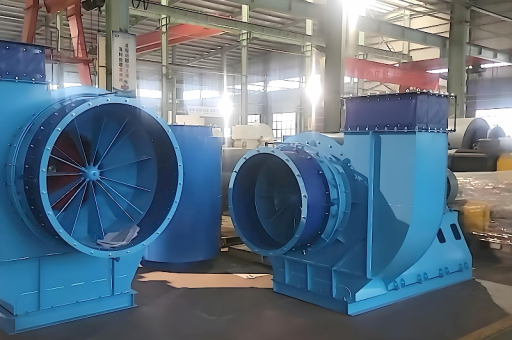
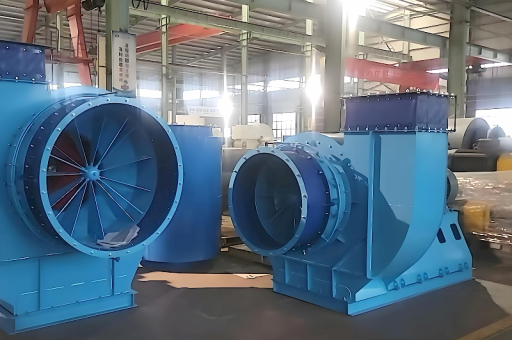
- Backward-Inclined (BI): Most common for dust-laden air. Self-cleaning blades prevent material buildup. Efficiency: 78-85%.
- Radial (Paddle Wheel): Used for sticky or fibrous dust (e.g., textile lint). Can handle larger particles but has lower efficiency.
Housing Material:
- Carbon Steel (standard): Cost-effective but susceptible to corrosion in wet environments.
- 304/316 Stainless Steel: Required for food processing, pharmaceutical, or chemical plants where hygiene is critical.
- Abrasion-Resistant Lining: For mining or sandblasting applications, internal coatings add 2-3 years to fan life.
Drive Configuration:
- Direct Drive (coupled): Fewer moving parts, easier maintenance, but RPM is fixed to motor speed.
- Belt Drive: Allows adjustment of fan speed via pulley changes to optimize airflow for changing ductwork or filter loading.
Question: Should I choose a direct drive or belt drive for my 22000 m³/h exhaust fan?
Answer: For constant dust load, direct drive is preferable (lower maintenance). For variable processes (e.g., multiple machines running intermittently), belt drive allows speed reduction to save energy—especially when used with a Variable Frequency Drive (VFD).
Applications: Where This Fan Excels
Woodworking Industry:
Sanding and routing stations generate fine wood dust that is explosive. A 22000 m³/h fan with a 1 μm filter can achieve 99.9% capture efficiency, meeting OSHA’s combustible dust standards. Example: A furniture factory with 10 sanding booths requires this capacity to maintain 0.5 m/s capture velocity at each hood.
Cement & Lime
Bulk loading and bagging operations produce calcium oxide dust. The fan must handle high temperatures (up to 120°C) and resist abrasion. A radial impeller with tungsten carbide coating prolongs service life.
Mining & Quarrying:
Conveyor transfer points are major dust sources. This fan, paired with a cyclone pre-separator, can reduce dust loading by 80% before air reaches the main filter.
Case Study: A Chinese tile manufacturer reduced its annual filter replacement cost by 40% by switching from three 7,500 m³/h fans to one 22000 m³/h fan with VFD control. The single unit allowed centralized ductwork and optimized energy use across production shifts.
Energy Efficiency & Compliance: How to Reduce Operational Costs
Operating a 22 kW motor for 8,000 hours/year at €0.12/kWh costs €21,120 annually. However, several strategies cut costs:
- VFD Installation: Reduces motor speed by 20% when demand drops (e.g., non-peak hours), saving 40-50% on energy.
- High-Efficiency Motors (IE4/IE5): Despite a 15-20% higher purchase price, they recover costs within 1-2 years through lower power consumption.
- Regular Filter Cleaning: A clogged filter increases static pressure, forcing the fan to work harder. Pressure drop below 1500 Pa indicates cleaning is needed.
Regulatory Compliance:
- EU: Directive 2009/125/EC requires fans to meet minimum efficiency grades (N ≥ 60 for this size).
- USA: OSHA 29 CFR 1910.107 mandates dust collection systems maintain negative pressure; the 22000 m³/h fan must include a pressure differential alarm.
Question: How do I calculate the payback period for a VFD on this fan?
Answer: Use the formula: Payback (years) = (VFD cost + installation) / (Annual kWh savings × electricity cost). For a €3,500 VFD installation saving 80,000 kWh/year at €0.12/kWh, payback is 3.6 years.
Installation Best Practices: Ductwork, Sound Dampening, and Safety
Duct Design:
- Maintain a transport velocity of 18-22 m/s to prevent dust settling.
- Use 150-200 mm diameter main ducts; reduce to 100-125 mm for branch lines.
- Avoid 90-degree elbows; use 45-degree or gentle radius bends to minimize pressure loss.
Sound Dampening:
A 22000 m³/h fan at full load generates 85-92 dBA. Solutions:
- Install a silencer (attenuator) on the discharge side—expect a 10-15 dBA reduction.
- Use flexible connections between fan and ductwork to isolate vibration.
- Place the fan on a concrete inertia base with neoprene pads.
Safety Features:
- Spark-resistant construction (Type C) for wood or metal dust.
- Explosion relief panel rated to 0.1 bar (compliance with ATEX Directive).
- Shut-off damper to isolate the fan during maintenance.
Maintenance Guide: Extending Fan Life and Preventing Downtime
Weekly Checks:
- Inspect impeller for erosion or dust buildup (unbalance causes vibration).
- Lubricate bearings using NLGI-2 grease; do not over-grease.
Monthly Tasks:
- Measure motor current (should be within 95% of nameplate rating).
- Clean pressure taps and verify manometer accuracy.
Annual Overhaul:
- Replace V-belts (belt drive models) if they show cracks or glazing.
- Tighten all fasteners on fan housing and inlet cone.
- Perform vibration analysis; peak velocity under 7 mm/s is acceptable.
Common Failure & Fix:
- Symptom: Fan runs but no suction. Cause: Reverse rotation (3-phase motors). Fix: Swap two power phases.
- Symptom: Overcurrent tripping. Cause: Duct blockage or filter saturation. Fix: Clear ducts and replace filters.
Question: How often should I replace the fan impeller?
Answer: With proper balancing and no abrasive materials, a steel impeller lasts 5-8 years. If handling abrasive dust (e.g., silica), inspect annually and replace when blade thickness reduces by 30%.
FAQ: Common Questions Answered by Industry Experts
Q: Can a 22000 m³/h fan handle 120°C air?
A: Yes, if ordered with a heat-resistant motor (Class F/H insulation) and high-temperature grease. Standard models are rated for 80°C; above that, derate by 5% per 10°C.
Q: What is the typical lifespan of this fan?
A: 10-15 years with proper maintenance. Key wear components: bearings (replace every 2-3 years) and impeller (5-8 years).
Q: Can I use this fan for welding fume extraction?
A: Yes, but you must install a spark arrestor and a high-efficiency filter (HEPA H13) because welding fume contains ultrafine particles (<1 μm). Standard dust collection filters may be insufficient.
Q: How do I calculate duct size for this fan?
A: Use the formula: Duct area (m²) = Flow rate (m³/h) / (3600 × velocity m/s). For 22,000 m³/h and 20 m/s, area = 0.306 m², so a diameter of 625 mm. Always size up slightly (650 mm) to reduce noise.
Q: Is a 22000 m³/h fan suitable for a paint booth?
A: No—paint booths require explosion-proof motors (ATEX Zone 1), grounded non-sparking impellers, and ductwork with fast-opening dampers. Standard dust collection fans may create ignition sources.