This article's table of contents introduction:
- Key Parameters (The "Specs")
- Fan Type Selection
- Critical Design Considerations (For 10,000 m³/h)
- Typical Application Examples for 10,000 m³/h
- How to Select the Right Fan (Step-by-Step)
- Summary Recommendation
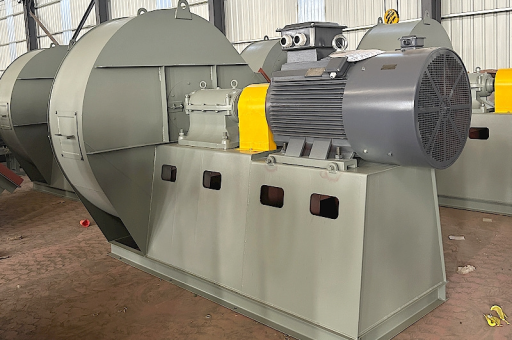
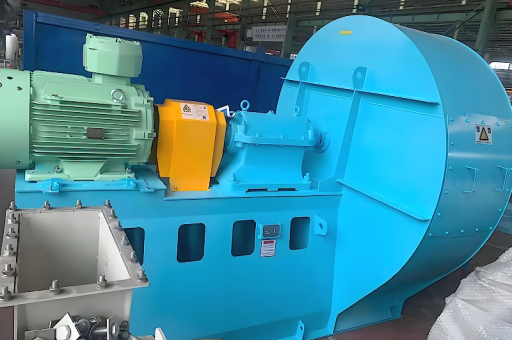
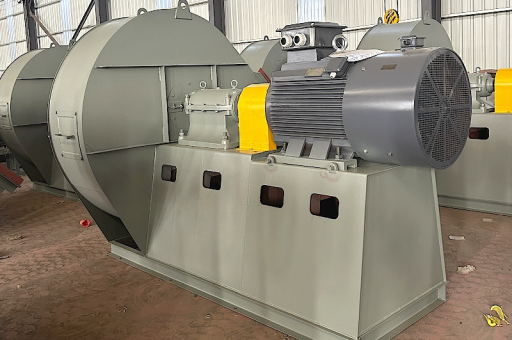
This is a common specification for an industrial dust collection system. A flow rate of 10,000 m³/h (cubic meters per hour) is a medium-sized system, often used in woodworking shops, cement plants, textile mills, or chemical processing.
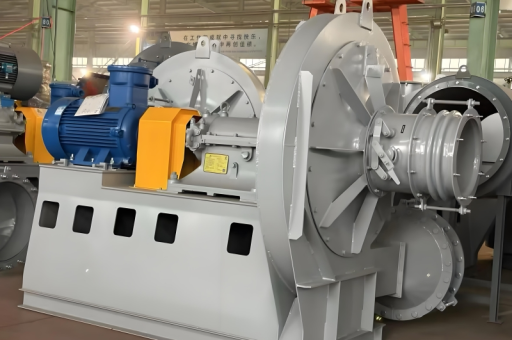
Here is the detailed breakdown of what you need to know about selecting and specifying a 10,000 m³/h dust removal induced draft fan.
Key Parameters (The "Specs")
To specify this fan correctly, you need Flow Rate (10,000 m³/h) and Pressure. The pressure is the unknown variable based on your ductwork.
- Flow Rate: 10,000 m³/h (equivalent to ~5,888 CFM).
- Static Pressure (SP): This is the most critical missing spec. It depends on duct length, diameter, elbows, and filter resistance.
- Typical ranges for 10,000 m³/h:
- Low Pressure (1,000 – 2,000 Pa): Simple systems, short ducts, few filters (e.g., local exhaust for welding fume).
- Medium Pressure (2,000 – 3,500 Pa): Standard baghouse or cartridge filter systems with moderate ductwork.
- High Pressure (3,500 – 5,000+ Pa): Long duct runs, dense material conveying, high-efficiency HEPA filters.
- Typical ranges for 10,000 m³/h:
- Power (Motor):
- Theoretical power: $P = (Q \times p) / \eta$
- Typical motor sizes for 10,000 m³/h:
- 2000 Pa: ~7.5 kW to 11 kW
- 3000 Pa: ~15 kW
- 4000 Pa: ~18.5 kW to 22 kW
Fan Type Selection
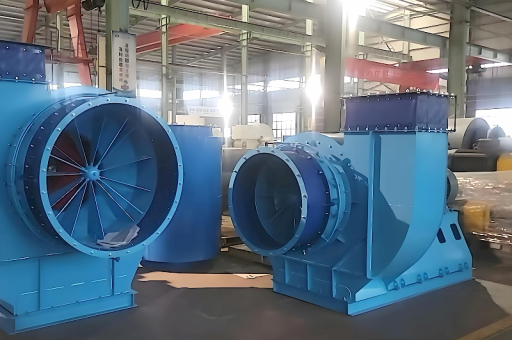
For dust removal, the fan wheel (impeller) design is critical to prevent material buildup and erosion.
| Fan Type | Best For | Why |
|---|---|---|
| Backward Curved (BC) | Best Overall | High efficiency, non-overloading power curve. Good for clean-ish air or fine dust. Most common for 10k m³/h. |
| Radial (Paddle Wheel) | Heavy/sticky dust | Robust, handles large particles, but lower efficiency. Easy to clean. |
| Forward Curved (Squirrel Cage) | NOT Recommended | Very inefficient for dust. Blades clog easily. Only for HVAC, not dust collection. |
| Plug Fan (Plenum Fan) | Space-saving | Compact, but requires an external enclosure for ducting. |
Recommendation: A Backward Curved (BC) or Backward Inclined (BI) fan with a heavy-duty steel wheel is the standard for this flow rate.
Critical Design Considerations (For 10,000 m³/h)
A. The "Pre-Separator" ( Cyclone or Drop-Out Box)
- Crucial: Do not send coarse sawdust, metal chips, or heavy particles directly into the fan impeller.
- Solution: Install a cyclone or a drop-out box before the fan. The fan should ideally be on the clean side of the filter (induced draft).
- Consequence of Failure: An unprotected 10k m³/h fan will quickly erode the blades, creating imbalance and vibration. A spark from a cutting wheel hitting the fan housing can cause a fire or explosion.
B. Variable Frequency Drive (VFD)
- Highly Recommended: A 10,000 m³/h fan motor (e.g., 15kW) is a significant load. Starting it across-the-line (DOL) causes massive electrical and mechanical stress.
- Benefits of VFD:
- Soft start (reduces belt/motor/shaft stress).
- Allows fine-tuning of airflow (you don't always need 100% flow).
- Crucial: Enables balancing of the system.
C. Construction Material
- Standard: Mild Steel (MS) with a corrosion-resistant paint (epoxy or powder coat).
- Upgrade: Stainless Steel (SS304 or SS316) for corrosive dust (e.g., chemical, pharmaceutical, food processing).
Typical Application Examples for 10,000 m³/h
- Woodworking: A central dust collection system for 4-6 large machines (planer, table saw, CNC router, sander). Requires a cyclone upstream.
- Cement/Lime: Conveying dust from a silo vent filter or a baghouse.
- Pharmaceutical/Checmical: Venting a reactor or drying oven through a cartridge filter.
- Welding Fume: A central system for 8-12 welding stations.
How to Select the Right Fan (Step-by-Step)
- Calculate Static Pressure (SP): Measure your duct length (both straight and equivalent length of elbows), filter manufacturer's clean/loaded pressure drop, and hood/slot entry loss. This is the hardest part.
- Use Selection Software: Fan manufacturers (e.g., Greenheck, New York Blower, Twin City Fan, or Chinese brands like Yilida, Shangfeng) have selection software. Input 10,000 m³/h and your calculated SP.
- Analogy Check: A 10,000 m³/h fan moving 3000 Pa is a serious piece of machinery. The motor will be ~15-18kW. The inlet/outlet size will typically be DN400 to DN500 (16" to 20" diameter).
- Sound Level: At full speed, this fan will likely generate 85-95 dB(A) . You must add a silencer (duct silencer) on the outlet to meet workplace noise regulations (typically <85 dB(A)).
Summary Recommendation
"Do Not Oversimplify."
A "10,000 m³/h fan" is not a standard off-the-shelf item. It must be matched to your system pressure.
- Action: Call a fan supplier and give them:
- "I need a fan for 10,000 m³/h at [Your Calculated SP] Pa."
- "It is for dust removal. The media is [Wood/Cement/Checmical]."
- "The pre-separator is a [Cyclone / None]."
If you skip the pressure calculation, you will buy a fan that either: (A) cannot move the air (undersized motor/wheel) or (B) uses twice the electricity needed and is incredibly loud (oversized motor/wheel).