This article's table of contents introduction:
- The Core Problem: Corrosive and Hazardous Gases
- Critical Material Selection (The Fan & Ductwork)
- Fan Type & Design
- Safety & Operational Considerations
- Checklist for Specification
- Summary (TL;DR)
It seems like you're asking about an exhaust fan system designed to handle both Hydrochloric Acid (HCl) fumes and Hydrofluoric Acid (HF) gas. This is a highly specific and dangerous industrial application.
Here is a critical breakdown of the engineering, safety, and material considerations for such a system.
The Core Problem: Corrosive and Hazardous Gases
- Hydrochloric Acid (HCl): Highly corrosive to most metals. Creates a corrosive mist.
- Hydrofluoric Acid (HF): Anhydrous HF is a gas. Liquid HF is extremely dangerous. It is highly corrosive to metals and attacks glass, silicone, and many ceramics.
- Combined Risk: A mixture containing HF is particularly aggressive because HF can "eat through" the passivation layer on stainless steel, allowing HCl to then attack the base metal.
Critical Material Selection (The Fan & Ductwork)
DO NOT USE standard PVC, standard polypropylene, or standard stainless steel for a mixed HCl/HF stream unless specifically tested and rated.
| Material | Suitability | Reason |
|---|---|---|
| PVDF (Kynar) | Excellent | Excellent chemical resistance to both HCl and HF. High temperature capability. Gold standard for HF. |
| ECTFE (Halar) | Excellent | Similar to PVDF. Often used for lining steel ducts. |
| PTFE (Teflon) | Excellent | Chemically inert. Used for gaskets, seals, and impeller coatings. |
| FRP (Fiberglass Reinforced Plastic) | Good (Special Resin) | Must use a Vinyl Ester or Furan resin with a Carbon-fiber veil or special glass that is HF-resistant. Standard glass fibers will be destroyed by HF. |
| Stainless Steel (304/316) | Very Poor | HF will attack the chromium oxide layer. HCl will cause pitting. It will fail rapidly. |
| Polypropylene (PP) | Marginal / Poor | PP is attacked by concentrated HCl and has a low temperature limit. Not recommended for HF service. |
Our Recommendation: PVDF (Kynar) solid construction for the fan housing and impeller, or a PTFE-lined steel fan. Ductwork should be PVDF, ECTFE-lined steel, or special FRP (with carbon veil) .
Fan Type & Design
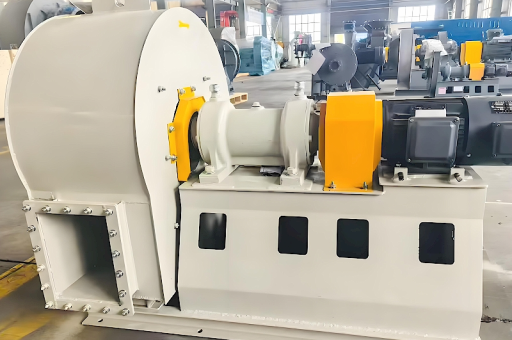
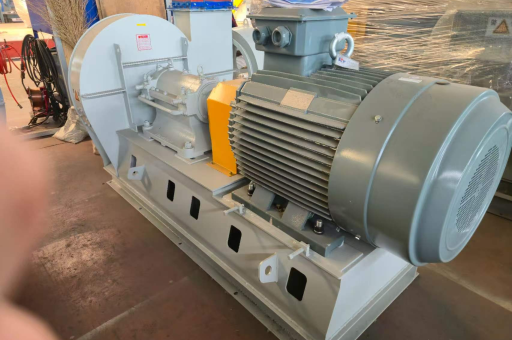
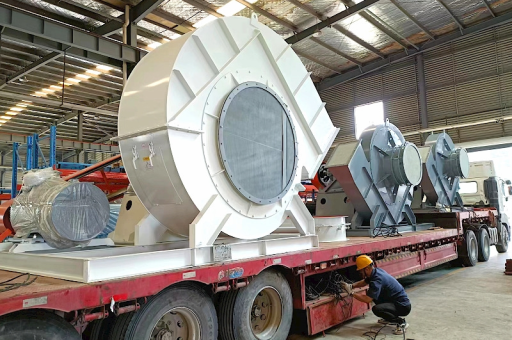
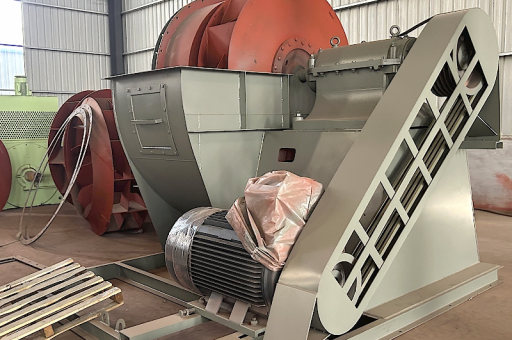
- Fan Type: Centrifugal (Radial) fan is preferred over axial fans.
- Radial: Handles higher static pressure needed for scrubbers/long duct runs. Blades are typically backward-curved or open-paddle wheel.
- Motor: Must be TEFC (Totally Enclosed Fan Cooled) or better yet, a C-face motor mounted outside the airstream to protect it from corrosive gases.
- Shaft Seal: Use a Teflon (PTFE) lip seal or a mechanical seal with a purge port (air purge) to prevent gas from traveling along the shaft into the bearings.
- Impeller: Must be fully encapsulated in PVDF or made of solid PVDF/Halar.
Safety & Operational Considerations
-
Explosion-Proof (Hazardous Location):
- Check if the concentration of HF gas could reach explosive limits (typically not, but hydrogen gas from the acid reactions can be generated).
- Motor: Class I, Division 2 or Class I, Division 1 depending on the specific gas and local codes.
- Electrical: All wiring, starters, and disconnect switches must be rated for the area.
-
Emergency Shutdown & Alarms:
- High Temperature: HF/HCl reactions can generate heat. A high-temperature sensor in the duct should trigger a shutdown or dilution.
- Flow Switch: Install a flow switch to ensure the fan is running before chemical processes begin. If flow stops, chemicals must be valved off.
- Vibration Monitor: Corrosion can unbalance the impeller.
-
Fire Suppression:
The ductwork should have a fire damper (or chemical suppression) system, especially if the duct runs through walls to an SCRUBBER.
-
Scrubber Interface:
- The exhaust fan MUST be on the clean side of the scrubber (downstream) or the fan itself must be the scrubber type (e.g., a centrifugal fan where the housing acts as a scrubber). Never push raw HF/HCl gas through a fan if you can avoid it.
Checklist for Specification
When ordering or designing this system, provide these specs:
- Airflow (CFM): e.g., 500 CFM
- Static Pressure (inches w.g.): e.g., 4" w.g.
- Gas Temperature: e.g., 120°F (49°C)
- Gas Composition: "Mix of HCl gas up to 10% and HF gas up to 5% in air"
- Moisture Content: "Saturated with water vapor / Wet"
- Duct Material: "PVDF Schedule 80"
- Fan Material: "Solid PVDF (Kynar) housing & impeller"
- Motor: "5 HP, TEFC, 208-230/460V, 3-phase, Class I Div 2" (if required)
- Mounting: "Inlet/Outlet flanged, 4" diameter"
- Accessories: "Teflon shaft seal, drain plug (if wet)"
Summary (TL;DR)
- Do not use standard PVC, Polypropylene, or Stainless Steel.
- Use PVDF (Kynar) or ECTFE (Halar) for the fan and ductwork.
- Place the fan downstream of a scrubber (clean side) if possible.
- Include safety interlocks (flow, temperature, vibration).
- Consult a qualified corrosion engineer and the fan manufacturer (e.g., Plast-O-Matic, Vanton, Magnatex, or a local FRP specialist like Fiber-Aire or DualDraw).
Disclaimer: I am an AI, not a chemical engineer. Handling HF and HCl is extremely dangerous and requires a Process Safety Management (PSM) review, engineering controls, and compliance with OSHA (29 CFR 1910.119) and local codes. Always work with a licensed professional engineer experienced in handling these gases.