
This article's table of contents introduction:
- The System Interaction
- Types of Fans Involved
- Critical Challenges & Solutions
- Specific Fan Types for FGD Services
- "Material Handling" Specifics for FGD
- Key Selection Criteria
This is a specific industrial engineering topic, typically found in coal-fired power plants, steel mills, cement plants, or chemical processing facilities. Your query links three distinct components: Material Handling, Flue Gas Desulfurization (FGD) , and Industrial Boiler Fans.
Here is a technical breakdown of how these interact, the specific types of fans used, and critical design considerations.
The System Interaction
The flow is usually: Boiler $\rightarrow$ Air Heater $\rightarrow$ Particulate Scrubber (ESP/Baghouse) $\rightarrow$ FGD System $\rightarrow$ Induced Draft (ID) Fan $\rightarrow$ Stack
The "Material Handling" aspect refers to the transport of the sorbent (limestone, lime) into the FGD and the byproduct (gypsum) out of the FGD.
Types of Fans Involved
Depending on the system design, you will find these fan types:
A. FGD Booster Fan
- Role: Overcomes the pressure drop across the FGD absorber tower (typically 15–25 in. w.g. or 3.7–6.2 kPa).
- Location: Placed before (Duct/Combustion Air) or after (Induced Draft) the scrubber. Post-scrubber fans handle wet gas.
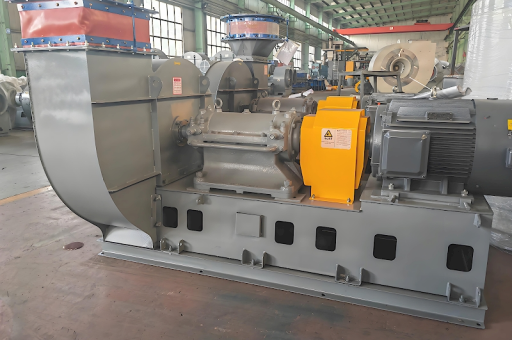
- Design: Often centrifugal, single or double inlet. Must be corrosion-resistant (stainless steel or rubber/FRP lined).
B. Oxidation Air Blower (in Forced Oxidation FGD)
- Role: Forces air into the bottom of the scrubber sump to oxidize calcium sulfite into marketable gypsum.
- Type: High-pressure Centrifugal or Roots Blower.
- Spec: Pressure often 50–100+ psig (3.5–7 bar) to overcome hydrostatic head.
C. Limestone / Gypsum Material Handling Fans
- Role: Conveying dried or pulverized material.
- Type: High-pressure pneumatic conveying blower (Roots type or Multistage Centrifugal).
- Note: These are auxiliary fans, separate from the main boiler draft system.
Critical Challenges & Solutions
When selecting or troubleshooting a fan in this service, these are the three biggest issues:
Corrosion (The #1 Enemy)
- Problem: Flue gas leaves the scrubber saturated with water vapor and contains residual $H_2SO_4$ (below acid dew point).
- Solution:
- Housing: FRP (Fiber-Reinforced Plastic), Rubber-lined carbon steel, or Duplex stainless steel (e.g., 2205).
- Impeller: High-alloy stainless steel (254 SMO) or titanium.
Abrasion (Material Handling)
- Problem: Unreacted limestone or gypsum carryover erodes the impeller.
- Solution:
- Hard-facing: Weld overlay with Tungsten Carbide or Stellite on the impeller leading edges.
- Inlet Design: Use of wear liners in the inlet box.
Erosion (Wet Gas Issues)
- Problem: In Post-FGD ID fans, water droplets cause pitting and balancing issues.
- Solution:
- Drain Holes: Impeller blades must have drain holes to prevent pooling of water.
- Speed: Lower tip speeds (Max < 150 m/s or 500 ft/s) to reduce droplet impact velocity.
Specific Fan Types for FGD Services
| Application | Fan Type | Key Feature |
|---|---|---|
| Booster Fan (Dry side) | Backward-Curved Centrifugal | High efficiency, handles dirty gas before scrubber. |
| Booster Fan (Wet side) | Axial (Variable Pitch) or Radial Tipped Centrifugal | Handles high volume, low pressure; can adjust flow. |
| Oxidation Air Blower | Multistage Centrifugal or Roots | High pressure (50+ psi), oil-free air. |
| Material Handling (Dust) | Roots Blower or Regenerative Blower | Constant volume, must have air filtration. |
"Material Handling" Specifics for FGD
If you are specifically designing the pneumatic conveying system for Limestone Unloading or Gypsum Disposal:
- Limestone Feed: Roots blowers (positive displacement) are standard.
- Pressure: 15–20 psig (1.0–1.4 bar)
- Key: Must handle abrasive powder. Requires a silencer (due to noise) and a relief valve.
- Gypsum Removal: Usually done via belt conveyor (not pneumatic), but if pneumatic:
- Problem: Gypsum is sticky and hygroscopic. It will clog if cooled below dew point.
- Solution: Use dense phase conveying (low velocity, high pressure) rather than dilute phase.
Key Selection Criteria
If you are buying an FGD Fan or Blower for this system, provide these parameters to the manufacturer:
- Gas Composition: Is it before or after the scrubber? (Wet vs. Dry).
- Temperature: FGD inlet is ~140°F (60°C) typical. Booster fans are usually ~250-300°F (120-150°C).
- Particulate Load: Mg/Nm³ of dust entering the fan (determines erosion rate).
- Turndown Ratio: You need to vary flow as the boiler load changes (Variable Frequency Drive or Inlet Guide Vanes).
- Byproduct: Is the material handling system conveying limestone, gypsum, or both?
Recommendation: If you are designing an FGD Booster Fan, go with a centrifugal, single-inlet fan with a backward-curved impeller, housing made of Corten steel (for dry side) or Rubber-lined carbon steel (for wet side), and a Variable Frequency Drive (VFD) for energy savings.
If you are selecting the Material Handling Blower, a Tri-lobe Roots Blower (for limestone) or a Screw Compressor (for dense phase gypsum) is standard.





