
This article's table of contents introduction:
- The "Long Lifetime" Requirements (The Engineering Challenge)
- Critical "High Temperature" Materials
- Design Features for "Long Lifetime"
- Common Applications (Materials Cooling)
- How to Specify This Fan (For Procurement)
- Summary Recommendation
This is a highly specific product query, likely for an engineer or procurement specialist in heavy industries like cement, steel, power generation, or glass manufacturing.
The core requirement is for a fan that can operate continuously at high temperatures (often 250°C to 600°C+) without warping, oxidizing, or suffering from bearing failure, while maintaining structural integrity at high rotational speeds (centrifugal force).
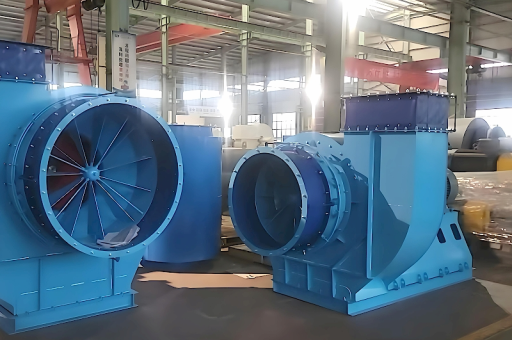
Here is a technical breakdown of what constitutes a Long Lifetime Industrial Centrifugal Fan for High Temperature Materials Cooling, including the critical design features, materials, and common pitfalls.
The "Long Lifetime" Requirements (The Engineering Challenge)
Standard fans fail in high-temp applications due to three primary factors:
- Creep & Warping: Metal loses strength and sags over time.
- Oxidation (Scaling): Rusting speeds up dramatically above 400°C.
- Thermal Expansion Mismatch: Bearings lock up or seals break due to different expansion rates.
- Resonance: Material stiffness changes with temperature, causing the fan to pass through natural frequencies during start-up/shut-down.
Critical "High Temperature" Materials
The selection of materials defines the fan's lifespan. You cannot use standard mild steel (Q235) for long-term high-temp use.
| Component | Standard Material | High-Performance Material (for Long Life) | Temp Limit (Continuous) |
|---|---|---|---|
| Impeller | Q235 / SS304 | 15Mo3 (P265GH) or Hastelloy X | 450°C – 700°C |
| Stainless 310S (For highly oxidizing environments) | 500°C – 800°C | ||
| Shaft | 45# Steel | 42CrMo4 (For strength at temp) | 400°C |
| Inconel 718 (For extreme temp + strength) | 650°C+ | ||
| Housing | Q235 | Q345R (Boiler plate) or 25Cr-0.5Mo | 450°C – 600°C |
| Bearings | Standard ball | SKF High-Temp (VXL or similar) or RHP | 200°C (with cooling) |
| Shaft Seal | Rubber | Graphite braided packing or PTFE / Viton (FP) | 250°C – 350°C |
Key Insight: For long life above 400°C, the impeller must be made of alloy steel (like 15Mo3 or Corten) or 310S stainless. Mild steel will scale (flake) rapidly, shortening life to months or weeks.
Design Features for "Long Lifetime"
A. The Cooling System (Most Critical for Bearings)
Bearing life is the #1 limiting factor. You cannot just use "high-temp grease."
- Shaft Cooling: The shaft extending from the hot housing to the bearings must be cooled.
- Radiation Discs (or Heat Shedders): Finned metal discs attached to the shaft between housing and bearing. They radiate heat away.
- Forced Air Cooling: A small dedicated fan blows air over the shaft and bearing housing.
- Water Jacket (for >300°C): Circulating cool water around the bearing housing. This is mandatory for continuous operation above 350°C.
B. Impeller Design (Stress Management)
- Conical Hub: A conical (tapered) hub is better than a flat one. It reduces stress concentration as the metal expands.
- Backward Curved Blades: Generally better for high-temp / high-pressure applications as they are less prone to stall and vibration.
- Expansion Slots: The impeller shroud (inner/outer ring) should have slots or be split to allow for thermal expansion without warping.
- High-Strength Welding: Use weld rods rated for the specific alloy (e.g., P92 rods for creep-resistant steels).
C. Vibration Control
- Dynamic Balancing: Must be done at operating temperature (or with a sophisticated thermal growth calculation). A fan balanced cold will vibrate at 400°C.
- Structural Stiffness: The base frame must be heavily gusseted and made from H-beams (not angle iron) to prevent thermal deflection.
Common Applications (Materials Cooling)
This type of fan is typically used in:
- Cement Plants: Clinker cooler fans (extreme hot gas, dusty).
- Steel Mills: Hot strip mill cooling, EAF furnace roof fans.
- Glass Industry: Float bath cooling, annealing lehr cooling.
- Power Plants: Induced Draft (ID) fans handling flue gas.
- Incinerators: Combustion air fans.
How to Specify This Fan (For Procurement)
If you are buying this, do not just say "High Temp Fan." Use this checklist:
- Gas Temperature: Continuous (e.g., 350°C) & Peak (e.g., 450°C for 20 minutes).
- Gas Composition: Clean? Dusty? (Abrasive). Corrosive? (Sulfur, Chlorine).
- Volume (CFM/m³/hr): ________
- Pressure (SP/mmWG): ________
- Impeller Material: (e.g., "310S Stainless, fully stress-relieved")
- Shaft Seal Type: (e.g., "Graphite packing with air purge")
- Bearing Cooling: (e.g., "Integral water jacket, flow rate 5 LPM")
- Balance Grade: (e.g., "G2.5 at operating temp")
Summary Recommendation
For a Long Lifetime fan in a Materials Cooling application (e.g., clinker cooler or furnace cooling):
- Choose: A manufacturer specializing in "Separable Bearing Housings" with a water-cooled shaft.
- Impeller: Must be 15Mo3 (for up to 450°C) or 310S (for >450°C).
- Motor: Must have a cooling fan capable of operating in a hot environment (often requires a separate IP55 rated forced cooler).
- Maintenance: Plan for bearing replacement every 2-3 years depending on duty cycle. The impeller should last 5-10 years.
If you need a specific recommendation, provide the gas temperature and dust load (mg/Nm³) – that dictates the alloy and erosion protection (e.g., tungsten carbide coating or wearing strips).





