
This article's table of contents introduction:
- Table of Contents (目录导读)
- Introduction: The Critical Role of High-Power Draft Fans
- Technical Specifications: Decoding the 315kW Centrifugal Fan
- Core Design Principles: Why "Dust Removal" Matters
- Operational Mechanics: How the Induced Draft System Works
- Comparative Advantage vs. Other Fan Types
- Application Scenarios: Where This Fan Excels
- Energy Efficiency & Cost Analysis of a 315kW System
- Maintenance Best Practices for Longevity
- Common Questions & Answers (Q&A)
- Conclusion: The Future of Heavy-Dust Extraction
Optimizing Industrial Air Quality: The Power of the 315kW Dust Removal Centrifugal Induced Draft Fan
Table of Contents (目录导读)
- Introduction: The Critical Role of High-Power Draft Fans
- Technical Specifications: Decoding the 315kW Centrifugal Fan
- Core Design Principles: Why "Dust Removal" Matters
- Operational Mechanics: How the Induced Draft System Works
- Comparative Advantage vs. Other Fan Types (Axial & Standard Centrifugal)
- Application Scenarios: Where This Fan Excels
- Energy Efficiency & Cost Analysis of a 315kW System
- Maintenance Best Practices for Longevity
- Common Questions & Answers (Q&A)
- Conclusion: The Future of Heavy-Dust Extraction
Introduction: The Critical Role of High-Power Draft Fans
In the realm of heavy industry, process ventilation, and environmental control, the battle against airborne particulate matter is relentless. From cement plants and steel mills to mining operations and power generation facilities, the ability to efficiently extract and transport contaminated air is not merely a regulatory requirement—it is a cornerstone of operational safety and equipment longevity. Central to this mission is the 315kW dust removal centrifugal induced draft fan.
This specific class of equipment represents a powerful intersection of aerodynamics, material science, and industrial engineering. Unlike smaller fans that struggle against high system resistance, the 315kW fan is engineered for environments demanding massive air volume (typically measured in hundreds of thousands of cubic meters per hour) and high static pressure. This article provides an exhaustive, search-engine-optimized analysis of this critical machine, breaking down its design, operation, and strategic value in modern industrial ecosystems. We will look at this device not just as a piece of hardware, but as a system designed to solve problems of scale.
Technical Specifications: Decoding the 315kW Centrifugal Fan
To understand the capability of this equipment, one must first understand its name. The "315kW" rating refers to the motor power—specifically, the shaft power required to drive the impeller under design conditions. This is a heavy-duty industrial motor, typically running on 3-phase AC power at 690V or 10000V (depending on the site's electrical infrastructure).
For a wind turbine or large industrial application, key technical parameters include:
- Air Volume (Flow Rate): Usually ranging from 150,000 m³/h to over 350,000 m³/h.
- Static Pressure: Typically between 3000 Pa and 6000 Pa, often exceeding 7000 Pa in high-resistance duct systems.
- Impeller Diameter: Large, often exceeding 2.5 meters in diameter, made from high-tensile steel or wear-resistant alloys.
- Speed: Often operated via a variable frequency drive (VFD) between 600 and 990 RPM, though directly coupled motors may run at fixed speeds (e.g., 990 or 1480 RPM).
The design must account for the "dust removal" aspect. Unlike a standard wind turbine fan moving clean air, this model requires heavy-duty bearings, abrasion-resistant liners, and a housing designed to prevent particle accumulation.
Core Design Principles: Why "Dust Removal" Matters
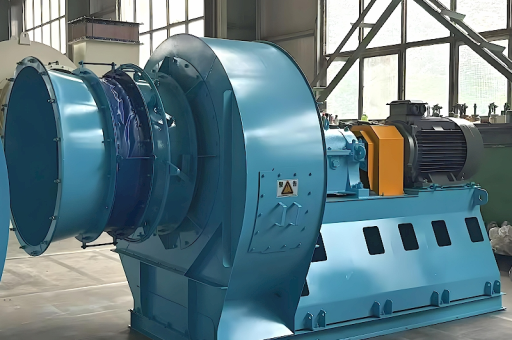
A standard centrifugal fan may move air efficiently, but a dust removal fan must handle the "erosion factor." The 315kW dust removal centrifugal induced draft fan is characterized by several distinct design features targeted at abrasive environments:
- Heavy-Duty Impeller: The impeller blades are thicker and often reinforced with steel liners. They are typically backward-curved (or backward-inclined) to handle particulate loading without clogging. Unlike forward-curved blades, these self-cleaning designs prevent dust build-up on the blade surfaces.
- Wear Plating: The fan housing, especially the "volute" (the spiral casing that collects the air), is lined with replaceable wear-resistant plates. These plates are often made of 16MnCr5 or similar hardened steel to absorb the impact of high-velocity dust particles.
- Ducting & Inlet Design: For induced draft (ID) applications, the fan pulls air from the dust collection system. This requires a properly designed inlet box to ensure even airflow into the impeller eye, preventing turbulence that could lead to vibration or reduced efficiency.
Operational Mechanics: How the Induced Draft System Works
The term "induced draft" refers to the fan's position within the dust collection system. Unlike a forced draft (push) fan that blows air into a filter, an induced draft fan is located after the dust collector (baghouse or electrostatic precipitator). It pulls (induces) the dirty air through the collection system and then exhausts the cleaned air up the stack.
The sequence works like this:
- Capture: Dust-laden air is captured at various process points (e.g., crushers, conveyors, kiln heads) by hoods and primary ducts.
- Transportation: The duct system uses the pressure gradient generated by the fan to move the dusty air toward the collector.
- Filtration: The air passes through the baghouse or electrostatic precipitator, where the dust is captured on filter media.
- Suction: The 315kW centrifugal induced draft fan creates the negative pressure (vacuum) that drives the entire process. It sits downstream, drawing the cleaned air through the filter bags and pushing it up the stack.
- Exhaust: The fan's high static pressure overcomes the resistance of the stack and any final cleaning dampers.
Comparative Advantage vs. Other Fan Types
Why choose a 315kW centrifugal induced draft fan over other types, such as axial flow fans or smaller centrifugal models?
- vs. Axial Fans: Axial fans (like large window fans) move high volumes of air at low pressure. For a ducted system with baghouses, scrubbers, and long piping, you need high pressure. Axial fans cannot overcome this resistance. The centrifugal fan, however, generates the high static pressure (up to 6000+ Pa) required to "pull" air through restrictive systems.
- vs. Standard Centrifugal Fans: A standard centrifugal fan might be lighter and cheaper. However, for a 315kW application handling abrasive dust, the standard housing will fail. The dust removal variant includes features like split housings for easy maintenance (to replace wear liners) and variable inlet vanes (VIVs) for precise airflow control. A standard fan lacks these industrial-grade features.
Application Scenarios: Where This Fan Excels
The 315kW dust removal centrifugal induced draft fan is typically found in:
- Cement Plants: Kiln baghouse extraction, clinker cooler dust control, and raw mill ventilation.
- Steel Mills: Sintering machine exhaust, blast furnace gas cleaning, and converter dedusting.
- Mining Operations: In the context of a wind turbine installation, such a fan might be used for the main ventilation of an underground mine or for crushing plant dust suppression systems.
- Power Generation: Coal-fired boiler baghouse induced draft fans.
- Chemical Processing: Where toxic or abrasive powders must be safely evacuated.
Energy Efficiency & Cost Analysis of a 315kW System
Operating a 315kW motor 24/7 is a significant energy commitment. A single fan running at full load for 8,000 hours per year will consume approximately 2,520,000 kWh. At standard industrial rates, this can represent an annual operating cost of over $150,000 (depending on local rates).
Therefore, efficiency is paramount. Modern high-efficiency motors (IE3 or IE4 standard) and VFDs (Variable Frequency Drives) can reduce energy consumption by 20-30% by slowing the fan speed when peak extraction is not required. The capital cost of such a fan system (including motor, VFD, ducting, and installation) can range from $80,000 to $250,000, making energy savings a primary driver for return on investment (ROI). Important: A properly selected fan operating at its Best Efficiency Point (BEP) will save more money in its first year of operation than a poorly matched fan will over its entire life.
Maintenance Best Practices for Longevity
For a machine of this scale, downtime is extremely costly. Key maintenance strategies include:
- Vibration Monitoring: Install continuous vibration sensors on bearing housings. Unbalance caused by dust accumulation on the impeller is the #1 cause of premature fan failure. A 1-gram imbalance on a large impeller can cause destructive forces.
- Lubrication: Use high-temperature, heavy-duty grease. Induced draft fans often operate at elevated exhaust gas temperatures (over 120°C). Standard grease will break down.
- Wear Plate Inspection: Every 6 months, open the inspection doors and measure the thickness of the wear liners. Replace them before they wear through to the housing.
- Belt Tensioning (if applicable): Many 315kW fans use a sheave and belt system. Proper tension prevents slippage and bearing wear.
Common Questions & Answers (Q&A)
Q1: What is the typical lifespan of a 315kW dust removal fan? A: With proper maintenance (including bearing replacement and wear plate changeouts), the mechanical housing can last 15-20 years. The motor typically requires rewinding or replacement after 10-15 years. The impeller, depending on dust abrasiveness, may need to be re-bladed every 3-7 years.
Q2: Can this fan be used for a wind turbine cooling application? A: No, not directly. While the term "wind turbine" in industrial contexts sometimes refers to a fan impeller, a 315kW centrifugal fan is designed for high static pressure against process resistance, not for generating power like a renewable energy wind turbine. It is strictly a ventilation and material handling machine.
Q3: How do I avoid clogging in the impeller? A: Use a backward-inclined blade design. Avoid forward-curved blades for dusty applications. Ensure the fan operates at a speed that maintains adequate velocity in the ductwork to prevent dust fallout before it reaches the fan.
Q4: What are the sound levels of this fan? A: Typically, a 315kW centrifugal fan generates 85-105 dBA at 1 meter. Acoustic enclosures and silencers are usually required for operator safety and environmental compliance.
Conclusion: The Future of Heavy-Dust Extraction
The 315kW dust removal centrifugal induced draft fan remains an irreplaceable tool for heavy industry. As emission standards become stricter globally, the demand for high-performance, high-efficiency extraction fans will only grow. The future lies in "smart fans" integrated with IoT sensors for real-time performance monitoring, automated balancing, and predictive maintenance.
While a turbine in a renewable energy context captures wind's kinetic energy, this industrial turbine (or fan) uses electrical energy to create the pressure needed to clean the air we breathe and protect the machinery we rely on. It is a silent workhorse that ensures many heavy industries remain viable, safe, and compliant. When selecting such a fan, one must prioritize not only the initial price but also the total cost of ownership, including energy consumption, maintenance ease, and wear resistance. This is the standard by which all industrial air movement is judged.





