This article's table of contents introduction:
- Table of Contents (目录导读)
- Introduction: Why 800℃ Fans Matter in Extreme Environments
- Core Technology: Materials and Engineering Behind 800℃ Heat Resistance
- Key Performance Parameters: Flow, Pressure, and Thermal Stability
- Critical Application Scenarios
- Common Challenges & Troubleshooting (Q&A Section)
- Selection Criteria: How to Choose the Right 800℃ Centrifugal Fan
- Maintenance Best Practices for Longevity
- Conclusion & Future Trends
*The Essential Guide to 800℃ High-Temperature Centrifugal Exhaust Fans: Design, Applications, and Industry Solutions*
Table of Contents (目录导读)
- Introduction: Why 800℃ Fans Matter in Extreme Environments
- Core Technology: Materials and Engineering Behind 800℃ Heat Resistance
- Key Performance Parameters: Flow, Pressure, and Thermal Stability
- Critical Application Scenarios: From Industrial Furnaces to Fire Safety
- Common Challenges & Troubleshooting (Q&A Section)
- Selection Criteria: How to Choose the Right 800℃ Centrifugal Fan
- Maintenance Best Practices for Longevity
- Conclusion & Future Trends
Introduction: Why 800℃ Fans Matter in Extreme Environments
In the world of industrial ventilation and thermal management, few components face as extreme a challenge as the 800℃ high-temperature centrifugal exhaust fan. Unlike standard fans that fail at temperatures above 300°C, these specialized units are engineered to handle continuous operation at red-hot conditions—where even steel begins to glow and lose structural integrity.
These fans are predominantly used in metal smelting plants, glass manufacturing lines, cement kilns, chemical reactors, and fire simulation test chambers. Without them, toxic flue gases, superheated air, and corrosive fumes would accumulate, leading to equipment failure, safety hazards, and halted production. The 800℃ rating is not arbitrary—it represents the threshold where ordinary carbon steel (which softens at ~425°C) is replaced by high-alloy stainless steels such as 310S (1.4845) or Inconel 625.
Did you know? The 800℃ figure refers to the continuous inlet gas temperature. Peak operation can briefly reach 850–900°C, provided the fan is properly cooled and constructed.
Core Technology: Materials and Engineering Behind 800℃ Heat Resistance
Building a fan that endures 800℃ involves a marriage of metallurgy and aerodynamics. Here is what sets these fans apart from standard centrifugal models:
-
Impeller & Shaft Material: The impeller is typically fabricated from stainless steel 310S (25% Chrome, 20% Nickel) or Inconel 718. These materials retain tensile strength and creep resistance even at 800℃. For extreme chemical + heat exposure, ceramic-coated impellers are used.
-
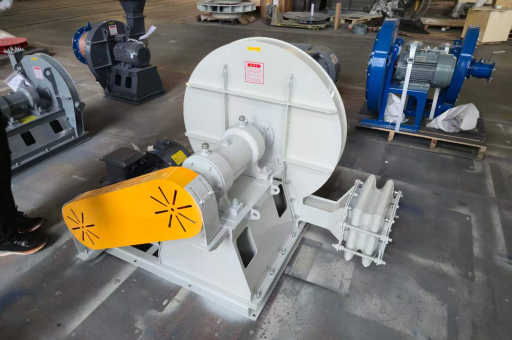
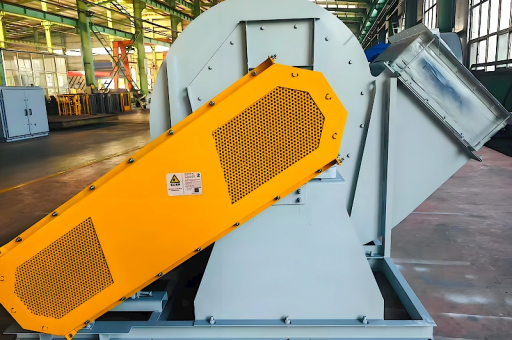
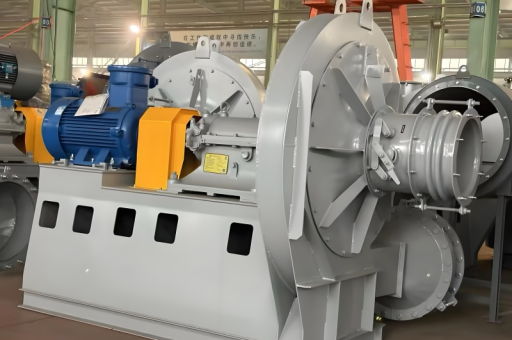
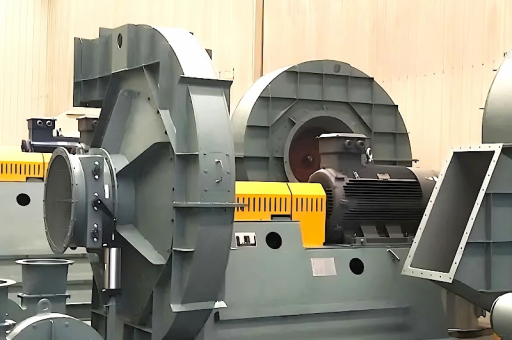
Shaft Cooling System: Heat travels along the shaft toward the motor. To prevent bearing damage, an external forced-air cooling wheel is installed on the shaft between the impeller and the motor. This wheel draws ambient air to create a cooling barrier.
-
Bearing Housing & Lubrication: The bearing housing is separated from the hot gas path by a long thermal isolation base. High-temperature grease (e.g., Kluber Petamo GHY 133 N) or oil circulation cooling is mandatory. Some designs include water-cooling jackets for the bearing housing.
-
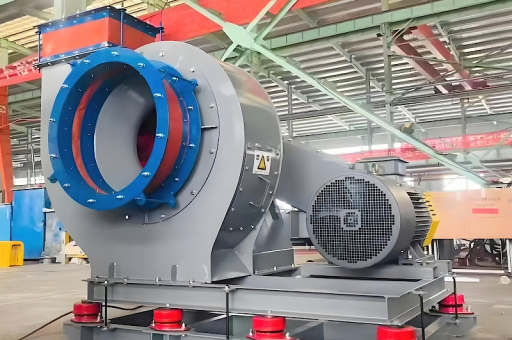
Housing Expansion Joints: Because metal expands when heated, the fan housing is designed with radial expansion slots or bellows to prevent thermal stress cracking.
-
Motor Separation: In most 800℃ fan designs, the motor is directly coupled but mounted on a common base with a thermal barrier plate. Alternatively, a belt-driven configuration further isolates the motor.
Question: Can a standard centrifugal fan be modified to handle 800℃?
Answer: No. Retrofitting a standard fan with high-temp components is unsafe and inefficient. The entire weld structure, balancing, and thermal expansion tolerances must be calculated from scratch. Always purchase a dedicated high-temp model.
Key Performance Parameters: Flow, Pressure, and Thermal Stability
When specifying an 800℃ centrifugal exhaust fan, several metrics must be aligned with your system’s requirements:
| Parameter | Typical Range for 800℃ Operation | Explanation |
|---|---|---|
| Inlet Temperature | 800℃ continuous (850℃ peak) | Beyond this, refractory metals (e.g. Hastelloy) may be required. |
| Air Volume (Flow) | 500 – 200,000 m³/h | Lower volume at higher temperature due to air density reduction. |
| Static Pressure | 1,000 – 15,000 Pa | Higher pressure needed to overcome flue gas resistance in ducts. |
| Impeller Speed | 1,450 – 2,900 RPM | Speed influences noise and bearing life. Lower speeds recommended for durability. |
| Motor Power | 5 kW – 400 kW | Power is higher than cold applications because hot gas is less dense but requires more torque. |
Important Note: At 800℃, the density of air is roughly one-third of its density at 20℃. This means the fan moves the same mass flow but at a much higher volumetric rate. Therefore, motor power selection must account for this derating factor.
Critical Application Scenarios
-
Metal Smelting Furnaces (Steel, Copper, Aluminum):
Exhausting high-temperature fumes from electric arc furnaces (EAFs) or ladle furnaces requires fans that can survive flying sparks, molten metal droplets, and thermal shock. -
Glass & Ceramics Kilns:
During glass melting (up to 1700°C), post-combustion gases are typically extracted at 600–800°C after heat recovery systems. The fan must handle silica dust and alkali vapors. -
Cement & Lime Rotary Kilns:
The preheater tower exhaust gases reach 800–900°C. Fans here must be constructed with abrasion-resistant liners because of limestone particles. -
Waste Incineration & Pyrolysis:
Municipal and hazardous waste incinerators produce acidic, corrosive exhaust gases at high temperature. The fan is often downstream of a heat exchanger but still sees 600–750°C peaks. -
Fire Test & Simulation Chambers:
UL 1709 fire testing requires fans to operate continuously during a hydrocarbon pool fire (up to 1100°C). While not all fans are rated for that extreme, 800℃ fans are often used for ISO 834 cellulosic fire curve tests.
Question: Do high-temperature fans require special starters or variable frequency drives (VFDs)?
Answer: Yes. Soft starters or VFDs are strongly recommended to avoid mechanical shock during cold start. Additionally, VFDs allow controlled ramp-up to prevent thermal stress on cold impellers.
Common Challenges & Troubleshooting (Q&A Section)
Q1: Why does my 800℃ fan vibrate excessively after a few months?
A: Thermal imbalance is the most common cause. Even a small accumulation of dust (unevenly heated) can cause the impeller to shift. Solutions: (1) Install a balance correction weight flange (2) Use self-cleaning impeller blades (3) Schedule regular thermal balancing.
Q2: What happens if the cooling fan on the shaft fails?
A: The bearing housing temperature will spike. If it exceeds 90°C, the grease degrades, and the bearing seizes. Install a thermal cutout sensor that shuts down the motor if housing temperature > 100°C.
Q3: Can I use a variable speed drive to reduce fan speed at lower temperatures?
A: Better to maintain constant speed. Reducing speed at high temperatures may lead to backflow or insufficient cooling across the shaft. Instead, use a damper or inlet guide vanes for flow control.
Q4: How do I clean a hot fan without shutting down the entire process?
A: Use a bypass duct or install a cleaning access port with a compressed air inlet. During low-temperature cycles (e.g., 200°C), you can inject abrasive-free filter media through the housing to avoid scraping.
Q5: What is the typical lifespan of an 800℃ fan?
A: With proper material selection and maintenance, the impeller lasts 1–3 years depending on thermal cycling frequency. The bearing and housing can last 5–8 years if the cooling system is maintained.
Selection Criteria: How to Choose the Right 800℃ Centrifugal Fan
To ensure you are buying a fan that genuinely meets your needs, consider this checklist:
- Gas Composition: Is the exhaust neutral, oxidizing, or reducing? Chlorine or sulfur compounds require higher chromium alloys or coatings.
- Presence of Particulates: If dust or metal powders are present, choose a radial blade impeller (not backward-curved) to avoid clogging.
- Thermal Cycling Frequency: Frequent cool-downs (e.g., weekend shutdowns) require ductile materials (like Incoloy 800) to avoid cracking from thermal fatigue.
- Mounting : Horizontal or vertical? Vertical outlet is common for roof-mounted exhaust systems.
- Certification : Look for ISO 1940 G2.5 dynamic balancing and ATEX if the gas is explosive.
- Factory Testing : Always request a hot test —the fan should run at 800°C for at least 4 hours before shipment to verify performance.
Supplier Tip: Reputable manufacturers such as fan (of North America) and European specialists often offer water-cooled bearing frames for applications exceeding 600°C continuous.
Maintenance Best Practices for Longevity
-
Weekly Checks:
- Listen for unusual scraping noise (indicates impeller expansion clearance loss).
- Monitor bearing housing temperature (keep below 90°C).
-
Monthly Checks:
- Inspect shaft cooling wheel for debris buildup.
- Lubricate bearings with high-temp grease per manufacturer schedule (usually every 200 hours of operation).
-
Quarterly Checks:
- Perform vibration analysis on bearing housings.
- Check bolts on impeller and baseplate for thermal loosening.
-
Annual Overhaul:
- Remove impeller and send for rebalancing (thermal creep shifts mass).
- Replace bearings (even if running smoothly) to avoid catastrophic failure.
- Inspect housing interior for weld cracks; repair using 310S filler rods.
Conclusion & Future Trends
The 800℃ high-temperature centrifugal exhaust fan is the unsung hero of high-temperature industries—a piece of equipment that operates where no plastic fan, aluminum fan, or standard steel fan survives. With the rise of green steel production (using hydrogen instead of coal) and carbon capture technologies, the demand for ultra-high-temperature fans is only expected to grow.
Future developments include:
- Ceramic matrix composite (CMC) impellers for even higher temperature tolerance (up to 1200°C).
- AI-driven predictive maintenance that monitors impeller deformation in real-time.
- Hybrid cooling systems that reduce water consumption while maintaining bearing longevity.
Whether you are managing a steel foundry, a glass furnace, or a fire test lab, selecting and maintaining the correct 800℃ fan is a critical investment in safety and productivity. Always consult with a qualified fan engineer to match the material, motor, and cooling design to your specific gas conditions.
Need further guidance? Contact a specialized industrial fan manufacturer like fan for detailed application support.