This article's table of contents introduction:
- Table of Contents
- Introduction: The Need for High-Power, Low-Noise Industrial Fans
- Understanding the Core Components: Dust Suction Blower vs. Forced Draught Fan vs. ID Fan
- Technical Deep Dive: Why 55kW and Low Noise Matter
- Key Design Features: Aerodynamics, Acoustics, and Durability
- Applications Across Industries: From Cement Plants to Steel Mills
- Common Questions & Expert Answers (Q&A)
- Selection Criteria: How to Choose the Right 55kW Fan System
- Maintenance & Lifecycle: Ensuring Long-Term Performance
- Conclusion: The Future of Industrial Ventilation
*The Ultimate Guide to Low Noise 55kW Dust Suction Blower & Forced Draught ID Fan: Efficiency, Design & Applications*
Table of Contents
- Introduction: The Need for High-Power, Low-Noise Industrial Fans
- Understanding the Core Components: Dust Suction Blower vs. Forced Draught Fan vs. ID Fan
- Technical Deep Dive: Why 55kW and Low Noise Matter
- Key Design Features: Aerodynamics, Acoustics, and Durability
- Applications Across Industries: From Cement Plants to Steel Mills
- Common Questions & Expert Answers (Q&A)
- Selection Criteria: How to Choose the Right 55kW Fan System
- Maintenance & Lifecycle: Ensuring Long-Term Performance
- Conclusion: The Future of Industrial Ventilation
Introduction: The Need for High-Power, Low-Noise Industrial Fans
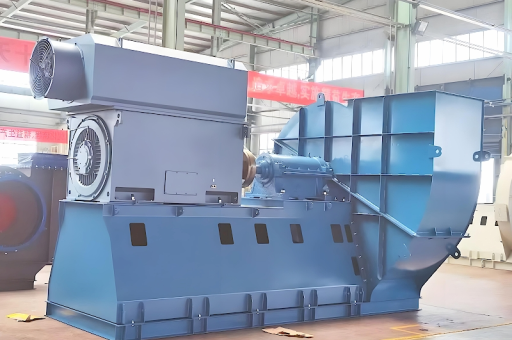
In modern industrial environments, the balance between high-performance air movement and workplace noise compliance is a critical engineering challenge. The Low Noise 55kW Dust Suction Blower Forced Draught Fan ID Fan represents a specialized class of equipment designed to handle heavy particulate loads, maintain combustion air supply, or create negative pressure—all while keeping operational noise levels within strict occupational safety limits.
This article synthesizes the latest technical specifications, real-world applications, and selection strategies for this 55kW class fan system. Whether you are a plant manager upgrading from a smaller unit, or an engineer specifying a new dust collection network, understanding the interplay between the fan’s suction power, forced draught capability, and induced draft (ID) function is essential.
Why 55kW? This power rating is a sweet spot for medium-to-large scale industrial processes, offering sufficient static pressure (typically 1500-3000 Pa) and airflow (15,000 - 40,000 m³/h) without requiring the infrastructure upgrades needed for 75kW+ systems.
Understanding the Core Components: Dust Suction Blower vs. Forced Draught Fan vs. ID Fan
To fully grasp the capabilities of this fan, we must first distinguish its three operating identities:
- Dust Suction Blower: Designed to create high negative pressure at the inlet to pull dust-laden air from collection points (hoods, chutes, bag filters). The impeller design must resist erosion and clogging. In a 55kW unit, this means a heavy-duty, backward-inclined or radial blade design with a wear-resistant lining.
- Forced Draught (FD) Fan: Used to push fresh air into a combustion system (boiler, furnace, kiln). For a 55kW FD fan, emphasis is on stable pressure output and low vibration. Noise reduction here often involves inlet silencers and acoustic enclosures.
- Induced Draught (ID) Fan: Located at the system’s exhaust end, this fan pulls flue gases or hot air out. The 55kW ID fan must handle higher temperatures (up to 250°C or more) and corrosive gases. A low-noise ID fan uses advanced impeller balancing and isolation dampers.
Integration Point: Some high-end units combine these functions with a variable frequency drive (VFD). The same 55kW motor can switch between dust suction mode (high negative pressure) and forced draught mode (high positive pressure) by adjusting the damper position and speed.
Technical Deep Dive: Why 55kW and Low Noise Matter
The “Low Noise” designation is not a marketing term—it represents specific engineering achievements.
- Noise Reduction Mechanisms:
- Aerodynamic Impeller Design: Optimized blade angles (typically backward-curved) reduce tip vortex noise.
- Sound-Attenuating Housing: Multi-layer composite panels filled with mineral wool or acoustic foam.
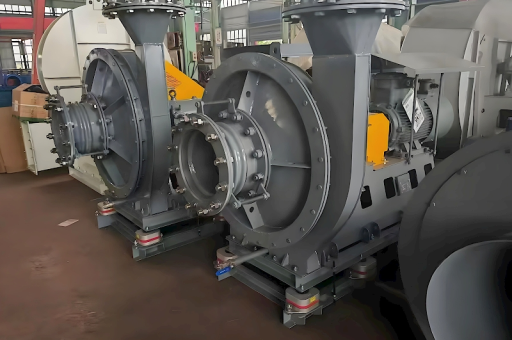
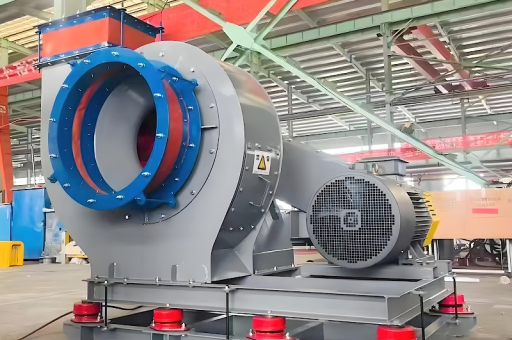
- Vibration Isolation: Use of spring or rubber mounts between the fan base and the floor. For a 55kW fan, even 1mm of imbalance can create a 5-10 dB(A) increase.
- Silencers: Inlet and outlet silencers can reduce noise from 85 dB(A) to 65-70 dB(A) at 1 meter.
- Electrical Efficiency: A 55kW motor running at 85% efficiency wastes 8.25 kW as heat. Modern IE4 or NEMA Premium motors can push efficiency above 94%, reducing heat and noise.
Typical Performance Data (Example):
| Parameter | Value | Condition |
|---|---|---|
| Power | 55 kW | Full load |
| Airflow | 25,000 m³/h | At 2000 Pa static pressure |
| Static Pressure | 2500 Pa | Max efficiency point |
| Noise Level | 72 dB(A) | With silencer, 1m distance |
| Temperature Rating | -20°C to 120°C | Standard; up to 300°C for ID variant |
Key Insight: A well-designed low-noise 55kW fan can operate quieter than a poorly designed 30kW unit running at full speed.
Key Design Features: Aerodynamics, Acoustics, and Durability
When evaluating a Low Noise 55kW Dust Suction Blower Forced Draught ID Fan, look for these specific features:
- Impeller: Cast or welded steel with wear-resistant coating (e.g., ceramic tile or hard-facing). For dust suction, a radial or paddle-wheel impeller handles large particles better than backward-curved.
- Shaft Seals: Carbon ring or labyrinth seals prevent dust leakage into bearings. This is critical for the “Dust Suction” role.
- Bearings: Heavy-duty spherical roller bearings with an L10 life of >50,000 hours is standard for 55kW. Grease or oil mist lubrication.
- Housing Self-Supporting Structure: To avoid resonance at 50/60 Hz. The housing should be reinforced with stiffeners.
- Access for Cleaning: A 55kW dust suction fan will accumulate material. A door or quick-release hatch is essential.
Applications Across Industries: From Cement Plants to Steel Mills
This 55kW class fan is versatile but excels in specific heavy-duty environments:
- Cement & Mining: For baghouse dust collectors handling limestone, coal, and clinker. The fan must maintain high negative pressure even as filters cake.
- Power Generation: As an FD fan for small biomass boilers or an ID fan for coal mills. The 55kW rating matches medium-scale CFB boilers.
- Steel & Foundry: For fume extraction at electric arc furnaces (EAF) or ladle tapping stations. The low-noise feature is crucial for worker safety near the furnace.
- Woodworking & Grain: For high-volume dust collection from planers, sanders, and saws. A 55kW suction blower can power a central system for an entire factory floor.
Case Study Example: A cement plant replaced two 37kW fans with one 55kW low-noise ID fan paired with a VFD. The result: a 15% reduction in total decibel levels (from 88 dB(A) to 73 dB(A)), 12% energy savings, and simpler ductwork.
Common Questions & Expert Answers (Q&A)
Q1: Can a single 55kW fan be used for both dust suction and forced draught? A: Yes, but with careful system design. You need a combined inlet/outlet damper and a changeable impeller configuration (or a specialized hybrid impeller). Most setups use separate fans. However, a VFD-controlled 55kW ID fan can be throttled to mimic low-flow forced draught duty in smaller systems.
Q2: How do I reduce noise further if 72 dB(A) is still too high? A: Install a box enclosure around the fan using acoustic panels (minimum 50mm mineral wool). Add a muffler on the inlet and outlet. Replace the motor with a water-cooled motor (no air-cooling fan). Ensure the foundation is heavy (concrete block) and decoupled from the floor.
Q3: What is the difference between a Low Noise ID Fan and a standard ID Fan for the same 55kW rating? A: The low-noise variant typically has a lower tip speed (smaller diameter impeller running at lower RPM), but wider blades to maintain airflow. It also includes integrated silencers and a more rigid housing. Standard units emphasize cost and maximum pressure at the expense of noise.
Q4: What causes high noise in a 55kW dust suction blower over time? A: The most common cause is impeller imbalance due to erosion or material buildup. To prevent this, use a bolt-on wear plate on the impeller blades. Regular cleaning (weekly for high-dust applications) is essential.
Selection Criteria: How to Choose the Right 55kW Fan System
Use this checklist when evaluating a supplier:
- Duty Point: Confirm airflow (m³/h), static pressure (Pa), and gas temperature. A 55kW motor can run overloaded by 10% for short periods, but continuous operation at maximum requires a 75kW motor.
- Noise Compliance: Ensure the fan meets OSHA 8-hour exposure limit (85 dB(A) on average) AND your local municipal night-time noise ordinance.
- Material of Construction: For dust suction: mild steel with abrasion-resistant coating. For ID: SS316 or Corten for flue gas.
- Accessories: Inlet box, expansion joint, damper, silencer. A turn-key package from the fan manufacturer simplifies installation.
- Motor Type: IE4 efficiency preferred. Ensure motor frame matches fan mount (e.g., B5 flange for direct drive).
Recommendation: For a true “low noise” ID fan at 55kW, specify a backward-inclined impeller (airfoil design) with a maximum tip speed of 50 m/s and a +3 dB tolerance.
Maintenance & Lifecycle: Ensuring Long-Term Performance
A 55kW fan is an investment. Extend its life with these practices:
- Monthly: Check vibration on bearings. ISO 10816-3 limits for a rigid fan are 4.5 mm/s RMS alarm, 7.1 mm/s trip.
- Quarterly: Inspect impeller for wear. Replace or rebuild when thickness drops 30%.
- Yearly: Replace grease in bearings. Check damper linkage alignment. Test silencer acoustic material (replace if eroded).
- 5 Years: Major overhaul – rebalance impeller, replace shaft, recoat internal surfaces.
Conclusion: The Future of Industrial Ventilation
The Low Noise 55kW Dust Suction Blower Forced Draught Fan ID Fan is not just a piece of equipment—it is a solution to three concurrent challenges: maintaining process efficiency, ensuring compliance with stricter noise regulations, and extending equipment lifespan in harsh environments.
By choosing a unit that prioritizes aerodynamic efficiency, robust construction, and integrated acoustic treatment, plant operators can achieve both an optimal working environment and tangible energy savings. As industries push toward net-zero and worker well-being becomes non-negotiable, fans like these will become the standard, not the exception.
Whether you are extracting cement dust, feeding a power boiler, or pulling hot gases from a steel furnace, investing in a well-engineered 55kW low-noise fan is a step toward a more productive and quieter industrial future.
For technical consultation or to request a custom silencer design for your 55kW fan, contact a certified fan manufacturer directly.