
This article's table of contents introduction:
- What It Is
- Key Components & Features Explained
- Common Applications
- Key Specifications You Need to Define
- Typical Manufacturers (Examples)
- Summary for Procurement / Engineering
This is a highly specific piece of industrial equipment. To provide the most accurate information, let's break down what this item is, its components, its applications, and the key specifications you would need to look for when sourcing or specifying one.
What It Is
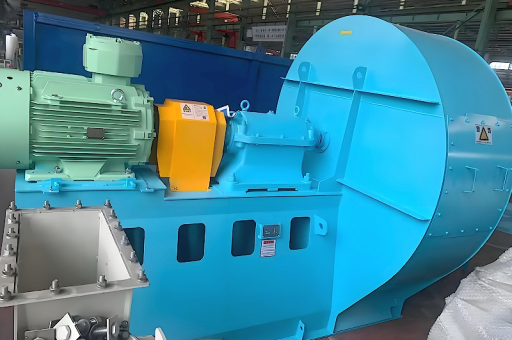
This is a Centrifugal Fan (Blower) designed to handle hot, corrosive, and potentially explosive flue gases from industrial processes. It is constructed from Stainless Steel and built according to strict safety standards for Explosion Protection.
Key Components & Features Explained
-
Stainless Steel Construction (Material):
- Why: Flue gas often contains acidic condensates (e.g., sulfuric acid from burning sulfur-containing fuels) and moisture. Carbon steel would corrode rapidly. Stainless steel (typically grades 304, 316, 316L, or 310S) provides excellent corrosion resistance and can withstand higher temperatures (e.g., 310S up to 2000°F / 1100°C).
- Grade Matters: A standard blower for exhaust might use 304. For highly corrosive gases (e.g., from waste incineration or chemical processing), 316L or even duplex stainless steel is required.
-
Explosion Protection (Safety Feature):
- Why: Flue gas can contain combustible components (unburned fuel, carbon monoxide, hydrogen) or the particulate matter in the gas stream can create a dust explosion hazard. A spark from the fan blades or a bearing failure could ignite the gas.
- Key Design Elements:
- Spark-Resistant Construction: The fan wheel and housing are designed to avoid metal-to-metal contact. This often involves using a non-sparking material for the wheel (e.g., aluminum or stainless steel) or adding a spark-proof shroud.
- Explosion-Proof Motors: The motor driving the fan is built to contain any internal explosion without igniting the surrounding atmosphere.
- Pressure Relief / Explosion Panel: The fan housing may include a pressure relief panel (explosion door) that opens to vent a pressure wave safely, preventing catastrophic failure of the casing.
- Grounded Construction: All components are electrically bonded and grounded to prevent static discharge.
-
Flue Gas (Application):
- Gas Characteristics: Typically high temperature (200°F to 1000°F+), often contains particulate matter (fly ash, soot), corrosive acids (SOx, NOx, HCl), and high humidity/condensation.
- Role: The fan creates the draft (negative or positive pressure) to move the exhaust gases from the combustion chamber (boiler, furnace, incinerator) through the pollution control equipment (scrubbers, baghouses, electrostatic precipitators) and out the chimney (stack).
-
Centrifugal Blower Fan (Mechanical Design):
- How it works: Air enters the center of the fan wheel (impeller) and is flung outward by centrifugal force. This design creates high pressure and is ideal for overcoming the resistance of ductwork, filters, and scrubbers.
- Wheel Design (Crucial for flue gas):
- Backward-Inclined (BI): Very common. High efficiency, non-overloading power curve. Best for clean to moderately dirty gases.
- Radial (R) or Paddle Wheel: For extremely dirty, high-particulate gases (e.g., from a cement kiln or biomass boiler). These are rugged, self-cleaning (less prone to dust buildup), and handle high temperatures well, but are less efficient and noisier.
- Airfoil (AF): Most efficient but most prone to erosion/dust buildup. Not ideal for dirty flue gas.
Common Applications
- Biomass Boilers / Wood Pellet Boilers: Handling ash, soot, and high moisture.
- Waste Incineration: Handling corrosive acid gases from burning municipal or industrial waste.
- Chemical Processing: Exhaust from reactors, dryers, and furnaces.
- Cement & Lime Kilns: Handling hot, abrasive, and dusty exhaust.
- Steel Manufacturing: Exhaust from blast furnaces, converters, and electric arc furnaces.
- Glass Melting Furnaces: Handling hot, corrosive gases.
- Pharmaceutical & Food Processing: Where sanitary conditions and corrosion resistance are critical.
Key Specifications You Need to Define
When sourcing this fan, you must specify the operating conditions precisely. Don't just use descriptors; provide numbers.
| Parameter | How to Define It | Why It's Critical |
|---|---|---|
| Gas Temperature | Normal operating temp, max continuous temp, and peak (upset) temp | Determines material grade (304 vs 310S), thermal expansion, and bearing cooling requirements. |
| Gas Composition | List major components (CO2, N2, O2, H2O, SOx, NOx, HCl, dust) and their concentrations | Determines corrosion resistance (SS grade) and if explosion protection is needed. |
| Particulate Load | mg/Nm³ or grains/ft³ | Determines impeller type (radial vs BI), housing wear protection (liner), and cleaning access. |
| Volume Flow Rate | CFM (Cubic Feet per Minute) or m³/hr at actual operating temp/pressure | Sizing basis. |
| Static Pressure | in. wg (inches water gauge) or Pa (Pascals). This is the resistance the fan must overcome. | Sizing basis. |
| Explosion Class | Zone 20/21/22 (for dust) or Zone 0/1/2 (for gas) or Class/Division per NEC | Specifies exact level of explosion proofing required for motor and enclosure. |
| Mounting Type | Direct drive (motor shaft to fan shaft) or Belt drive | Direct drive is simpler; belt drive allows speed adjustment but adds maintenance. |
| Orientation | Inlet/Outlet angles (e.g., "Top Horizontal, Side Vertical") | Fits into existing ductwork layout. |
| Surface Treatment | None, passivation, pickling, or a specific finish | Critical for sanitary or corrosive environments. |
Typical Manufacturers (Examples)
These are major global players in industrial heavy-duty fans:
- Greenheck
- New York Blower (NYB)
- Howden / Chart Industries
- TLT-Turbo / Babcock & Wilcox (B&W)
- Aerovent (Twin City Fan)
- Chicago Blower Corp.
- Systemair / FläktGroup
- Robinson Fans
- Cincinnati Fan
Summary for Procurement / Engineering
If you are writing a spec sheet or requesting a quote, your request should look something like this:
Request for Quote:
- Description: Stainless Steel Explosion-Proof Flue Gas Centrifugal Blower Fan
- Application: Exhaust for a 50 MMBTU/hr Natural Gas / #2 Oil Boiler (up to 20% sulfur oil backup)
- Flow: 25,000 CFM @ 15 in. wg static pressure
- Temperature: 450°F normal / 650°F max
- Gas: Combustion products with H2O and trace SO3, no solids.
- Material: Fan housing & wheel: AISI 316L. Shaft: AISI 316.
- Explosion Protection: AMCA Type C Spark Resistant construction with explosion-proof motor per Class I, Division 2, Group D.
- Drive: Direct drive with a 200 HP, 1800 RPM, TEFC, Class F motor.
- Orientation: Inlet: Bottom Horizontal. Outlet: Top Vertical.
Final Note: Do not use a standard air-handling fan for this duty. Flue gas is aggressive, hot, and potentially explosive. Always specify a fan designed and rated for the exact temperature, corrosive, and explosion hazards of your specific process. Consult with a manufacturer's application engineer.





