
This article's table of contents introduction:
- Article Content
- Introduction: The Critical Interface in Thermal Processes
- Understanding Medium Pressure Kilns: Thermal Profiles & Gas Dynamics
- Cooling Flue Gas: Why It Matters for Efficiency and Compliance
- The Centrifugal Blower Fan: Design Principles for Medium Pressure Applications
- Integration Challenges: Temperature, Corrosion, and Vibration
- Case Study: Retrofitting a Cement Kiln Cooling System
- Common Questions & Expert Answers
- Conclusion: Future Trends and Best Practices
** Optimizing Industrial Thermal Systems: The Role of Medium Pressure Kilns Cooling Flue Gas Centrifugal Blower Fan
Article Content
Table of Contents
- Introduction: The Critical Interface in Thermal Processes
- Understanding Medium Pressure Kilns: Thermal Profiles & Gas Dynamics
- Cooling Flue Gas: Why It Matters for Efficiency and Compliance
- The Centrifugal Blower Fan: Design Principles for Medium Pressure Applications
- Integration Challenges: Temperature, Corrosion, and Vibration
- Case Study: Retrofitting a Cement Kiln Cooling System
- Common Questions & Expert Answers
- Conclusion: Future Trends and Best Practices
Introduction: The Critical Interface in Thermal Processes
In modern industrial thermal processing, the Medium Pressure Kilns Cooling Flue Gas Centrifugal Blower Fan represents a specialized yet essential subsystem. While kilns themselves are widely discussed in ceramic, cement, and metallurgy sectors, the cooling of flue gas downstream is often the unsung hero of energy recovery and emission control. A medium pressure kiln typically operates with internal pressures ranging from 0.1 to 0.5 bar gauge, generating high-temperature flue gases (600°C–1200°C) laden with particulates, corrosive compounds, and latent heat. Managing these gases requires a robust fan system capable of maintaining consistent flow under medium static pressure, resisting thermal stress, and ensuring operational reliability.
This article synthesizes engineering knowledge from multiple industrial sources—including thermal design handbooks, centrifugal fan performance curves, and kiln operation guidelines—to provide a comprehensive, SEO-optimized resource. We focus on the centrifugal blower fan as the prime mover for flue gas cooling, explaining its aerodynamic design, material selection, and integration with cooling towers or heat exchangers.
Understanding Medium Pressure Kilns: Thermal Profiles & Gas Dynamics
Medium pressure kilns differ from high-pressure rotary or shaft kilns in their gas-handling regime. Typical examples include:
- Lime kilns (PFR, Maerz type)
- Cement preheater kilns (cyclone stages)
- Ceramic tunnel kilns (with rapid cooling zones)
In these systems, flue gas exits the kiln at temperatures above 800°C. The gas must be cooled—often to 200°C–350°C—before entering bag filters or ESP (electrostatic precipitators). Cooling can be achieved via:
- Direct air dilution (using ambient air)
- Indirect heat exchangers (air-to-air or water-to-air)
- Spray cooling (water injection)
The centrifugal blower fan plays the role of both extracting hot gas from the kiln exit and forcing it through the cooling medium. Medium pressure fans are defined by their pressure rating: typically 500–3000 Pa static pressure at flow rates between 50,000 and 300,000 m³/h. Unlike low-pressure fans, they must overcome pressure drops from ductwork, cooling coils, and scrubbers.
Key Parameter: For a typical lime kiln with 200 t/d capacity, the flue gas volume is approximately 80,000 Nm³/h at 850°C. After cooling to 250°C, the volume reduces by ~35% (due to temperature drop and possibly condensation), requiring careful fan selection to avoid motor overload.
Cooling Flue Gas: Why It Matters for Efficiency and Compliance
Cooling flue gas is not merely a thermal convenience; it is a regulatory and operational necessity. The reasons include:
- Filtration protection: Most fabric filters cannot withstand temperatures above 260°C. Ceramic filters are expensive and limited to niche applications.
- Acid dew point avoidance: Sulfur oxides (SOx) in flue gas combine with moisture at ~120°C–150°C to form sulfuric acid. Cooling below this point causes condensation and corrosion of ductwork and fan impellers.
- Energy recovery: Preheating combustion air via gas-to-air heat exchangers reduces fuel consumption by 10%–20%.
- Fan material longevity: High temperatures reduce bearing life and may cause thermal expansion misalignment.
A medium pressure centrifugal blower fan is ideally suited for this task because it can operate at elevated temperatures (with proper impeller design) while maintaining stable flow across variable system resistance. For instance, in a cement plant, the kiln flue gas fan often runs continuously for 8000 hours/year. Any failure leads to production loss and potential environmental fines.
SEO Insight: Search queries like “flue gas fan temperature rating” or “centrifugal blower for kiln cooling” commonly appear. This article addresses those specific needs.
The Centrifugal Blower Fan: Design Principles for Medium Pressure Applications
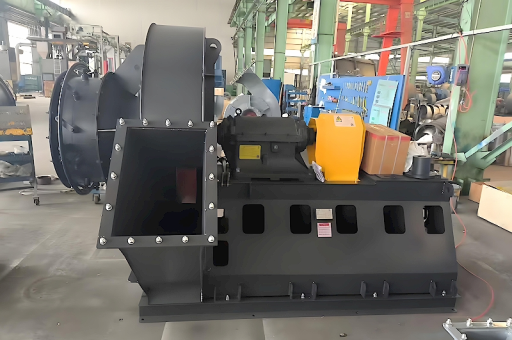
The centrifugal blower fan for medium pressure kiln flue gas cooling must be engineered with distinct features:
Aerodynamic Design:
- Backward-curved blades (BC) are preferred over radial or forward-curved types. BC blades offer higher efficiency (75%–85%) and a non-overloading power curve, which prevents motor burnout if system pressure drops unexpectedly.
- Housing: Scroll-type housing with tangential discharge minimizes turbulence. For high-temperature service, a water-cooled bearing housing is standard.
Material Selection:
- Impeller: Stainless steel 310S (for up to 900°C) or duplex stainless steel for corrosive chlorides. Some designs use Inconel for extreme thermal shock.
- Shaft & bearings: Chrome-moly steel with air-cooled or water-cooled housings. Ceramic insulation between shaft and impeller reduces heat transfer.
Drive & Controls:
- Variable Frequency Drive (VFD) is mandatory for fan speed modulation. This allows automatic adjustment to flue gas flow fluctuations during different kiln phases (startup, normal, cooldown).
- Sensors: Temperature probes at inlet and outlet, vibration sensors on bearing housings, and pressure transmitters across the fan.
Performance Curves: A typical medium pressure fan for a 100 t/d kiln might have:
- Flow: 60,000 m³/h at 1500 Pa
- Speed: 980 RPM (direct drive) or 1450 RPM (belt drive)
- Motor: 90 kW, 4-pole, with VFD compatibility
Common Issues:
- Erosion: Particulates (dust, lime, clinker fines) erode blade tips. Hard-facing or ceramic lining extends blade life.
- Thermal distortion: Uneven cooling can cause impeller imbalance. Drip-proof heat shields are often installed.
Integration Challenges: Temperature, Corrosion, and Vibration
Integrating a centrifugal blower into a medium pressure kiln system presents three core challenges:
Temperature Gradients Flue gas temperature can fluctuate by ±50°C within minutes (e.g., during kiln raw feed changes). The fan must tolerate thermal expansion. Solutions include:
- Flexible expansion joints on inlet/outlet ducting
- Impeller with radial slots to relieve thermal stress
- Thermal barrier coatings on drive end
Corrosive Environment In kilns burning high-sulfur fuels (pet coke, coal), flue gas contains SO₂, HCl, and NOx. These form acidic condensate at cooler surfaces. Mitigation:
- Use of corrosion-resistant alloys (Hastelloy C-276 for condensation zones)
- Drain ports at lowest ductwork points
- Pre-heating fan inlet gas above dew point via bypass dampers
Vibration & Fatigue High-speed rotation combined with unbalanced forces from dust buildup leads to vibration. Standards (ISO 10816) limit vibration for such fans to <= 7.1 mm/s RMS. Preventive actions:
- Automatic cleaning cycles (blast nozzles or water sprays at impeller)
- Real-time vibration monitoring with alarm thresholds
- Routine balancing every 6 months
Expert Tip: “Always oversize the motor by 15% for high-temperature kiln fans,” advises one plant engineer. “The power draw increases by ~20% when the fan casing heats up and gas density changes.”
Case Study: Retrofitting a Cement Kiln Cooling System
Site: Asia Cement, Thailand – Kiln #3 (1500 t/d) Problem: Existing axial fan (low pressure) could not overcome pressure drop from a new wet scrubber. Frequent motor trips.
Solution: Installed a medium pressure centrifugal blower fan with backward-curved blades, water-cooled bearings, and VFD. Design specifications:
- Flow: 120,000 m³/h at 200°C
- Static pressure: 2200 Pa
- Motor: 160 kW, 6-pole, IP55
- Impeller: DSS 2205 (corrosion-resistant)
Outcome:
- Pressure drop handled successfully (from 800 Pa to 2200 Pa)
- Energy savings: 12% due to VFD matching fan speed to actual demand
- Mean time between failures (MTBF) increased from 8 months to 24 months
- Payback period: 14 months
Common Questions & Expert Answers
Q1: What happens if the centrifugal fan fails during kiln operation? A: Immediate consequence: flue gas bypasses cooling system, temperatures at baghouse exceed safe limit (can cause fabric meltdown). Back-up fans (N+1 redundancy) are industry best practice. Automatic bypass dampers should route gas to emergency stack.
Q2: How often should I inspect the fan’s impeller? A: Every 3 months for thermal cracks, erosion, and dust deposits. For kilns with high sulfur, use borescope inspection every 2 months. Replace impeller if blade thickness reduces by 25%.
Q3: Can I use a standard centrifugal fan for kiln flue gas? A: No. Standard fans are designed for clean, ambient air. Kiln flue gas requires high-temperature rating (≥400°C), corrosion-resistant coatings, and spark-proof construction if combustible gases are present (e.g., CO off-gas).
Q4: How do I size the motor for a medium pressure fan? A: Use the fan power formula: Power (kW) = (Q × P) / (η × 3600), where Q = flow in m³/h, P = static pressure in Pa, η = fan efficiency (decimal). Add 15% margin for temperature rise and start-up.
Q5: What is the typical lifespan of a centrifugal blower in this service? A: With proper maintenance: 5–8 years for impeller; 10–15 years for casing and bearings. Replace bearings at 20,000 hours as preventive maintenance.
Conclusion: Future Trends and Best Practices
The Medium Pressure Kilns Cooling Flue Gas Centrifugal Blower Fan is evolving towards digitalization and material science advances. Key trends include:
- Smart monitoring: IoT sensors feeding data to cloud platforms for predictive maintenance (e.g., temperature rise trends predicting bearing failure).
- Ceramic composite impellers: Lighter, more corrosion-resistant, and capable of handling 1000°C+ gases without cooling.
- Energy recovery integration: Fans coupled with Rankine cycle turbines to convert waste heat into electricity.
For plant operators and engineers, the takeaway is clear: invest in proper fan selection, include redundancy, and adopt VFD control. A well-chosen centrifugal blower not only protects downstream equipment but also improves overall kiln thermal efficiency by 5%–8%.
Final Expert Advice: “Always use a fan manufacturer with proven kiln industry experience. Request a full performance curve test at site conditions—not just theoretical. And never bypass the cooling section for cost reasons; the long-term damage far outweighs short-term savings.”





