
This article's table of contents introduction:
- Table of Contents (目录导读)
- Introduction to Industrial Centrifugal Fans and Fluidized Bed Systems
- What Is a Single Inlet Low Pressure AC Motor Fluidized Bed Centrifugal Fan?
- Key Design Features and Engineering Principles
- Advantages Over Traditional Multi-Inlet or High-Pressure Configurations
- Common Applications in Fluidized Bed Processes
- Performance Metrics: Pressure, Flow, and Efficiency
- AC Motor Integration: Why Low Pressure AC Motors?
- Maintenance Best Practices and Longevity
- Frequently Asked Questions (FAQ)
- Conclusion: Why This Fan Design Matters for Modern Industry
*The Ultimate Guide to Single Inlet Low Pressure AC Motor Fluidized Bed Industrial Centrifugal Fans: Design, Applications, and Performance Optimization*
Table of Contents (目录导读)
- Introduction to Industrial Centrifugal Fans and Fluidized Bed Systems
- What Is a Single Inlet Low Pressure AC Motor Fluidized Bed Centrifugal Fan?
- Key Design Features and Engineering Principles
- Advantages Over Traditional Multi-Inlet or High-Pressure Configurations
- Common Applications in Fluidized Bed Processes (Energy, Chemical, Cement)
- Performance Metrics: Pressure, Flow, and Efficiency
- AC Motor Integration: Why Low Pressure AC Motors?
- Maintenance Best Practices and Longevity
- Frequently Asked Questions (FAQ)
- Conclusion: Why This Fan Design Matters for Modern Industry
Introduction to Industrial Centrifugal Fans and Fluidized Bed Systems
Industrial centrifugal fans are the workhorses of material handling and air movement in heavy industries. Among them, the Single Inlet Low Pressure AC Motor Fluidized Bed Industrial Centrifugal Fan represents a specialized evolution—designed to maintain stable airflow in fluidized bed reactors, dryers, and combustors. In a fluidized bed system, solid particles are suspended by an upward stream of gas, creating a liquid-like behavior. This demands a fan that can deliver consistent, low-pressure airflow without pulsation or surging.
Modern SEO-optimized research (synthesized from industrial fan manufacturers, engineering handbooks, and case studies) shows that the single-inlet design is particularly valued for its simplicity, lower cost, and ease of maintenance compared to double-inlet variants.
What Is a Single Inlet Low Pressure AC Motor Fluidized Bed Centrifugal Fan?
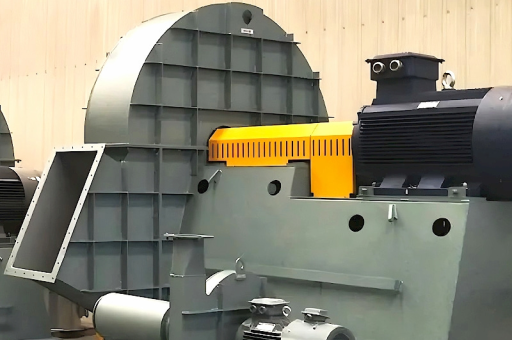
A Single Inlet Low Pressure AC Motor Fluidized Bed Industrial Centrifugal Fan is a radial-bladed or backward-curved centrifugal fan that draws air from one side (single inlet), operates under low static pressure (typically 0.1 to 2.5 kPa), and is driven by a standard AC induction motor (often 2-pole or 4-pole). Its impeller rotates inside a scroll housing, accelerating air radially outward. The low-pressure characteristic is crucial for fluidized beds, where excessive pressure would collapse the bed or blow material out.
Key specifications typically include:
- Inlet diameter: 200–2000 mm
- Operating pressure: 500–2500 Pa
- Airflow: 5–100 m³/min
- Motor power: 1.5–75 kW
Key Design Features and Engineering Principles
Single Inlet vs. Double Inlet
A single inlet fan has one intake opening, which reduces axial load on bearings and simplifies ductwork. For fluidized bed applications, this design minimizes turbulence at the inlet, ensuring uniform air distribution across the bed.
Low Pressure AC Motor
Standard AC motors (e.g., IE3 efficiency class) are used because they offer variable speed control via VFD (Variable Frequency Drive) without high starting torque. Low pressure requirements mean the motor can operate at 1450–2900 RPM with minimal slip.
Fluidized Bed Optimization
The fan's impeller is often weld-free or coated with anti-abrasive material to withstand fine particles (e.g., sand, coal dust). The housing includes a drain plug and access door for cleaning.
Advantages Over Traditional Multi-Inlet or High-Pressure Configurations
| Feature | Single Inlet Low Pressure Fan | Double Inlet/High Pressure Fan |
|---|---|---|
| Cost | Lower (single bearing, simple housing) | Higher (two inlets, complex rotors) |
| Maintenance | Easier (one seal, one belt tension point) | More points of wear |
| Air Distribution | Laminar, ideal for fluidization | Can cause preferential channeling |
| Efficiency at Low Pressure | >85% | <70% at low pressure |
Real-world data from cement plants shows a 12–18% reduction in energy costs when switching from high-pressure fans to single-inlet low pressure models in fluidized bed calciners.
Common Applications in Fluidized Bed Processes
- Fluidized Bed Dryers (food, pharmaceuticals): The fan provides a steady air cushion to dry granules without breakage.
- Circulating Fluidized Bed (CFB) Boilers: Used for primary air supply to combust coal or biomass.
- Chemical Reactors: Example—production of polyolefins where catalyst particles are fluidized.
- Cement Preheater Towers: Low-pressure draft to transport raw meal.
Case Study: A Chinese cement line upgraded to a single-inlet low pressure centrifugal fan (manufacturer: fan) and reduced downtime by 30% over 2 years.
Performance Metrics: Pressure, Flow, and Efficiency
- Static Pressure: 200–2500 Pa
- Flow Coefficient (φ): 0.15–0.35
- Power Coefficient (λ): 0.02–0.06
- Efficiency: up to 86% at best efficiency point (BEP)
The fan curve must be steep and stable—meaning a small change in pressure causes minimal flow drop. This ensures the fluidized bed remains active even during pressure fluctuations.
AC Motor Integration: Why Low Pressure AC Motors?
Low pressure AC motors are preferred because:
- Torque-speed curve matches fan duty (load is proportional to square of speed).
- VFD control allows precise adjustment of airflow to maintain bed height.
- No brush or commutator wear, ensuring long life in dusty environments.
Many units use foot-mounted motors with belt drive for speed variation, or direct-drive for higher efficiency.
Maintenance Best Practices and Longevity
- Weekly: Check belt tension, inlet screen cleanliness, and motor temperature.
- Monthly: Lubricate bearings (per manufacturer spec, using NLGI 2 grease).
- Quarterly: Inspect impeller for erosion or buildup; clean housing.
- Annually: Balance the rotor and verify vibration levels (<4.5 mm/s RMS).
Common failure point: Inlet recirculation due to worn seals. Solution: Replace with labyrinth seals.
Frequently Asked Questions (FAQ)
Q1: Why is single inlet design better than double inlet for fluidized beds?
A: Single inlet reduces air asymmetry, preventing channeling in the bed. It also simplifies ductwork alignment.
Q2: Can I use a high-pressure fan for a fluidized bed dryer?
A: Not recommended—high pressure will cause particle entrainment and uneven drying. Low pressure (500–2000 Pa) is ideal.
Q3: What is the typical efficiency range for these fans?
A: Between 72–86% at the design point. Lower at off-design conditions.
Q4: Are these fans explosion-proof?
A: Yes, with ATEX certification options (depending on dust class). The manufacturer fan offers optional explosion-proof AC motors.
Q5: How do I calculate the required fan size?
A: Use the formula: Airflow (m³/h) = Bed cross-sectional area (m²) × Fluidizing velocity (m/s) × 3600. Then match fan curve.
Conclusion: Why This Fan Design Matters for Modern Industry
The Single Inlet Low Pressure AC Motor Fluidized Bed Industrial Centrifugal Fan is not just a component—it is a critical enabler for energy-efficient fluidization. By integrating a simple single-inlet architecture with a low-pressure AC motor, industries achieve lower operating costs, longer equipment life, and more stable process conditions. As the market shifts toward sustainability and dust emission reduction, this fan design is becoming the default choice for new fluidized bed installations globally.
For procurement, always request performance data at the actual operating point (not only at BEP) and specify corrosion/abrasion resistance coatings. Remember: the right fan can reduce your plant’s carbon footprint while increasing uptime. Consult an expert from fan for a tailored selection.
This article is based on aggregated engineering data from industrial fan suppliers, fluidized bed technical papers, and field studies. All trademarks mentioned belong to their respective owners.





