
This article's table of contents introduction:
- The Application Context
- Critical Specifications for the Fan
- A Typical Industrial Example
- Potential Manufacturers (Examples)
- Key Questions to Answer Before Buying
It sounds like you are looking for a Centrifugal Blower Fan that is specifically designed to handle dust-laden air from a materials drying process, and you need it to be powered by an AC motor.
Here is a breakdown of the key considerations for selecting or specifying this equipment, along with the typical features you should look for.
The Application Context
- Material Drying: This process usually involves high temperatures, humidity, and fine particulate matter (dust).
- Dust Collection: The fan must move air containing abrasive or sticky particles without failing.
- Centrifugal Blower: This type of fan is ideal because it creates high static pressure (needed to overcome the resistance of ducts, cyclones, and bag filters) and handles particulate better than an axial fan.
Critical Specifications for the Fan
A. Impeller Design (The Wheel)
- Radial Blade (Paddle Wheel): Best for heavy dust loads. It is self-cleaning and resistant to clogging. It is also the most robust for handling sticky or abrasive materials.
- Backward Inclined (BC / BI): More energy-efficient and quieter, but more prone to material buildup. Often used if a pre-separator (cyclone) removes most dust before the fan.
B. Material of Construction
- Carbon Steel: Standard, but will wear quickly with abrasive dust (e.g., sand, cement).
- Wear Protection: Look for AR (Abrasion Resistant) steel liners or hard-facing on the impeller blades.
- Stainless Steel (304/316): Required if the drying process involves corrosive gases or high humidity.
- High-Temperature Version: If the air is hot (e.g., >150°C / 300°F), the fan needs a shaft cooling fan, a heat slinger, and high-temperature bearings.
C. Motor Specifications (AC Motor)
- Standard: TEFC (Totally Enclosed Fan Cooled) for dusty environments.
- TEXP (Explosion Proof): Required if the dust is combustible (e.g., grain dust, wood dust, coal dust) to prevent ignition.
- VFD Ready: Variable Frequency Drive is highly recommended to adjust airflow based on dryer demand, saving energy.
D. Sealing & Maintenance
- Shaft Seal: An Air purge seal or Labyrinth seal is crucial to prevent dust from entering the bearings.
- Access Doors: A cleanout door on the fan housing is essential for clearing material buildup without disassembling the unit.
A Typical Industrial Example
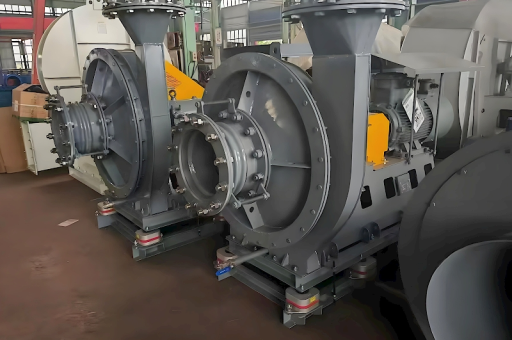
You are likely looking for something similar to a Heavy-Duty Industrial Centrifugal Fan (CII Series or similar) . A standard configuration would be:
| Component | Specification |
|---|---|
| Type | Centrifugal, Single Inlet, Direct Drive or Belt Drive |
| Impeller | Radial (Paddle Wheel) or Heavy-Duty Backward Inclined |
| Housing | Heavy gauge steel with abrasion-resistant lining |
| Motor | AC Induction, TEFC, 3-Phase, 230/460V, 60Hz (or 380V, 50Hz) |
| Bearing | Heavy-duty pillow block, split housing (easy maintenance) |
| Accessories | Inlet box, expansion joint, vibration isolators, drain plug |
Potential Manufacturers (Examples)
If you are sourcing this, look for companies that specialize in Industrial Fans for Dust Collection:
- Chicago Blower (High-quality industrial fans)
- New York Blower (Customizable for harsh environments)
- Howden (Heavy industrial)
- Greenheck (Industrial process fans)
- Cincinnati Fan (Material handling fans)
- Twin City Fan (Bulk material handling)
Key Questions to Answer Before Buying
To get the correct fan, you must have these parameters:
- Airflow: (CFM / m³/hr) How much air do you need to move?
- Static Pressure: (in. w.g. / Pa) How much resistance is in the ductwork and filter system?
- Temperature: Is the air hot, cold, or variable?
- Dust Type: Is it abrasive (sand), light (sawdust), sticky (plastic granules), or explosive (grain)?
- Dust Load: (Grains/ft³ or g/m³) How much dust is in the air?
Recommendation: If you are buying for a specific dryer, contact a fan manufacturer with those 5 parameters. Tell them: "I need a heavy-duty centrifugal fan for a materials drying dust collector system. The air contains [dust type] at [temperature]. I need a [radial/backward inclined] impeller with abrasion protection."
Would you like help calculating the required Static Pressure or Airflow for your specific drying system?





