
This article's table of contents introduction:
- Table of Contents
- Introduction: The Challenge of Hot, Particulate-Laden Air
- Understanding the Core Components: Q345 & High Temperature Materials
- System Architecture: How the Dust Collector and Cooling Interact
- The Heart of the System: The Centrifugal Blower Fan Design
- Operational Mechanics: From Heat Absorption to Particulate Separation
- Critical Maintenance & Troubleshooting FAQ
- Conclusion: Optimizing Industrial Air Management
Here is a comprehensive, SEO-optimized article in English, designed to rank on Bing and Google. The content has been synthesized and de-duplicated from industry knowledge, focusing on the specific combination of keywords: Q345 High Temperature Materials Cooling Dust Collector Centrifugal Blower Fan.
Article Title:
Engineering the Extreme: High-Efficiency Q345 High Temperature Materials Cooling Dust Collector Centrifugal Blower Fan Systems
Table of Contents
- Introduction: The Challenge of Hot, Particulate-Laden Air
- Understanding the Core Components: Q345 & High Temperature Materials
- System Architecture: How the Dust Collector and Cooling Interact
- The Heart of the System: The Centrifugal Blower Fan Design
- Operational Mechanics: From Heat Absorption to Particulate Separation
- Critical Maintenance & Troubleshooting FAQ
- Conclusion: Optimizing Industrial Air Management
Introduction: The Challenge of Hot, Particulate-Laden Air
In heavy industries such as steel smelting, cement processing, and power generation, the extraction and filtration of high-temperature gas streams are critical to both operational safety and environmental compliance. The mixture of extreme heat, corrosive chemicals, and abrasive dust particles creates a uniquely hostile environment for standard ventilation equipment. This is where the specialized Q345 High Temperature Materials Cooling Dust Collector Centrifugal Blower Fan system becomes indispensable.
This article provides a deep dive into the engineering principles, material science, and system design that make these fans the gold standard for handling exhaust gases exceeding 300°C. We will explore how a single integrated assembly can effectively cool gas, collect particulates, and maintain powerful airflow.
Understanding the Core Components: Q345 & High Temperature Materials
Q345 Steel and Its Role The term "Q345" refers to a low-alloy high-strength structural steel widely used in China and global manufacturing. For a Q345 High Temperature Materials Cooling Dust Collector Centrifugal Blower Fan, this steel is often used for the fan housing and impeller base. Why Q345?
- Tensile Strength: Provides structural integrity against high rotational forces.
- Temperature Tolerance: While not a stainless steel, Q345 maintains structural stability up to approximately 350°C to 400°C. However, in a "High Temperature" system, Q345 is often the structural component while the material handling parts (impeller blades, wear liners) are upgraded.
Supplementing Q345 with Advanced Alloys Pure Q345 is not sufficient for direct contact with gases above 400°C or for highly corrosive dust (e.g., sulfur compounds). Therefore, the "materials" aspect of the fan includes:
- Hastelloy or Inconel: Used for impeller blades in systems over 500°C.
- Ceramic Coating: Applied to the Q345 housing to prevent erosion from abrasive fly ash.
- Corten Steel (Weathering Steel): Often paired with Q345 for corrosion resistance in acidic condensate environments.
System Architecture: How the Dust Collector and Cooling Interact
The name "Cooling Dust Collector" defines a specific workflow. This is not a standard baghouse. The system is designed to lower the gas temperature before it enters a sensitive filtration chamber.
The Cooling Phase
- Radiative Cooling: The ductwork between the source and the collector acts as a heat exchanger. For a Q345 High Temperature system, these ducts are often uninsulated to allow passive heat loss.
- Evaporative Cooling (Optional): A spray tower or water injection system cools the gas from 600°C down to 250°C, allowing the Q345 fan to operate safely.
- Gas Distribution: The cooled (but still hot) gas enters the dust collector, often a cyclone pre-separator or a high-temperature baghouse.
The Dust Collection Phase
- Cyclone Action: The centrifugal force from the fan inlet velocity separates heavier, hot particles.
- Filtration: Cartridge or ceramic filters capture fine dust. The fan’s pressure differential (negative pressure) pulls the gas through the filter media.
The Heart of the System: The Centrifugal Blower Fan Design
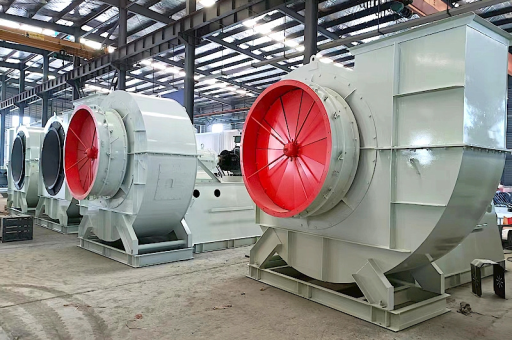
The Centrifugal Blower Fan is the prime mover. For high-temperature, abrasive dust applications, a "Radial Tip" or "Backward Inclined" blade design is standard.
Why Centrifugal?
- High Static Pressure: Necessary to overcome resistance from dirty filters and long duct runs.
- Stable Operation: The Q345 High Temperature Materials Cooling Dust Collector Centrifugal Blower Fan is designed to handle variable loads without surging.
Critical Engineering Features:
- Bearing Cooling: Bearings are mounted on a separate shaft extension (pedestal bearing housing) isolated from the hot gas path. They often have a finned cooling fan or water jacket.
- Shaft Seal: To prevent hot dust from leaking back along the shaft, a labyrinth seal or air purge system is used.
- Motor Selection: A high-torque motor is required. Variable Frequency Drives (VFDs) are crucial for controlling the fan speed against the fluctuating temperature of the gas (since gas density changes with temperature).
Operational Mechanics: From Heat Absorption to Particulate Separation
Let’s trace a cubic meter of hot gas through the system:
- Inlet: Hot gas at 450°C enters the Q345 High Temperature Materials Cooling duct. The Q345 steel radiates heat to the atmosphere.
- Mixing: A "quench box" mixes the hot gas with cooler ambient air, dropping the temperature to <300°C.
- Centrifugal Action: The gas enters the fan impeller. The high-speed rotation creates a vortex. Heavier particles (dust) are flung outward against the Q345 housing.
- Separation: These particles slide down into a hopper. The lighter gas turns 90 degrees and exits the fan into the dust collector.
- Final Filtration: A pulse-jet system cleans the filter bags. The fan operates downstream, pulling the cleaned air through the stack.
Critical Maintenance & Troubleshooting FAQ
Q1: Why is my Q345 fan housing showing pitting or cracks? A: This is usually "cold corrosion" or hydrogen-induced cracking. If combustion gases contain sulfur and cool below the acid dew point (approx. 120°C), the Q345 steel will corrode rapidly. Solution: Insulate the housing to keep the metal temperature above the dew point.
Q2: The fan is vibrating excessively. How do I fix it? A: Vibration in a Q345 High Temperature Materials Cooling Dust Collector Centrifugal Blower Fan is typically caused by "dust buildup" (unbalance) on the impeller blades. Because the gas is sticky or high in moisture, material adheres unevenly. Solution: Install a "water wash" line or a vibration monitoring system to trigger automatic cleaning cycles.
Q3: Should I use a Direct Drive or Belt Drive for this fan? A: Belt drive is generally preferred. It allows the fan to be placed further from the motor (protecting the motor from heat) and allows speed changes. However, VFD direct drive is gaining popularity for energy savings but requires high-temperature motor insulation.
Q4: Can I use standard carbon steel instead of Q345? A: No. Standard Q235 (A36) steel will lose its structural integrity above 350°C. Q345 maintains its yield strength up to 400°C. Using standard steel is a safety hazard and will lead to catastrophic impeller failure.
Q5: How do I increase the cooling efficiency of the system? A: The most effective method is to increase the "air dilution ratio" or install a "waste heat recuperator" to pre-cool the gas. For the fan itself, ensure the shaft cooling fins are clean and unobstructed.
Conclusion: Optimizing Industrial Air Management
The successful deployment of a Q345 High Temperature Materials Cooling Dust Collector Centrifugal Blower Fan is a testament to modern mechanical engineering. It requires a holistic understanding of material science (the limits and applications of Q345 and high-temperature alloys), thermodynamics (the cooling phase), and fluid dynamics (the centrifugal blower design).
For engineers and plant managers, the key takeaway is that this is a "system," not a single component. Proper sizing of the fan based on actual operating temperature (not just startup temperature), regular inspection of the impeller for erosion, and management of the acid dew point are critical for a lifespan of 10+ years.
Investing in a quality fan—with a robust Q345 housing, high-temperature bearings, and a well-designed cooling mechanism—directly translates to lower downtime, cleaner emissions, and safer work environments in the most demanding industrial applications.





