
This article's table of contents introduction:
- Table of Contents
- Introduction: The Heart of Industrial Air Management
- What is a Backward Curved Drying Dust Collector Centrifugal Blower Fan?
- How It Works: The Aerodynamics of Backward Curved Blades
- Key Advantages Over Forward Curved and Radial Fans
- Critical Applications: From Dust Collection to Material Drying
- Selection Criteria: Sizing, Speed, and Static Pressure
- Installation, Maintenance, and Noise Reduction
- FAQ: Common Questions Answered
- Conclusion: Why This Fan is a Smart Investment
** The Ultimate Guide to Backward Curved Drying Dust Collector Centrifugal Blower Fans: Efficiency, Design, and Applications
Table of Contents
- Introduction: The Heart of Industrial Air Management
- What is a Backward Curved Drying Dust Collector Centrifugal Blower Fan?
- How It Works: The Aerodynamics of Backward Curved Blades
- Key Advantages Over Forward Curved and Radial Fans
- Critical Applications: From Dust Collection to Material Drying
- Selection Criteria: Sizing, Speed, and Static Pressure
- Installation, Maintenance, and Noise Reduction
- FAQ: Common Questions Answered
- Conclusion: Why This Fan is a Smart Investment
Introduction: The Heart of Industrial Air Management
In the demanding environments of industrial processing, woodworking, cement plants, and HVAC systems, the reliability of air movement equipment dictates productivity. Among the most specialized and effective solutions is the Backward Curved Drying Dust Collector Centrifugal Blower Fan. This type of fan is not merely a component; it is the engineered heart of systems that require high pressure, variable air volume, and resistance to particulate buildup.
Unlike standard axial fans, a centrifugal fan accelerates air radially. The "backward curved" design specifically optimizes efficiency by reducing turbulence and energy loss. When paired with drying and dust collection functions, this fan becomes indispensable for industries where moisture removal and airborne particle capture are critical.
This article provides a comprehensive, SEO-optimized deep dive into the technology, benefits, and best practices surrounding these fans. We will explore how they differ from other designs, why they dominate high-efficiency applications, and how to select the correct unit for your facility.
What is a Backward Curved Drying Dust Collector Centrifugal Blower Fan?
To break down the name:
- Backward Curved: The fan blades curve away from the direction of rotation (the trailing edge is curved opposite to the rotation).
- Drying: Designed to handle high-temperature air or moist environments without performance degradation.
- Dust Collector: Capable of moving air containing particles, sawdust, or granular materials without clogging.
- Centrifugal Blower Fan: Uses rotational energy to increase air pressure via a rotating impeller.
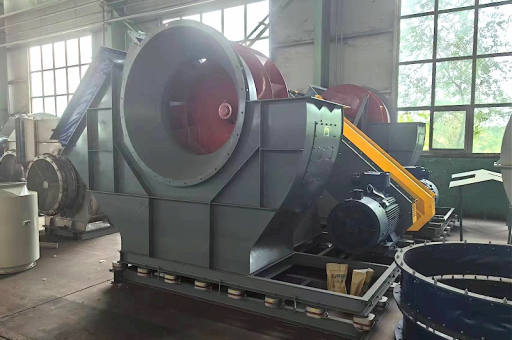
Construction & Materials: These fans are typically constructed from heavy-gauge steel, stainless steel, or aluminum to withstand abrasion and corrosion. The housing is often coated with a powder finish or lined with wear-resistant material. The impeller features multiple blades welded between a backplate and a shroud (or open for handling sticky materials).
Why "Drying" and "Dust" Matter: Standard fans fail when exposed to high humidity or particulate-laden air. Moisture can cause rust and imbalance, while dust can coat blades, reducing efficiency. The backward curved design features a self-cleaning property: the blade profile allows dust to slide off rather than accumulate, making it ideal for dust collectors and drying processes.
How It Works: The Aerodynamics of Backward Curved Blades
Understanding the aerodynamic principle is key to appreciating this fan.
Contrast with Forward Curved: A forward curved blade (like a hamster wheel) scoops air and moves it directly. It creates high volume at low pressure but suffers from "overloading" – the motor draws more current if system resistance drops. Backward curved blades do the opposite: they accelerate air gradually.
The Physics: As the impeller rotates, air enters the eye (center) axially. Centrifugal force throws the air outward. The backward curve means that the air leaves the blade tip at a velocity lower than the tip speed. This reduces the kinetic energy imparted to the air, converting more energy into static pressure rather than velocity. This results in:
- Higher efficiency (up to 85% total efficiency).
- Non-overloading horsepower curve – power increases only up to a point, then declines. This protects the motor from burnout if ductwork is suddenly blocked.
Dynamic Self-Cleaning: The curved path also creates a continuous airflow that pushes particles away from the blade roots. Combined with the high tip speed, this prevents material from adhering.
Key Advantages Over Forward Curved and Radial Fans
Choosing the wrong fan can waste 20-30% of energy annually. Here is a direct comparison:
| Feature | Backward Curved (BC) | Forward Curved (FC) | Radial / Paddle Wheel |
|---|---|---|---|
| Efficiency | High (75-85%) | Medium (60-70%) | Low (50-60%) |
| Horsepower Curve | Non-overloading | Overloading | Overloading |
| Dust Handling | Excellent (self-cleaning) | Poor (clogs easily) | Good (but low efficiency) |
| Noise | Low to Medium | Low | High (due to turbulence) |
| Pressure Capability | High (up to 20+ inches w.g.) | Low to Medium | Very High |
| Size for Same Duty | Smaller | Larger | Larger |
Why BC Wins for Drying & Dust:
- Non-overloading means you can run the fan even if filters are dirty without tripping breakers.
- Self-cleaning reduces maintenance downtime.
- High static pressure is required to push air through dryer ducts, cyclones, or baghouse filters.
Critical Applications: From Dust Collection to Material Drying
The versatility of the Backward Curved Drying Dust Collector Centrifugal Blower Fan makes it a staple in several industries.
A. Industrial Dust Collection:
- Woodworking facilities: Captures sawdust, shavings, and sanding dust from Sanders, planers, and saws.
- Cement and mining: Moves abrasive dust from grinding mills and crushers.
- Metalworking: Filters grinding dust, weld fumes, and metal shavings.
B. Drying Systems:
- Grain dryers: Moves high-temperature, humid air through grain columns.
- Textile drying: Airborne lint and moisture removal after dyeing or washing.
- Spray drying (food/pharma): Handles mixture of hot air and fine powder.
C. Pneumatic Conveying: Transporting granular materials (pellets, seeds, plastic resin) through pipes. The high pressure and gentle handling avoid product damage.
D. HVAC & Fume Extraction: Laboratory exhaust, kitchen hoods, and paint spray booths where grease or particles are present.
Selection Criteria: Sizing, Speed, and Static Pressure
Selecting the correct fan requires understanding system characteristics.
Airflow (CFM / m³/h): Calculate the total volume of air needed for the process (e.g., for dust collection: 400 FPM capture velocity at the hood opening).
Static Pressure (SP / Total Pressure): This is the resistance the fan must overcome (duct friction, filter resistance, cyclone pressure drop). System effects are often underestimated—allow 20% margin for dirty filters.
RPM and Motor Power: Backward curved fans typically operate at higher speeds (1800-3600 RPM) compared to forward curved. Use fan laws:
- CFM ∝ RPM
- Pressure ∝ RPM²
- Power ∝ RPM³
Material Handling: If conveying dust, check if the fan is designed with an open impeller or a shroud. For very sticky materials (e.g., resins), consider a radial tip or backward inclined (BI) design.
Temperature: Standard fans are rated up to 200°F (93°C). For drying, you need a fan with a heat slinger, high-temperature grease, and possibly a shaft cooling system for temperatures up to 600°F.
Pro Tip: Always consult the manufacturer's performance curve. Do not rely solely on generic sizing calculators.
Installation, Maintenance, and Noise Reduction
Installation Best Practices:
- Inlet and outlet ductwork: Maintain a straight run of 3-5 duct diameters before and after the fan to avoid turbulence and performance loss.
- Vibration isolation: Use spring isolators or rubber pads. A BC fan runs at higher speed, so dynamic balance is critical.
- Drainage: For drying applications, install a drain at the lowest point of the housing to remove condensation.
Maintenance Schedule:
- Weekly: Visual check of blade condition (clean dust buildup).
- Monthly: Measure motor current and compare to nameplate. Check belt tension (if belt-driven).
- Quarterly: Lubricate bearings (grease type and amount per manufacturer spec).
- Annually: Perform a vibration analysis. Replace worn bearings and check impeller balance.
Noise Control:
- Use a sound attenuator (silencer) on the inlet and outlet.
- Install flexible connectors to prevent vibration transmission to ductwork.
- Ensure the fan operates at its best efficiency point (BEP). Running off-BEP increases noise drastically.
FAQ: Common Questions Answered
Q1: Can a backward curved fan handle sticky materials like resin dust? A: Yes, but with caution. Sticky materials can build up on the blade trailing edges. For severe stickiness, consider a backward inclined (BI) or radial paddle wheel fan with a cleaning port. Ensure the blade design has a large radius to reduce adhesion zones.
Q2: Why is the non-overloading horsepower curve important? A: In dust collection, filters get dirty over time, increasing system resistance (pressure). A standard fan (forward curved) would draw more current as pressure rises, potentially tripping the motor. A backward curved fan’s power curve peaks and then declines, allowing the motor to run safely even under high resistance.
Q3: What is the maximum temperature for a standard BC drying fan? A: Standard construction handles up to 250°F (121°C). For drying applications (grain, spray dryers), special construction with heat slingers, high-temp lubricants, and shaft cooling can handle up to 600°F (315°C).
Q4: How does this fan compare to a plug fan? A: A plug fan is a backward curved centrifugal fan without a housing, designed to mount directly into a plenum or oven wall. For ovens and dryers, plug fans are ideal for compact installations. For ducted dust systems, a housed centrifugal fan is better.
Q5: Can I use a frequency drive (VFD) with a BC fan? A: Absolutely. BC fans are excellent candidates for VFD control because the non-overloading curve prevents motor overload even at reduced speeds. Ensure the motor is inverter-duty rated.
Q6: Is a backward curved fan louder than a radial fan? A: Generally, no. The backward curved blade design generates less turbulence, resulting in quieter operation at comparable pressure. However, higher tip speeds (necessary for high pressure) can increase noise. Proper ductwork and silencers mitigate this.
Conclusion: Why This Fan is a Smart Investment
The Backward Curved Drying Dust Collector Centrifugal Blower Fan is an engineering marvel designed for efficiency, longevity, and adaptability. Its self-cleaning geometry, non-overloading power characteristics, and ability to handle high static pressures make it the preferred choice for industries where moving dirty, hot, or moist air is the norm.
While the upfront cost may be higher than a forward curved fan, the total cost of ownership is lower due to reduced energy consumption (15-20% savings), less maintenance downtime, and motor protection. When selecting a fan for your next dust collection system, drying line, or pneumatic conveyor, insist on a backward curved design from a reputable manufacturer.
For reliability, always buy from a supplier who provides certified performance curves and a full warranty. Remember, the correct fan will pay for itself within two years through energy savings and reduced maintenance.





