
This article's table of contents introduction:
- Why "Forced Draught" Changes the Design
- Key Components for "High Air Flow, High Pressure"
- Typical Performance Specifications
- Common Applications
- Selection & Pitfall Avoidance
- Summary for Procurement
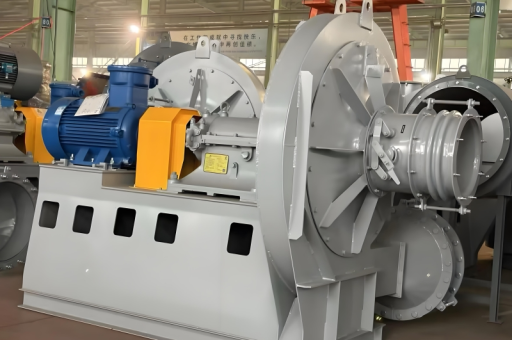
This is a specific and highly technical request. You are asking about a piece of industrial equipment defined by three key performance characteristics:
- Forced Draught (FD): The blower is located before the system (e.g., a boiler, furnace, or dryer) and pushes air into it, operating against positive pressure.
- High Air Flow: The blower is designed to move a large volume of air (measured in CFM or m³/hr).
- High Pressure: The blower must generate significant static pressure (measured in inches of water gauge, Pascal, or PSI) to overcome resistance from ductwork, filters, heat exchangers, or a fuel bed.
The design that most commonly meets these three criteria simultaneously is a Centrifugal Blower with a Backward-Inclined (BI) or Airfoil (AF) Wheel, driven by a high-power motor.
Here is a breakdown of the specific engineering and selection details for such a machine.
Why "Forced Draught" Changes the Design
Unlike an Induced Draught (ID) fan (which pulls air through a system), an FD blower must:
- Overcome System Resistance: It must push air through the entire system (burners, ducts, dampers, boiler tubes) from the inlet side.
- Deliver Combustion Air (Critical): In a boiler, it must provide a precise, stable air volume for combustion. This air is typically clean, ambient air, so the blower is not handling dust, hot gases, or corrosive particulate (simplifying material selection).
- Operate at Variable Loads: Almost all industrial FD systems require Variable Frequency Drives (VFDs) to modulate airflow and pressure to match the process demand, saving significant energy.
Key Components for "High Air Flow, High Pressure"
To achieve both high flow and high pressure, the fan must operate at high speed and have a robust design.
| Component | Specification for HD FD Blower | Reason |
|---|---|---|
| Impeller Type | Backward Inclined (BI) or Airfoil (AF) | These are the most efficient for high-pressure applications. They are non-overloading (motor won't burn out if duct is blocked) and provide a stable pressure curve. |
| Housing | Heavy-gauge steel (e.g., 10ga or thicker), spiral scroll design | Must withstand high internal pressure without distorting. |
| Shaft & Bearings | Oversized shaft (e.g., 4140 steel), mounted on heavy-duty pillow block or split-roller bearings | High radial loads from high pressure. Bearings often require continuous oil lubrication or regreasing systems. |
| Drive System | Direct Drive (Coupling) or V-Belt Drive | Direct drive is common for large, high-power fans (over 200 HP) to avoid belt losses. Belt drive allows for speed (pressure) adjustment via pulley changes. |
| Motor | High-Efficiency (IE3/IE4 or NEMA Premium) TEFC (Totally Enclosed Fan Cooled) | Power is directly proportional to Flow × Pressure. High pressure = high power consumption. |
| Inlet | Conical inlet with an inlet box or vanes (Inlet Vane Control or Inlet Guide Vanes) | Allows precise control of airflow at the inlet of the fan, reducing power consumption compared to dampers. |
Typical Performance Specifications
For a "High Air Flow, High Pressure" FD blower, expect numbers like:
- Flow Rate: 50,000 to 500,000+ CFM (or 100,000 to 1,000,000+ m³/hr)
- Static Pressure: 20" to 100"+ w.g. (5 kPa to 25 kPa)
- Power: 200 HP to 5,000+ HP (150 kW to 3,000+ kW)
- Speed: 1,200 to 3,600 RPM (Direct Drive) or higher through belts.
Common Applications
- Coal/Gas/Biomass Power Plants: Main combustion air supply.
- Industrial Boilers (Packaged & Field Erected): High-pressure steam generation.
- Cement Kilns: Forcing air through the preheater tower.
- Glass Furnaces: Supplying high-pressure air for burners.
- Mining & Ventilation: Forcing fresh air into deep tunnel faces (though axial fans are also common here).
Selection & Pitfall Avoidance
- Don't Oversize the Pressure: A fan designed for 50" w.g. operating in a system needing only 30" w.g. will surge (hunt) and be unstable. The fan curve and system curve must match.
- Sound Levels: High-pressure centrifugal blowers are extremely loud. An acoustic enclosure, silencer on the inlet, and possibly on the discharge are mandatory for operator safety.
- Wheel Construction: For high pressure, the impeller blades must be fully welded. Rivet or bolted impellers can fail catastrophically under high-speed, high-pressure loads.
- Critical Speed Analysis: The manufacturer must perform a critical speed analysis. Operation near the shaft's natural resonant frequency will cause rapid fatigue failure.
- Ductwork Design: The duct immediately before and after the fan must be straight for at least 6 duct diameters. Any elbows or transitions create uneven flow into the impeller, causing vibration, noise, and reduced performance.
Summary for Procurement
If you are sourcing a Forced Draught High Air Flow High Pressure Centrifugal Blower, request a quote with the following minimum data:
- Type: Arrangement 1 or Arrangement 8 (Direct Drive) or Arrangement 3 (Belt Drive)
- Impeller: Backward Inclined (BI) or Airfoil (AF) - specify material (e.g., Corten steel for corrosion, stainless for hygiene).
- Performance: Guaranteed max CFM at max static pressure, operating temperature (ambient), and site altitude.
- Accessories: Inlet box with inlet vanes, VFD compatibility, vibration monitoring (accelerometers), sound enclosure.
- Standards: AMCA 210 (for performance testing) and ISO 1940 (for balance grade - demand G2.5 or G1.0 for high speed).
Recommendation: Contact a specialized industrial fan manufacturer like Howden, New York Blower, Greenheck, Cincinnati Fan, or Chicago Blower with your specific flow, pressure, and temperature requirements. Do not try to adapt a standard "high flow/low pressure" ventilation fan for this duty—it will fail.





