
This article's table of contents introduction:
- Table of Contents
- Introduction: The Role of High-Speed Blowers in Material Handling
- What Is an Oil Cooling Overhang Type Blower?
- Why 4000 RPM? Balancing Speed, Airflow, and Durability
- Design Breakdown: Overhang Mounting, Oil Cooling System, and Fan Structure
- Key Performance Metrics: Pressure, Volume, and Thermal Management
- Application Scenarios: Where This Blower Outperforms Standard Units
- Installation and Maintenance Considerations
- Frequently Asked Questions (FAQ)
- Conclusion: Future-Proofing Your Material Handling System
Article Title:
Maximizing Efficiency with Oil Cooling Overhang Type 4000 RPM Material Handling Blowers: Design, Performance, and Applications
Table of Contents
- Introduction: The Role of High-Speed Blowers in Material Handling
- What Is an Oil Cooling Overhang Type Blower?
- Why 4000 RPM? Balancing Speed, Airflow, and Durability
- Design Breakdown: Overhang Mounting, Oil Cooling System, and Fan Structure
- Key Performance Metrics: Pressure, Volume, and Thermal Management
- Application Scenarios: Where This Blower Outperforms Standard Units
- Installation and Maintenance Considerations
- Frequently Asked Questions (FAQ)
- Conclusion: Future-Proofing Your Material Handling System
Introduction: The Role of High-Speed Blowers in Material Handling
In modern industrial material handling—whether moving bulk solids, conveying granular products, or ventilating dusty environments—the blower is the unsung hero. A material handling blower must deliver consistent airflow, withstand particulate wear, and operate under continuous heavy loads. The Oil Cooling Overhang Type 4000rpm design represents a specialized evolution: it combines high rotational speed with robust thermal management to maintain performance even in high-temperature, high-dust environments. Unlike general-purpose fans, this blower uses an overhang mounting structure and oil circulation cooling to extend bearing life and reduce maintenance downtime—a critical factor for 24/7 industrial operations.
What Is an Oil Cooling Overhang Type Blower?
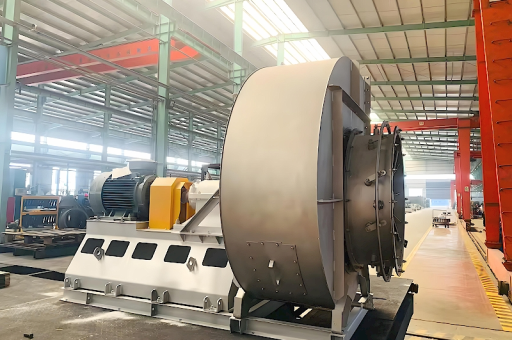
An Oil Cooling Overhang Type Blower refers to a centrifugal or axial flow fan where the impeller is mounted on the motor shaft with overhang support (meaning the impeller extends beyond the bearing support). This design reduces the overall footprint and simplifies shaft alignment. The integrated oil cooling system continuously circulates oil through the bearing housing and, in some configurations, through a heat exchanger or cooling fins. The oil serves dual purposes: it lubricates the bearings and absorbs frictional heat, preventing excessive temperature rise at 4000 RPM.
Key structural features:
- Overhang mounting: The impeller is located on the free end of the shaft, allowing direct coupling to the motor without an intermediate drive.
- Oil sump and circulation loop: Oil is fed via a pump or by shaft-driven slinger rings to bearings and returned to a reservoir.
- Cooling jacket or finned housing: Oil passes through a cooling area (air or water cooled) before recirculating.
This design is particularly advantageous when space is limited and the blower must handle hot gases or ambient temperatures exceeding 60°C.
Why 4000 RPM? Balancing Speed, Airflow, and Durability
Operating at 4000 RPM places this blower in the mid-to-high speed range for industrial fans. Why not slower or faster?
- Airflow vs. Pressure: At 4000 RPM, a typical material handling blower can generate static pressures between 2000–5000 Pa (8–20 inches w.g.) with air volumes of 5000–50,000 m³/h, depending on impeller diameter. This is ideal for pneumatic conveying of materials like cement, plastic pellets, or wood chips.
- Bearing life: Higher speeds generate more heat and wear. The oil cooling system mitigates this, allowing the blower to run at 4000 RPM without premature bearing failure (L10 life often exceeds 40,000 hours under proper maintenance).
- Energy efficiency: 4000 RPM often aligns with 2-pole induction motors (at 50Hz: ~3000 RPM; at 60Hz: ~3600 RPM). Some models use gearboxes or inverter drives to reach exactly 4000 RPM, balancing centrifugal force and impeller stress.
Compared to 3000 RPM units, the 4000 RPM blower delivers roughly 33% more airflow (assuming the same impeller diameter and fan law scaling) but requires careful thermal management—exactly what the oil cooling overhang type provides.
Design Breakdown: Overhang Mounting, Oil Cooling System, and Fan Structure
Overhang Mounting Advantages:
- Reduced shaft length and fewer coupling components → lower installation complexity.
- Easier impeller access for cleaning or replacement.
- Lower vibration tendency if dynamically balanced (ISO 1940 G2.5 or better).
Oil Cooling System Components:
- Oil reservoir – typically located below the bearing housing; holds 2–10 liters of mineral or synthetic oil (ISO VG 32–68).
- Slinger ring or gerotor pump – driven by the shaft to lift oil to the bearings.
- Cooling loop – oil passes through an external radiator (air-cooled) or water-cooled heat exchanger. A fan or blower cooling section may be added.
- Temperature sensors – optional thermocouples to monitor oil temperature and trigger alarms if >85°C.
- Bearing choices – deep groove ball bearings or angular contact bearings, with C3 or C4 clearance to handle thermal expansion.
Fan Structure:
- Impeller material: abrasion-resistant steel (e.g., Hardox 400 or stainless steel for corrosive environments).
- Casing: split housing (quick access for cleaning), with wear liners in the scroll area.
- Shaft seal: labyrinth seal or carbon ring seal to prevent oil leakage.
A typical example: a 250mm diameter impeller with backward-curved blades running at 4000 RPM can move 12,000 m³/h at 3500 Pa static pressure.
Key Performance Metrics: Pressure, Volume, and Thermal Management
| Parameter | Typical Range | Notes |
|---|---|---|
| Rotational speed | 4000 RPM | Fixed or VFD controlled |
| Air volume | 3,000 – 60,000 m³/h | Depends on impeller size |
| Static pressure | 1,500 – 6,000 Pa | Higher with forward-curved blades |
| Oil operating temperature | 50–75°C | Cooling loop limits max to 90°C |
| Noise level | 75–95 dB(A) | Silencer optional |
| Bearing L10 life | 40,000+ hrs | With oil cooling and proper viscosity |
Thermal performance example: Without oil cooling, bearings at 4000 RPM can reach 110°C within 30 minutes in a 40°C ambient. With oil cooling, steady-state bearing temperature is maintained below 70°C, reducing grease breakdown and extending relubrication intervals.
Application Scenarios: Where This Blower Outperforms Standard Units
-
Pneumatic Conveying of Bulk Solids
Example: Moving cement or fly ash through a pipeline. The oil cooling overhang blower runs reliably at high pressure with minimal pulsation. -
Dust Collection in Foundries or Woodworking Plants
High-speed operation generates sufficient suction to capture fine dusts; overhang design reduces buildup on the shaft. -
Oven or Dryer Exhaust Systems
Hot air up to 150°C requires cooling of the bearing area; oil cooling handles this better than air-cooled shaft fans. -
Mine Ventilation in Confined Spaces
Compact overhang design fits small entryways; 4000 RPM delivers required airflow despite backpressure. -
Material Separation (e.g., Air Classifiers)
Precise speed control at 4000 RPM allows tuning of cut size for separating fine powders.
Installation and Maintenance Considerations
- Foundation: Ensure rigid base to avoid resonance at 4000 RPM (typical natural frequency >50 Hz).
- Inlet/Outlet piping: Provide straight duct length (minimum 3x duct diameter) to avoid turbulence and impeller vibration.
- Oil change interval: Every 2,000–3,000 operating hours or annually, whichever comes first. Use oil with anti-oxidation additive.
- Bearing regreasing: If bearings are grease-lubricated (instead of oil), use high-temperature grease (NLGI 2 with PTFE). Oil-cooled bearings rarely need regreasing.
- Vibration monitoring: Install accelerometer on bearing housing; alarm at >7 mm/s RMS, shutdown at >11 mm/s.
- Cooling system check: Ensure heat exchanger fins are clean; water-cooled systems require anti-corrosion treatment.
Most failures occur due to oil starvation or contaminated oil. Using a sight glass and oil temperature gauge is highly recommended.
Frequently Asked Questions (FAQ)
Q1: Can I run an oil cooling overhang type blower at 4500 RPM for higher airflow?
A: Not recommended without consulting the manufacturer. Higher RPM increases centrifugal stress on the impeller and may exceed the cooling capacity of the oil system. Overspeed could lead to impeller burst or oil foaming.
Q2: How do I know if the oil cooling system is working properly?
A: Monitor the oil temperature gauge. Steady state temperature should remain below 75°C. If it exceeds 90°C, check oil level, pump operation, or heat exchanger blockage.
Q3: Is this blower suitable for food-grade material handling?
A: Only if the oil cooling system uses food-grade oil (e.g., NSF H1) and the shaft seal prevents any leak. Standard mineral oil is not suitable for food contact. Specify this when ordering.
Q4: What is the expected lifespan of the impeller?
A: With proper abrasive wear protection (e.g., hard coating or replaceable liners), the impeller can last 3–5 years in cement plants. Without protection, blade erosion may reduce lifespan to 12–18 months.
Q5: Can I retrofit an existing standard blower with oil cooling?
A: In some cases, yes. You would need to replace the bearing housing with a jacketed or finned version, add a circulating pump and heat exchanger, and modify the shaft seal. However, a dedicated oil cooling overhang type blower is more cost-effective for new installations.
Conclusion: Future-Proofing Your Material Handling System
The Oil Cooling Overhang Type 4000 RPM Material Handling Blower is not just a fan—it is an engineered solution for harsh industrial environments. By combining a space-saving overhang mount, a dedicated oil cooling loop, and a shaft speed optimized for high pressure and volume, this design addresses the three critical failure modes of industrial blowers: bearing overheating, shaft misalignment, and dust ingress. For facility managers and process engineers looking to reduce downtime and energy costs while ensuring continuous material movement, this blower offers proven reliability.
When selecting a unit, always verify the air volume vs. pressure curve, the oil cooler capacity against your ambient temperature, and the impeller material compatibility with your conveyed media. Whether you are upgrading a cement plant, a foundry, or a grain handling facility, the oil cooling overhang blower at 4000 RPM will keep your operation running—cool, clean, and efficient.





