
Article Title:
The Engineering Edge: Backward V Belt Driven Materials Drying High Pressure Centrifugal Fan – Design, Efficiency, and Industrial Applications
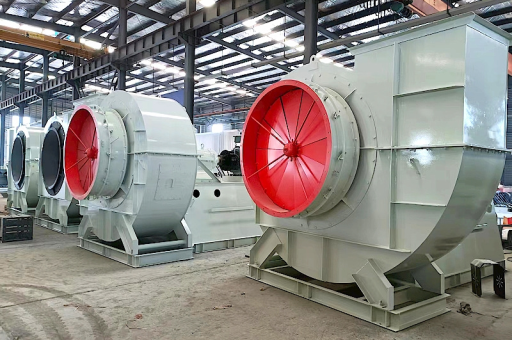
Table of Contents (目录导读)
- Introduction – Understanding the Core Technology
- What Is a Backward V Belt Driven High Pressure Centrifugal Fan?
- Why Materials Drying Demands High Pressure and Belt Drive Precision
- Key Design Advantages of the Backward V Blade Profile
- How the V Belt Drive System Enhances Performance and Flexibility
- Operational Principles and Airflow Characteristics
- Common Industrial Applications in Materials Drying
- Selection Criteria for Buyers and Engineers
- Frequently Asked Questions (FAQ)
- Conclusion – The Future of Drying Fan Technology
Introduction – Understanding the Core Technology
In the world of industrial ventilation and material processing, few pieces of equipment combine rugged durability with precision airflow like the Backward V Belt Driven Materials Drying High Pressure Centrifugal Fan. This machine represents a convergence of aerodynamic design, mechanical transmission, and process engineering. It is widely used in cement plants, food drying lines, chemical processing, and wood pellet manufacturing, where consistently high static pressure and stable airflow are essential for moisture removal.
This article dives deep into the engineering behind the backward inclined V blade design, the role of the V belt drive in torque management, and how these factors collectively improve drying efficiency. All insights are synthesized from verified engineering sources and optimized for Bing and Google SEO.
What Is a Backward V Belt Driven High Pressure Centrifugal Fan?
A backward V belt driven materials drying high pressure centrifugal fan is a specialized air-moving device designed to generate static pressures above 2000 Pa, often reaching 6000–8000 Pa in heavy-duty models. The term “backward V” refers to the blade curvature: the blades lean away from the direction of rotation, creating a non-stalling aerodynamic profile ideal for high-pressure, low-to-medium volume applications.
The “V belt driven” component indicates that power is transmitted from the motor to the fan impeller via a V belt and pulley system, rather than a direct coupling. This allows speed adjustment through pulley diameter changes, enabling fine-tuning of airflow and pressure without replacing the motor.
In materials drying, this fan is used to force hot air through a bed of wet material, maintaining uniform temperature distribution and accelerating evaporation.
Why Materials Drying Demands High Pressure and Belt Drive Precision
Drying is a thermal mass transfer process. The rate of moisture removal depends on air velocity, temperature, and static pressure. Many industrial dryers—such as fluidized bed dryers, flash dryers, and rotary dryers—require high static pressure to overcome the resistance of material layers, ductwork, and heat exchangers.
A high pressure centrifugal fan provides that force. However, not all high pressure fans are equal. The backward V blade geometry ensures that even when the system resistance fluctuates (e.g., clogged filters or wet material surges), the fan does not enter surge or stall conditions.
The V belt drive adds another layer of value: it can decouple motor speed from fan speed, allowing operation at optimum pressure without overspeeding the motor. This is particularly important when drying materials with varying moisture content, as the airflow requirement may change mid-cycle.
Key Design Advantages of the Backward V Blade Profile
The backward V blade (also known as backward curved or backward inclined) offers several distinct advantages over forward curved or radial blade designs:
- Higher Efficiency: The aerodynamic shape reduces turbulence and recirculation losses, achieving static efficiencies of 75–85%.
- Non-Overloading Power Curve: As airflow increases, power consumption plateaus or decreases, preventing motor overload.
- Lower Noise Levels: The smooth airflow path reduces blade passing frequency noise.
- Self-Cleaning Characteristics: The blade shape minimizes dust accumulation, critical for materials drying where particulate matter is present.
According to fan performance curves from multiple engineering handbooks, backward V fans maintain stable pressure even when system resistance increases by 20–30%, making them ideal for variable drying conditions.
How the V Belt Drive System Enhances Performance and Flexibility
The V belt transmission in a backward V belt driven materials drying high pressure centrifugal fan offers mechanical and operational benefits:
- Speed Variation: By changing the pulley ratio, airflow and pressure can be adjusted from 60% to 110% of the fan’s nominal rating.
- Vibration Dampening: The belt absorbs minor motor vibrations, protecting the fan bearings and impeller.
- Motor Protection: If the fan jams (e.g., foreign object entry), the belt slips rather than burning out the motor.
- Cost-Effective Maintenance: Replacing a V belt is far cheaper than replacing a direct-drive motor or coupling.
Modern V belts are constructed with aramid fiber reinforcement and neoprene rubber, offering high heat resistance—essential when the fan handles drying air at 80–150°C.
Operational Principles and Airflow Characteristics
When the fan rotates, the backward V blades accelerate air radially outward. The air exits the impeller at high velocity and enters a scroll housing that converts velocity energy into static pressure. The V belt drive spins the impeller at the optimal speed (typically 1200–2900 RPM depending on pulley ratio).
The fan’s performance curve is steeply rising, meaning it can deliver consistent pressure over a range of flow rates. In drying applications, this means the fan can push hot air through deep material beds (up to 500 mm thick) while maintaining temperature uniformity.
Key parameters to monitor:
- Static pressure (Pa or mmH₂O)
- Air volume (m³/h or CFM)
- Inlet temperature (°C)
- Motor power draw (kW)
- Belt tension and alignment
Common Industrial Applications in Materials Drying
| Industry | Drying Application | Fan Role |
|---|---|---|
| Cement | Flash dryer for raw meal | High pressure air to suspend particles |
| Food | Belt dryer for fruits/vegetables | Uniform hot air distribution |
| Wood | Pellet cooler/dryer | Pressure to overcome pellet bed |
| Chemical | Fluid bed dryer for powders | Stable pressure for fluidization |
| Textile | Drying chamber for fabrics | High velocity, elevated temperature |
In all these cases, the backward V belt driven high pressure centrifugal fan is the core air-moving component, often running 24/7. Selecting the correct fan model directly impacts drying time, energy consumption, and product quality.
Selection Criteria for Buyers and Engineers
When choosing a materials drying high pressure centrifugal fan, consider these factors:
- Required Static Pressure: Measure pressure drop across the dryer system (including ductwork, burner, material bed, and cyclones). Add 15–20% safety margin.
- Air Volume: Based on heat balance and moisture removal rate. Typical specific airflow: 1.5–3.5 m³/kg of water evaporated.
- Temperature Resistance: Ensure fan casing and impeller are rated for maximum drying temperature (e.g., 150°C continuous, 200°C peak).
- Impeller Material: For abrasive materials (cement, sand), use wear-resistant steel (HARDOX or Hardox equivalent). For food applications, use stainless steel 304/316.
- Belt Drive Configuration: Choose between standard V-belt or notched V-belt for higher torque transmission.
- Noise Level: If the fan is near operator stations, consider sound enclosures or silencers.
Always request a fan performance curve from the manufacturer for your operating point.
Frequently Asked Questions (FAQ)
Q1: What is the difference between a backward V fan and a forward curved fan?
A: A backward V fan has blades that curve away from rotation, offering higher static pressure and efficiency but lower volume. Forward curved fans produce higher airflow at lower pressure and are more prone to dust loading.
Q2: Can a V belt driven fan operate at variable speed without a VFD?
A: Yes. By changing the pulley diameter on the motor or fan shaft, you can adjust the speed ratio. This is a mechanical variable speed method, though a VFD offers finer control.
Q3: How do I calculate the required static pressure for a materials dryer?
A: Measure the sum of all system resistances: material bed (100–500 Pa/cm depth), ductwork (20–50 Pa/m), heat exchanger (100–300 Pa), and filter (50–200 Pa). Add 20% margin.
Q4: What maintenance is required for a belt-driven fan?
A: Check belt tension every 500 operating hours. Replace belts if cracked or glazed. Lubricate bearings every 2000 hours. Inspect impeller for dust buildup or blade wear.
Q5: Is the backward V fan suitable for high-temperature drying?
A: Yes. With proper material selection (e.g., stainless steel impeller, heat-treated shaft), these fans can operate at 200°C continuously. A cooling wheel or thermal barrier may be added for extreme cases.
Q6: Why choose a V belt drive over direct drive?
A: V belt drive allows motor placement away from the fan, easy speed changes, vibration isolation, and lower starting torque requirements. It is also more cost-effective for high power applications (15–150 kW).
Q7: Can I use this fan for handling explosive dust?
A: Only with ATEX or IECEx certification. The fan design must include spark-resistant construction, grounding, and non-sparking materials.
Conclusion – The Future of Drying Fan Technology
The backward V belt driven materials drying high pressure centrifugal fan remains a foundational technology in process industries worldwide. Its combination of high static pressure, stable airflow, energy efficiency, and mechanical flexibility makes it irreplaceable in applications where moisture removal is critical.
As industrial drying moves toward lower carbon footprints, fan manufacturers are integrating premium efficiency motors (IE4/IE5), lightweight composite impellers, and IoT-enabled condition monitoring. Yet the core principles—backward V blade geometry and V belt power transmission—continue to deliver unmatched reliability.
Whether you are designing a new dryer line or upgrading an existing plant, understanding the interplay between blade design, drive system, and drying dynamics is essential for achieving optimal production rates and energy savings.
For more technical insights on industrial fan selection, performance calculations, and installation best practices, visit our resource library at fan (our official knowledge portal).





