
This article's table of contents introduction:
- Introduction: Why Flue Gas Handling Matters
- What is a Flue Gas Centrifugal Blower Fan?
- Core Components and Engineering Design
- How Industrial Air Filtration Systems Integrate with Blowers
- Key Performance Metrics: Pressure, Flow, and Efficiency
- Common Applications Across Industries
- Maintenance Best Practices for Longevity
- Frequently Asked Questions (FAQ)
- Conclusion: Optimizing Air Filtration with the Right Fan
** The Critical Role of Flue Gas Centrifugal Blower Fans in Industrial Air Filtration Systems
Table of Contents (TOC)
- Introduction: Why Flue Gas Handling Matters
- What is a Flue Gas Centrifugal Blower Fan?
- Core Components and Engineering Design
- How Industrial Air Filtration Systems Integrate with Blowers
- Key Performance Metrics: Pressure, Flow, and Efficiency
- Common Applications Across Industries
- Maintenance Best Practices for Longevity
- Frequently Asked Questions (FAQ)
- Conclusion: Optimizing Air Filtration with the Right Fan
Introduction: Why Flue Gas Handling Matters
In modern industrial operations, managing exhaust gases is not just a regulatory requirement—it is a cornerstone of operational efficiency, environmental compliance, and workplace safety. The flue gas centrifugal blower fan stands at the heart of every robust industrial air filtration system. These fans are engineered to move large volumes of hot, corrosive, or particulate-laden gas streams from combustion processes, boilers, incinerators, and kilns to downstream filtration units. Without a reliable centrifugal blower, even the most advanced baghouse or scrubber cannot function effectively.
This article provides a comprehensive, SEO-optimized technical overview of flue gas centrifugal blower fans, their integration into industrial filtration systems, and critical factors for selection and maintenance. Content is based on cross-referenced industry data and engineering best practices.
What is a Flue Gas Centrifugal Blower Fan?
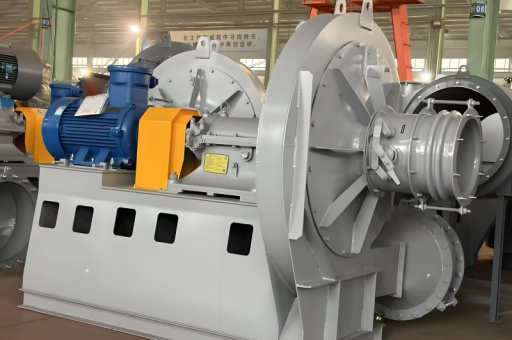
A flue gas centrifugal blower fan is a mechanical device that uses rotating impellers to increase the velocity and pressure of gas flow. Unlike axial fans, centrifugal blowers draw gas into the center of the impeller and discharge it radially, creating higher static pressure. This design is essential for overcoming the resistance of ductwork, filters, dampers, and scrubbers in an industrial filtration system.
These fans are specifically designed to handle harsh conditions: high temperatures (often up to 250°C or higher), acidic condensate, abrasive fly ash, and the risk of explosion in combustible environments. They are typically constructed from carbon steel, stainless steel (304/316), or specialty alloys with wear-resistant coatings and high-temperature seals.
Core Components and Engineering Design
A high-performance flue gas centrifugal blower is composed of several key subsystems:
- Impeller: The heart of the fan. Designs include backward-curved, forward-curved, and radial blades. For flue gas, backward-curved impellers are preferred for their high efficiency and self-cleaning properties.
- Housing (Volute): A spiral casing that converts velocity energy into static pressure. The housing must be robust enough to withstand thermal expansion and vibration.
- Shaft & Bearings: Heavy-duty bearings with cooling systems (oil mist or forced lubrication) are required to handle radial and axial loads from the rotating assembly.
- Drive System: Direct drive (motor mounted directly) or belt drive (for variable speed control). For corrosive environments, direct drive is often favored to reduce belt maintenance.
- Inlet & Outlet Flanges: Designed to match ductwork sizes (e.g., 200mm to 2000mm diameter). Dampers may be integrated for flow control.
- Sealing Systems: Mechanical seals or labyrinth seals prevent gas leakage to the bearing house and environment.
How Industrial Air Filtration Systems Integrate with Blowers
An industrial air filtration system consists of multiple stages: a capture hood, ductwork, a pre-separator (if needed), a primary filter (baghouse, cartridge, or electrostatic precipitator), a fan, and a stack or exhaust point. The flue gas centrifugal blower fan is always placed downstream of the filtration media in negative pressure systems, or upstream in positive pressure configurations.
- In a negative pressure system, the fan draws gas through the filter, preventing contaminated air from escaping through leaks.
- In a positive pressure system (less common for flue gas), the fan pushes gas into the filter.
The fan must generate sufficient static pressure to overcome the total system resistance: duct friction losses, filter pressure drop (often 1000–2000 Pa for baghouses), damper losses, and stack draft. A typical flue gas blower for a medium-sized boiler may operate at 15–50 kPa static pressure.
Key Performance Metrics: Pressure, Flow, and Efficiency
Selecting the correct fan requires careful analysis of these parameters:
- Volume Flow Rate (Q): Measured in m³/h or CFM. Determined by the combustion process and system requirements.
- Static Pressure (P): The pressure required to overcome system resistance. Higher static pressure often means higher power consumption.
- Fan Efficiency (η): Modern centrifugal blowers achieve 75–85% peak efficiency. Inefficient fans waste energy and generate unnecessary heat.
- Speed (RPM): Affects both flow and pressure. Variable frequency drives (VFDs) are increasingly used to match fan output to real-time process demand.
- Power Consumption (kW): Calculated as: Power (kW) = (Q × P) / (η × 3600). Accurate sizing reduces operational costs.
Example: A flue gas fan handling 50,000 m³/h at 5,000 Pa with 80% efficiency consumes approximately 86.8 kW. A 10% drop in efficiency can increase annual electricity costs by tens of thousands of dollars.
Common Applications Across Industries
| Industry | Application | Typical Gas Temperature | Key Considerations |
|---|---|---|---|
| Power Generation | Boiler flue gas extraction | 150–350°C | High particulate load; abrasion-resistant impellers |
| Cement & Lime | Kiln exhaust gas handling | 200–400°C | High dust concentration; specialized alloy impellers |
| Incineration (Waste-to-Energy) | Post-combustion gas filtration | 180–300°C | Corrosive acidic gases; hot acid-resistant coatings |
| Chemical & Petrochemical | Process furnace exhaust | 100–250°C | Potential explosive atmospheres; ATEX-certified design |
| Steel & Metals | Furnace off-gas removal | Up to 500°C | Extreme heat; water-cooled bearings |
Maintenance Best Practices for Longevity
To maximize the service life of a flue gas centrifugal blower in an industrial filtration system, adopt these maintenance strategies:
- Vibration Monitoring: Install accelerometers on bearing housings. Unbalance or blade erosion increases vibration levels and indicates impending failure.
- Bearing Lubrication: Use high-temperature grease (e.g., NLGI Grade 2) and follow manufacturer intervals. Over-lubrication can cause overheating.
- Impeller Inspection: Check for wear, erosion, or build-up (crusting) every 3–6 months. Build-up can unbalance the rotor.
- Belt Tension (Belt Drive Models): Keep belts properly tensioned. Loose belts reduce flow and accelerate wear.
- Seal Integrity: Monitor for gas leakage around the shaft. Replace seals proactively to prevent bearing contamination.
- Balancing: Re-balance the impeller after repairs or replacement to reduce vibration and bearing load.
Frequently Asked Questions (FAQ)
Q1: What is the difference between a flue gas centrifugal blower and a conventional centrifugal fan?
A: The primary difference is material selection and design for high temperature, corrosive gases, and abrasive particles. Standard fans cannot handle flue gas conditions and would fail prematurely.
Q2: How do I calculate the required fan power for my industrial filtration system?
A: Use the formula: Power (kW) = (Flow rate in m³/s × Static pressure in Pa) ÷ (1000 × Fan efficiency). For example, 13.89 m³/s (50,000 m³/h) × 5,000 Pa ÷ (1000 × 0.80) = 86.8 kW. Always include a 10–15% safety margin for system losses.
Q3: Can a flue gas centrifugal blower be used in a hazardous (ATEX) area?
A: Yes, but the fan must be designed with explosion-proof features: non-sparking impeller materials (e.g., aluminum bronze or stainless steel), conductive casing, shaft grounding, and ATEX-rated motors and seals.
Q4: Why is my fan vibrating after a short period of operation?
A: Common causes: impeller imbalance due to particulate accumulation, blade erosion, or bearing damage. First, check for build-up on blades. If clean, perform a dynamic balancing procedure.
Q5: What is the typical lifespan of a flue gas centrifugal blower fan?
A: With proper maintenance, 10–15 years. Harsh conditions (high temperatures, acidic gases, heavy particles) can reduce lifespan to 5–8 years if not properly specified and maintained.
Conclusion: Optimizing Air Filtration with the Right Fan
The flue gas centrifugal blower fan is a specialized, high-stakes component within every industrial air filtration system. Selecting the wrong fan leads to system inefficiency, increased maintenance costs, and even regulatory non-compliance. Engineers must consider gas composition, temperature, particulate load, system static pressure, and environmental safety standards when specifying a fan.
By integrating a properly sized, well-maintained centrifugal blower with efficient filtration media (baghouses, scrubbers, or electrostatic precipitators), industrial facilities achieve lower emissions, reduced energy consumption, and prolonged equipment life. As emissions regulations tighten globally, the demand for high-performance flue gas fans that deliver reliability under extreme conditions will only increase. For any facility managing combustion exhaust, the centrifugal blower remains an irreplaceable workhorse in the quest for clean air.





