
This article's table of contents introduction:
- The System: Induced Draft (ID) Fan
- The Problem: Flue Gas & Corrosion
- The Solution: Corrosion Resistant Design
- Typical Applications:
- To summarize the "AC Motor Flue Gas Fan Induced Draft Corrosion Resistant Exhaust Fan":
It sounds like you are describing a specific type of industrial fan used in power plants, chemical processing, or waste incineration. Based on the keywords you provided, here is a breakdown of what that fan is and its key characteristics:
The System: Induced Draft (ID) Fan
- Definition: An Induced Draft fan is located after the combustion chamber, boiler, or process equipment (on the "downstream" side). It creates a negative pressure (vacuum) inside the system, pulling flue gases through the heat exchangers, scrubbers, and ducts before exhausting them to the chimney.
- Opposite: Forced Draft (FD) fans pressurize and push air into the system.
The Problem: Flue Gas & Corrosion
Flue gases are hot, often abrasive, and chemically aggressive (acidic).
- Common Contaminants: Sulfur dioxide (SO₂) and trioxide (SO₃), which form sulfuric acid (H₂SO₄) when combined with water vapor below the acid dew point. Chlorides (HCl) are also common in waste-to-energy plants.
- Corrosion Risk: If the flue gas temperature drops below the acid dew point (typically 120-140°C / 248-284°F for sulfuric acid), condensation occurs, causing rapid, catastrophic corrosion of standard steel.
The Solution: Corrosion Resistant Design
This fan is engineered to survive the acidic, moist environment. Key features include:
-
Materials of Construction (Wetted Parts):
- High-Grade Stainless Steel: 316L, 904L, or Super-Duplex (e.g., SAF 2507) for extreme resistance to chlorides and sulfuric acid.
- FRP (Fiber-Reinforced Plastic): Entire fan housings and impellers can be made of FRP for excellent chemical resistance and light weight. This is common for low-temperature scrubbers.
- Coated / Lined: Carbon steel housing lined with rubber, epoxy (e.g., Novolac or Vinyl Ester), or PVDF.
-
Impeller Design (Wheel):
- Radial or Paddle Wheel: Most common for ID fans. Handles dust and particulate well (self-cleaning).
- Backward Curved or Airfoil: More efficient but more prone to erosion from fly ash, so they often require harder leading-edge coatings.
- Overhung vs. Double Inlet: Double inlet (double width, double inlet) is common for large volumes at low/medium pressure.
-
Shaft & Bearing Protection:
- Shaft Sleeves: Made of 316L SS or other alloys to protect the shaft from corrosive gases.
- Bearing Isolators: Inboard labyrinth seals, often with a purge air system to keep acidic fumes away from the bearings.
- External Bearings: Bearings are mounted outside the fan housing, on a pedestal, separated by a cooling/ventilation fan and shaft seal.
-
Drive Arrangement: Typically belt-driven or direct-driven via a motor.
Typical Applications:
- Power Plants: Coal, biomass, or oil-fired boilers (Boiler ID Fan).
- Waste-to-Energy (Incineration): Extremely harsh due to HCl and SO₂.
- Cement Plants: Kiln exhaust.
- Chemical & Metallurgical: Acid manufacturing, fertilizer plants.
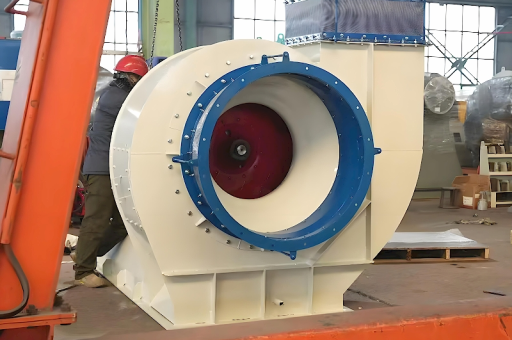
To summarize the "AC Motor Flue Gas Fan Induced Draft Corrosion Resistant Exhaust Fan":
It is a heavy-duty, negative-pressure exhaust fan driven by an AC electric motor, specifically designed to handle the hot, dirty, and highly acidic gases produced by industrial combustion, with all gas-contact parts made from stainless steel, FRP, or protective coatings to prevent acid attack.
If you are looking to specify or purchase one, you would need the following critical parameters:
- Volume (CFM / m³/hr)
- Static Pressure (in WG / Pa)
- Gas Temperature (Normal & Max)
- Gas Composition (% SO₂, HCl, H₂O)
- Dust Loading (grains/ft³ or mg/m³)
- Material of Construction (e.g., "Wetted parts: 316L SS" or "FRP")
Important Note for Industrial Safety: Because ID fans handle hot, corrosive, and potentially toxic gases, they are critical to plant safety. They must be monitored for vibration and blade wear. A failure can cause a boiler to back-pressure, leading to a flame-out or dangerous gas leaks. Regular inspection and maintenance are mandatory.





