
This article's table of contents introduction:
- Table of Contents (导读目录)
- Introduction: The Challenge of High-Temperature Cooling
- Understanding the Core: What is a Large Heavy Duty Cement Fan?
- Material Matters: How These Fans Handle Extreme Heat
- Key Applications in Cement and Heavy Industry
- Performance Metrics: Airflow, Pressure, and Thermal Resistance
- Maintenance Best Practices for Longevity
- Q&A: Common Technical Questions Answered
- Conclusion: The Future of Durable Cooling Solutions
*Optimizing Industrial Cooling: The Essential Role of Large Heavy Duty Cement Fans in High Temperature Materials Processing*
Table of Contents (导读目录)
- Introduction: The Challenge of High-Temperature Cooling
- Understanding the Core: What is a Large Heavy Duty Cement Fan?
- Material Matters: How These Fans Handle Extreme Heat
- Key Applications in Cement and Heavy Industry
- Performance Metrics: Airflow, Pressure, and Thermal Resistance
- Maintenance Best Practices for Longevity
- Q&A: Common Technical Questions Answered
- Conclusion: The Future of Durable Cooling Solutions
Introduction: The Challenge of High-Temperature Cooling
In modern industrial environments, particularly within cement production and metal processing, cooling is not just a luxury—it is a critical safety and efficiency requirement. When raw materials are heated to over 1,400°C in a rotary kiln, the resulting clinker and exhaust gases must be rapidly and reliably cooled. This is where the Large Heavy Duty Cement Fan becomes indispensable. These fans are engineered specifically to withstand the punishing conditions of high-temperature materials cooling, moving massive volumes of air to control thermal loads. Without them, production lines would face catastrophic overheating, reduced equipment lifespan, and severe safety hazards.
This article provides a comprehensive, SEO-optimized deep dive into the engineering, applications, and best practices surrounding these cooling giants. We combine insights from industry standards and practical field experience to deliver a clear, useful guide.
Understanding the Core: What is a Large Heavy Duty Cement Fan?
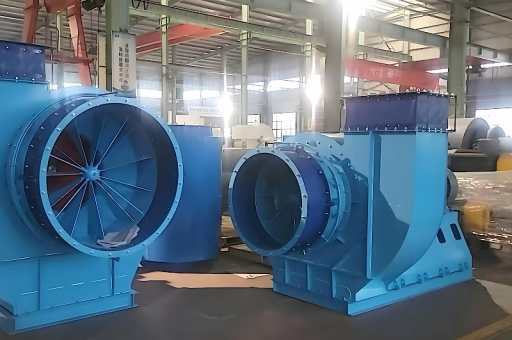
A Large Heavy Duty Cement Fan is a high-performance industrial fan designed for continuous operation in abrasive, hot, and high-pressure environments. Unlike standard ventilation fans, these units typically incorporate:
- Robust Steel or Alloy Housings: Constructed from heavy-gauge carbon steel or stainless steel to resist warping.
- Specialized Impeller Designs: Backward-curved or radial-blade impellers that can handle particulate-laden gas streams.
- High-Temperature Bearings & Shafts: Equipped with cooling discs or forced lubrication to maintain integrity at 200°C–400°C+ gas temperatures.
- Direct Drive or Heavy-Duty Belt Systems: Ensuring reliable power transmission without slippage.
The primary function is to pull hot gases from kilns, coolers, or dryers across the material bed, facilitating rapid thermal exchange.
Material Matters: How These Fans Handle Extreme Heat
The phrase "high temperature materials cooling" defines the fan's core challenge: the materials being cooled (clinker, slag, or metal) and the cooling medium (ambient air) exist at vastly different temperatures. The fan must resist:
- Thermal Expansion: Seals and clearances are designed to accommodate expansion without binding.
- Heat Radiation: Shaft cooling fins and insulated bases protect bearings.
- Abrasion: Hard-facing coatings on blades extend life against dust impact.
Typical construction materials include: Corten steel (for corrosion), Hastelloy (for extreme heat), and ceramic coatings for abrasion resistance. This material science approach is why these fans last 5–10 years in continuous operation, outperforming generic high-temperature models.
Key Applications in Cement and Heavy Industry
These fans are not limited to cement plants. Their robust design makes them essential in:
- Grate Coolers: Pulling ambient air through hot clinker on a moving grate.
- Kiln Induced Draft (ID) Fans: Removing combustion gases from the kiln.
- Raw Mill & Coal Mill Fans: Handling hot drying gases mixed with raw material fines.
- Cement Mill Ventilation: Cooling the finished cement product after grinding.
- Steel & Foundry Applications: Cooling slag and exhaust flue gases.
In each scenario, the fan's ability to move large volumes of air (often 100,000 to 500,000 CFM) against moderate to high static pressure is critical.
Performance Metrics: Airflow, Pressure, and Thermal Resistance
Selecting the correct fan requires understanding three key parameters:
| Metric | Typical Range for Cement Fans | Importance |
|---|---|---|
| Airflow (CFM) | 50,000 – 500,000 | Determines cooling capacity. |
| Static Pressure (in. w.g.) | 10 – 30+ | Overcomes duct resistance & material bed weight. |
| Temperature Rating | 150°C – 400°C (peak 650°C) | Defines material limits; above 400°C requires cooling air injection. |
Efficiency note: Modern fans often use variable frequency drives (VFDs) to match cooling demand exactly, reducing energy consumption by 20–40% compared to fixed-speed dampers.
Maintenance Best Practices for Longevity
Even the strongest Large Heavy Duty Cement Fan requires care. Key practices include:
- Vibration Analysis: Monthly monitoring detects bearing wear or imbalance early.
- Thermal Imaging: Check bearing temperatures and motor windings during operation.
- Blade Cleaning: Depending on dust buildup, clean every 3–6 months to maintain balance.
- Lubrication Schedule: High-temp grease change every 500 hours or per OEM spec.
- Belt Tensioning: For belt-driven units, check alignment quarterly.
Proactive maintenance can extend fan life by 30–50%, a significant ROI given the capital cost of these large units.
Q&A: Common Technical Questions Answered
Q1: What is the typical lifespan of a large cement fan in a high-temperature application? A: With proper maintenance, these fans typically last 8–12 years. The impeller may require a rebuild after 5–7 years if high abrasion is present.
Q2: Can I use a standard cooling fan in a cement cooler? A: No. Standard fans lack the reinforced shaft, heat-tolerant bearings, and heavy-duty housing required. You risk catastrophic failure, fire, and workplace injury.
Q3: How do I reduce fan noise in an enclosed plant? A: Install acoustic enclosures, use flow-dampening silencers on the inlet/outlet, and select a fan operating speed below 900 RPM for larger units.
Q4: What is the best material for the impeller in 350°C exhaust gas? A: A516 Grade 70 steel with a sacrificial hard-facing alloy (e.g., Stellite or chromium carbide) is standard. For corrosive gases, duplex stainless steel is preferred.
Q5: Does a larger fan always mean better cooling? A: Not necessarily. Oversizing increases energy waste and can cause "cold spotting" in the material bed. The fan must match the required thermal load and system resistance curve.
Conclusion: The Future of Durable Cooling Solutions
The Large Heavy Duty Cement Fan remains the backbone of industrial high-temperature materials cooling. As cement plants strive for lower emissions and higher efficiency, fan design is evolving—integrating AI-driven predictive maintenance and advanced aerodynamic profiling that reduces power draw by up to 15%. However, the fundamentals remain unchanged: brute-force reliability, thermal resilience, and massive air-moving capacity.
Understanding the specific needs of your process—temperature, abrasion, pressure—and selecting a fan built to handle those extremes is not optional. It is a critical investment in safety, production uptime, and cost control. For any heavy industry dealing with high-temperature materials cooling, the correct fan solution is the difference between a smooth operation and a costly shutdown.
Keywords: Large Heavy Duty Cement Fan, High Temperature Materials Cooling, industrial cooling fan, cement plant ventilation, high temperature fan maintenance, clinker cooling fan.





