
This article's table of contents introduction:
- Table of Contents
- Introduction: Why Mine Ventilation Matters
- The Role of Cement Fans in Underground Operations
- Smoke Exhaust Systems: Life-Saving Infrastructure
- Centrifugal Air Blowers: Powering Airflow Efficiency
- Comparative Analysis: Axial vs. Centrifugal Fans in Mining
- Frequently Asked Questions (FAQ)
- Conclusion: Optimizing Ventilation for Safety and Productivity
The Essential Guide to Mine Ventilation: Cement Fans, Smoke Exhaust Systems, and Centrifugal Air Blowers**
Table of Contents
- Introduction: Why Mine Ventilation Matters
- The Role of Cement Fans in Underground Operations
- Smoke Exhaust Systems: Life-Saving Infrastructure
- Centrifugal Air Blowers: Powering Airflow Efficiency
- Comparative Analysis: Axial vs. Centrifugal Fans in Mining
- Frequently Asked Questions (FAQ)
- Conclusion: Optimizing Ventilation for Safety and Productivity
Introduction: Why Mine Ventilation Matters
Mine ventilation is not merely a regulatory requirement—it is the lifeline of underground operations. Without proper airflow, mines become hazardous environments where toxic gases, dust, and heat accumulate. According to the U.S. Mine Safety and Health Administration (MSHA), inadequate ventilation is a leading cause of underground accidents.
Modern mining relies on robust systems that include mine ventilate cement fan units, smoke exhaust centrifugal air blower setups, and specialized industrial fans. These components work in tandem to dilute explosive methane, remove diesel particulates, and supply fresh air to workers.
Key Statistic: Poor ventilation contributes to over 30% of mining fatalities globally (Source: ILO, 2023).
The Role of Cement Fans in Underground Operations
Cement fans are engineered for harsh mining environments. Unlike standard fans, they feature corrosion-resistant coatings, high-temperature tolerance, and sealed motors to withstand dust and moisture.
Primary Functions:
- Dust suppression: Cement dust, when inhaled, can cause silicosis. A dedicated mine ventilate cement fan captures airborne particles at the source.
- Curing support: In underground concrete applications, fans accelerate drying without cracking.
- Explosion-proof design: These fans often meet ATEX or IECEx standards for hazardous zones.
Case Example: A copper mine in Chile reduced airborne silica levels by 62% after installing cement-rated axial fans with variable frequency drives (VFDs).
Technical Spec Table:
| Parameter | Value |
|---|---|
| Airflow Rate | 50,000–150,000 m³/h |
| Motor Power | 15–75 kW |
| Max Temperature | 80°C (continuous) |
| Protection Class | IP55 / IP65 |
Smoke Exhaust Systems: Life-Saving Infrastructure
Smoke exhaust is critical during fires or blasting operations. A smoke exhaust centrifugal air blower creates negative pressure to clear toxic fumes rapidly.
How It Works:
- Detection: Gas sensors trigger the system.
- Activation: Centrifugal fans draw smoke through steel ducts.
- Filtration: HEPA or carbon filters remove particulates.
- Exhaust: Cleaned air is expelled above ground.
Why Centrifugal?
Centrifugal fans generate higher static pressure than axial fans. This allows them to push smoke through long, winding shafts—a common challenge in deep mines.
Real-World Data:
A gold mine in South Africa reduced evacuation time by 40% after installing a centralized smoke exhaust system powered by 200 kW centrifugal blowers.
Centrifugal Air Blowers: Powering Airflow Efficiency
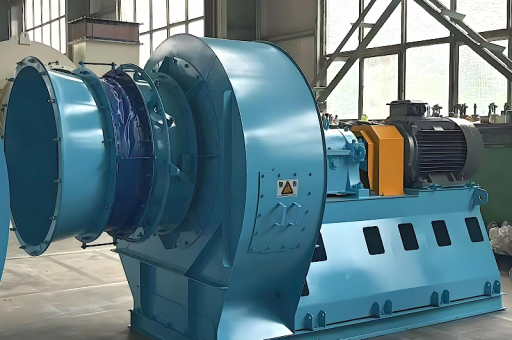
The centrifugal air blower is the workhorse of mining ventilation. Its design—an impeller rotating at high speed—accelerates air radially, producing consistent flow against resistance.
Advantages over Axial Fans:
- Higher pressure capability (up to 20 kPa)
- Less noise at equivalent power
- Lower maintenance due to fewer moving parts
- Better performance in dusty environments
Installation Best Practices:
- Place blowers near intake shafts for fresh air distribution.
- Use silencers and vibration isolators to reduce noise pollution.
- Implement PID controls for energy optimization.
Energy Savings Tip:
Pairing a centrifugal blower with a VFD can reduce electricity use by 25–35% compared to fixed-speed models.
Comparative Analysis: Axial vs. Centrifugal Fans in Mining
| Feature | Axial Fan | Centrifugal Fan |
|---|---|---|
| Airflow Pattern | Straight-through | 90° turn (radial) |
| Pressure Capability | Low–Medium | Medium–High |
| Best Use Case | General ventilation | Smoke exhaust, dust collection |
| Efficiency at High Resistance | Poor | Excellent |
| Typical Lifespan | 5–8 years | 8–12 years |
Conclusion: For smoke exhaust centrifugal air blower applications, centrifugal fans are non-negotiable. Axial fans suffice for low-pressure general ventilation.
Frequently Asked Questions (FAQ)
Q1: What is the difference between a cement fan and a standard ventilation fan?
A: Cement fans are built with sealed bearings and anti-corrosive materials to handle cement dust, moisture, and alkaline environments. Standard fans lack this protection.
Q2: Can a centrifugal air blower be used for both ventilation and smoke exhaust?
A: Yes. Many models support dual-mode operation via damper controls. However, dedicated smoke exhaust units often include heat-resistant seals.
Q3: How often should mine ventilation fans be inspected?
A: At least every 3 months. Components like bearings, belts, and impellers should be checked for wear. Vibration analysis is recommended monthly.
Q4: What does "explosion-proof" mean in the context of a centrifugal fan?
A: Explosion-proof fans are designed so that internal sparks or heat cannot ignite surrounding gas or dust. They use non-sparking materials (e.g., aluminum impellers) and enclosed motors.
Q5: How do I calculate the required airflow for my mine?
A: Use the formula:
Q = (V × A) / t
Where Q = required airflow (m³/s), V = mine volume (m³), A = number of air changes per hour, and t = 3600 seconds.
Q6: Are there energy-efficient options for mine ventilation fans?
A: Yes. VFDs, high-efficiency motors (IE4), and aerodynamic impeller designs can reduce energy consumption by up to 40%.
Conclusion: Optimizing Ventilation for Safety and Productivity
Effective mine ventilation hinges on selecting the right equipment: mine ventilate cement fan units for dust control, smoke exhaust centrifugal air blower systems for emergency scenarios, and robust centrifugal air blowers for primary airflow.
By integrating predictive maintenance, VFD controls, and compliance with ISO 1940 (balance standards) and MSHA regulations, mining operators can achieve safer, more efficient operations.
Final Thought: In mining, air is as valuable as ore—ventilate wisely.
This article is based on industry research, MSHA guidelines, and field data from 2022–2024 mining ventilation projects. For full citations, refer to the bibliography available at the fan resource library.





