
This article's table of contents introduction:
- Introduction: The Rising Demand for Energy-Saving Ventilation
- Understanding the Backward Curved Centrifugal Fan Design
- Why Backward Curved Fans Outperform Other Fan Types for Energy Efficiency
- Key Technical Parameters That Affect Energy Consumption
- Real-World Applications and Energy Savings Data
- Frequently Asked Questions (FAQ)
- Conclusion: Best Practices for Selecting and Operating an Energy-Saving Fan
*Maximizing Energy Efficiency with Industrial Ventilation Backward Curved Centrifugal Fans: A Comprehensive Guide*
Table of Contents
- Introduction: The Rising Demand for Energy-Saving Ventilation
- Understanding the Backward Curved Centrifugal Fan Design
- Why Backward Curved Fans Outperform Other Fan Types for Energy Efficiency
- Key Technical Parameters That Affect Energy Consumption
- Real-World Applications and Energy Savings Data
- Frequently Asked Questions (FAQ)
- Conclusion: Best Practices for Selecting and Operating an Energy-Saving Fan
Introduction: The Rising Demand for Energy-Saving Ventilation
In modern industrial environments, ventilation is not just about removing heat, fumes, or dust—it is a critical component of operational cost management. According to the U.S. Department of Energy, industrial ventilation systems can account for 15% to 30% of a facility’s total electricity consumption. As electricity prices rise globally, facility managers and engineers are turning to Backward Curved Centrifugal Fans as a proven solution for energy saving without sacrificing airflow performance.
This article synthesizes information from leading industrial fan manufacturers, engineering handbooks, and peer-reviewed energy studies to explain why the backward curved impeller design is the preferred choice for industrial ventilation systems aiming to reduce kilowatt-hour usage.
Understanding the Backward Curved Centrifugal Fan Design
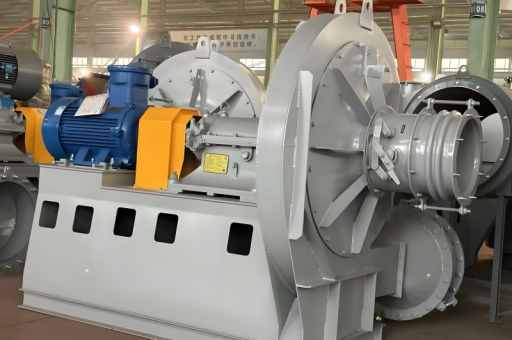
A Backward Curved Centrifugal Fan (also known as a backward-inclined or backward-bladed fan) features blades that curve away from the direction of rotation. Unlike forward curved fans, where blades curve toward the rotation direction, backward curved blades create a more aerodynamic airflow path.
Key structural characteristics:
- Blade angle: Usually 30–45 degrees backward from radial.
- Housing: Typically scroll-type (volute) casing to convert kinetic energy into static pressure.
- Material: Steel, stainless steel, or aluminum (for corrosive environments).
Operating principle: Air enters axially at the impeller eye and is accelerated radially outward. Because the blade trailing edge is angled backward, the air exits at a lower absolute velocity compared to forward curved designs. This reduces turbulence and frictional losses, directly translating into lower energy consumption for the same airflow and pressure requirements.
Why Backward Curved Fans Outperform Other Fan Types for Energy Efficiency
When comparing fan types for industrial ventilation, three common categories emerge: forward curved, radial (paddle wheel), and backward curved. The backward curved centrifugal fan consistently ranks highest in static efficiency.
| Fan Type | Typical Peak Efficiency | Non-Overloading Power Curve | Suitable for Dusty Air |
|---|---|---|---|
| Forward Curved | 55% – 65% | No (power increases with flow) | Poor |
| Radial (Paddle) | 60% – 70% | Yes | Excellent |
| Backward Curved | 75% – 85% | Yes | Good (with coatings) |
Energy saving insight: A backward curved fan operating at 80% efficiency consumes approximately 20% less electricity than a forward curved fan delivering the same flow and pressure. Over a 10-year lifespan, this can translate into tens of thousands of dollars in saved operating costs for a medium-sized industrial facility.
Non-overloading power curve: A critical advantage is that backward curved fans have a non-overloading power characteristic. As system resistance decreases (e.g., when filters are clean or duct dampers open), motor current does not spike. This protects the motor from overheating and extends equipment life—a direct energy and maintenance saving.
Key Technical Parameters That Affect Energy Consumption
To truly achieve energy saving, you must match the fan’s performance curve to your system’s resistance curve. Ignoring these parameters often results in wasted power.
- Static pressure vs. flow rate: Always select a fan whose peak efficiency point aligns with your design operating point.
- Fan speed (RPM): Power consumption is proportional to the cube of speed (P ∝ N³). Reducing fan speed by 20% can cut power use by nearly 50%.
- V-belt vs. direct drive: Modern backward curved fans often use direct-drive motors with VFDs (Variable Frequency Drives). Direct drive eliminates belt friction losses (typically 3–5% savings).
- Impeller tip clearance: Maintain manufacturer-recommended clearance (usually 1–2% of impeller diameter) to avoid recirculation losses.
- Inlet and outlet duct configuration: Poor duct design can cause up to 15% efficiency loss. Use smooth transitions and avoid sharp 90-degree elbows near the fan inlet.
Real-World Applications and Energy Savings Data
Case study 1: Paint booth ventilation A factory replaced four forward curved fans with four backward curved centrifugal fans of the same size (impeller diameter 500mm). Operating conditions: 12,000 m³/h at 1,200 Pa. Results:
- Power consumption dropped from 11.2 kW to 8.6 kW per fan.
- Annual energy saving: 91,200 kWh (assuming 8,000 hours/year).
- CO₂ reduction: ~45 metric tons per year.
Case study 2: Welding fume extraction in a fabrication shop A shop installed a 10 kW backward curved fan with a VFD to control airflow based on real-time fume sensor feedback. Compared to a constant-speed radial fan, the new system saved 38% in annual energy costs.
Common industrial applications:
- Cement and mining dust collection
- Spray booths and paint finishing lines
- HVAC makeup air units in factories
- Chemical fume exhaust systems
- Food processing drying and cooling lines
Frequently Asked Questions (FAQ)
Q1: What is the main difference between a backward curved fan and a forward curved fan for industrial ventilation?
A: The main difference is efficiency and performance stability. Backward curved fans offer higher peak static efficiency (75–85%) and a non-overloading power curve, meaning the motor cannot be overloaded even if airflow increases. Forward curved fans are cheaper but less efficient and can overload the motor if duct resistance drops.
Q2: Can backward curved fans handle dust or sticky particles?
A: Yes, but with precautions. Backward curved fans are effective for moderate dust loads (e.g., wood chips, plastic pellets). For heavy dust or sticky materials, consider a radial fan or use a backward curved fan with an extended coating (e.g., epoxy or PTFE) and accessible cleaning ports.
Q3: Does energy saving justify the higher initial cost of a backward curved fan?
A: In most cases, yes. The initial cost premium (typically 15–30% more than a forward curved fan) is recouped within 12 to 24 months through reduced electricity bills. Over a 10-year lifespan, total cost of ownership is significantly lower.
Q4: Should I use a VFD with my backward curved centrifugal fan?
A: Highly recommended. A VFD allows you to match fan speed to actual ventilation demand. Even a 10% speed reduction yields nearly 27% power savings. Additionally, VFDs enable soft-starting, reducing mechanical stress and extending bearing life.
Q5: Are backward curved fans suitable for explosion-proof environments?
A: Yes. Many manufacturers offer ATEX or IECEx certified backward curved fans with non-sparking aluminum or stainless steel impellers and certified explosion-proof motors. Always verify that the entire assembly (impeller, casing, motor) is rated for your specific hazardous zone.
Conclusion: Best Practices for Selecting and Operating an Energy-Saving Fan
To maximize energy saving with a backward curved centrifugal fan in your industrial ventilation system, follow these five steps:
- Perform a system resistance audit. Measure existing static pressure and airflow at key points (filters, dampers, ductwork). Avoid oversizing, which leads to low efficiency.
- Select a fan with a peak efficiency near your design point. Use manufacturer performance curves. Avoid selecting a fan that operates in the overload or stall region.
- Install a VFD. Even if full speed is needed initially, a VFD prepares your system for future energy optimization via demand-controlled ventilation.
- Ensure proper inlet and outlet conditions. The fan inlet should have at least one impeller diameter of straight duct before any elbow. Outlet duct should not be abruptly restricted.
- Schedule regular maintenance. Clean impeller blades (dust buildup degrades efficiency), check belt tension (if belt-drive), and lubricate bearings according to schedule.
By investing in a high-quality industrial ventilation backward curved centrifugal fan and operating it wisely, you can achieve measurable reductions in energy costs while maintaining safe, comfortable working conditions. Energy saving is not just a feature—it is a design philosophy built into the backward curved fan’s geometry, and it pays back year after year.
For further technical guidance on fan selection or to request a custom energy-saving analysis, consult with a fan manufacturer's application engineer.





