
This article's table of contents introduction:
- The Components Defined
- Why Backward Curved Fans are Used for PA Fans
- The Critical Role of Dynamic Balancing in a PA Fan
- Practical Considerations for a PA Fan
- Summary Table
This request combines a specific piece of industrial equipment (Backward Curved Centrifugal Fan), its specific application (PA Fan in Boiler), and a critical maintenance requirement (Dynamic Balanced).
Here is a detailed explanation of how these elements come together.
The Components Defined
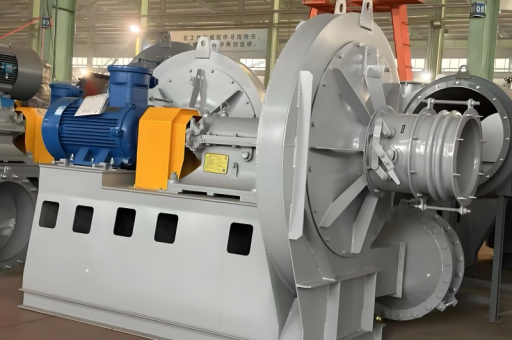
- Backward Curved Centrifugal Fan: This refers to the blade design. The blades curve away from the direction of rotation. This design is more efficient, generates less noise, and is non-overloading (power draw peaks at a specific point and then drops off, preventing motor burnout).
- PA Fan (Primary Air Fan): This is the function of the fan in a coal-fired power plant boiler. The PA Fan provides the "primary air" needed to:
- Dry the coal in the pulverizer (mill).
- Transport the pulverized coal from the mill to the burners.
- Provide the initial air for combustion at the burner.
- Dynamic Balanced: This is a mandatory manufacturing and maintenance process. It ensures that the rotating assembly (impeller, shaft, coupling) has its mass distributed symmetrically around the axis of rotation. An unbalanced fan causes high vibrations, bearing failure, shaft fatigue, and structural damage.
Why Backward Curved Fans are Used for PA Fans
While PA Fans can be centrifugal or axial, backward curved centrifugal fans are a very common choice, especially for high-pressure applications in modern boilers.
- High Pressure, High Efficiency: Coal transport requires significant static pressure to push the air-coal mixture through the mill and long pipe runs to the boiler. Backward curved fans offer high static pressure capability with superior efficiency (often 75-85%) compared to forward curved or radial blade fans.
- Stable Operation (Non-Overloading Power Curve): This is critical for boiler safety. If the pressure drop across the coal system changes (e.g., a mill is taken offline), the fan's power draw will not spike, protecting the motor from tripping.
- High-Speed Capability: They can handle the high rotational speeds needed to generate the required pressure (typically 800-1500 rpm for large utility fans).
- Resistance to Wear: The backward curved profile is less prone to particle buildup and erosion from coal dust than some other designs (like radial tip).
The Critical Role of Dynamic Balancing in a PA Fan
A PA Fan is a prime candidate for stringent dynamic balancing for several reasons:
Consequences of an Unbalanced PA Fan:
| Consequence | Specific Impact on PA Fan & Boiler |
|---|---|
| Bearing Failure | The fan operates at high speeds. An imbalance of just a few grams can create centrifugal forces (F = mrω²) large enough to destroy bearings within days. |
| Shaft Fatigue & Cracking | Cyclic vibration stress leads to fatigue failure of the shaft, a catastrophic event. |
| Coupling & Motor Damage | Vibration is transmitted to the motor, damaging its bearings, rotor, and shaft alignment. |
| Structural Damage | High vibration can crack the fan housing, ductwork, and foundation bolts. |
| Mill & Coal Transport Disruption | Vibration can trip vibration sensors, shutting down the PA fan. This stops coal flow to the boiler, causing a sudden loss of boiler load (a "runback" or "trip"). |
The Dynamic Balancing Process (for a PA Fan):
- Rig & Machine: The assembled fan impeller is placed on a dynamic balancing machine (hard or soft bearing type) that measures both magnitude and phase of imbalance.
- Initial Reading: The machine spins the impeller (often at operating speed) and displays the amount and location of the "heavy spot."
- Correction: Material is removed (typically by grinding or drilling) from the heavy spot.
- Manufacturing: Balancing is done on the impeller disc or hub.
- Field Balancing (In-Situ): If the fan is already installed, balancing is sometimes done by adding weights to a dedicated balancing ring on the shaft or impeller.
- Verification: The fan is re-spun, and the residual vibration is measured. Standards like ISO 1940 G-6.3 or G-2.5 (for high-speed fans) are the typical acceptance criteria. A well-balanced PA fan will have vibration levels well below 0.1 inches per second (IPS) or 1.5 mm/s RMS.
Practical Considerations for a PA Fan
- Erosion & Wear: The impeller of a PA fan is constantly exposed to coal dust. Even if perfectly balanced at installation, erosion can alter the blade profile and mass distribution over time, creating a new imbalance. Regular vibration monitoring and re-balancing (every 6-12 months or after mill maintenance) is essential.
- Buildup of Material: "Ragging" or coal dust buildup on the blades can also cause imbalance. Water washing or abrasive cleaning procedures are used periodically.
- High Temperature: The air from the PA fan is preheated (via the Air Preheater) to 300-400°F. This thermal expansion can affect the balance if not accounted for during manufacture.
- Standard vs. Spark-Resistant: In environments with explosive coal dust, the fan must be built to AMCA Type C or D Spark-Resistant Construction (using non-ferrous impeller rings or blading). Dynamic balancing must be done with extreme care to avoid overheating components.
Summary Table
| Feature | PA Fan Requirement | Backward Curved Fan Advantage |
|---|---|---|
| Pressure | High (silt transport) | Excellent high-pressure efficiency |
| Power Stability | Non-overloading (to protect motor) | Inherent non-overloading power curve |
| Vibration | Must be low for reliability | Allows for precise dynamic balancing (G-2.5) |
| Wear Resistance | Moderate - exposed to coal dust | Blade shape minimizes erosion impact |
In short: A Backward Curved Centrifugal PA Fan that is properly Dynamic Balanced is a reliable, efficient, and safe workhorse for a coal-fired boiler. Without that balance, it is a source of constant downtime, vibration-induced failures, and potential boiler trips.





