
This article's table of contents introduction:
- Core Function & Why "High Pressure"?
- Key Design Features for Waste Gas Applications
- Types of High Pressure Fans Used
- Fan Placement in the System
- Selection & Sizing: A Step-by-Step Guide
- Common Applications
- Key Maintenance & Troubleshooting
- Summary Table for Selection
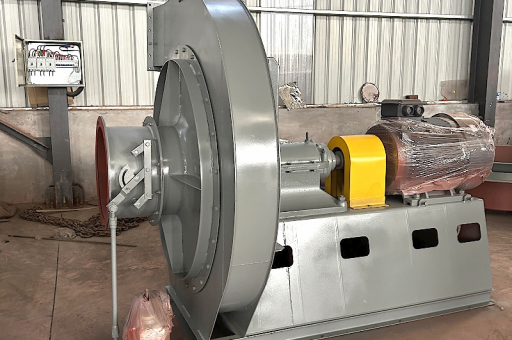
This is a comprehensive topic. An Industrial Waste Gas Treatment High Pressure Centrifugal Fan is a critical component in pollution control systems. Its primary job is to overcome the significant resistance (pressure drop) created by scrubbers, filters, ducts, and stacks to move corrosive or particulate-laden air safely and efficiently.
Here is a detailed breakdown of its design, selection criteria, applications, and key considerations.
Core Function & Why "High Pressure"?
In waste gas treatment, the fan is not just moving air; it is pulling or pushing air through restrictive equipment.
- Low/Medium Pressure Fans: Used for simple ventilation (e.g., moving air through a warehouse) with minimal resistance.
- High Pressure Fans (≥ 2,000 Pa / 200 mmH₂O up to 15,000+ Pa): Required when the system includes:
- Wet Scrubbers: Water sprays and packing media create significant backpressure.
- Baghouse Filters / Dust Collectors: Cloth filters, especially when caked with dust, are very restrictive.
- Carbon Adsorbers: Granular activated carbon beds create resistance.
- Regenerative Thermal Oxidizers (RTOs): Ceramic media beds cause pressure drops.
- Long, Complex Ductwork: Many elbows, dampers, and long runs.
Key Design Features for Waste Gas Applications
Standard fans will corrode or fail quickly in these harsh environments. Specialized features are critical.
-
Material of Construction (Most Important):
- Impeller: Often made of 316L Stainless Steel (for mild corrosives), Hastelloy (for strong acids like HCl, SO₂, or chlorides), or FRP (Fiber Reinforced Plastic) (excellent for acidic gases like HF, H₂SO₄ mist). For abrasive dust (e.g., cement, fly ash), a hardened steel or ceramic-lined impeller is needed.
- Housing (Volute/Scroll): Can be carbon steel with thick epoxy or rubber lining, or solid FRP, or stainless steel.
- Shaft: Typically 316L or a high-strength alloy, often sealed from gas contact with a shaft sleeve.
-
Sealing & Leak Prevention (Crucial for Hazardous Gases):
- Shaft Seals: Mechanical seals (for zero leakage) or carbon ring seals are used instead of simple packing. This prevents VOC (Volatile Organic Compound) or toxic gas from leaking into the atmosphere or the motor room.
- Compensators/Flexible Connectors: Installed at the inlet and outlet to absorb vibration and allow for thermal expansion, preventing stress on ductwork.
-
Explosion-Proof & Safety:
- ATEX / IECEx / NEC Certification: If the gas stream is flammable (e.g., VOCs from paint booths, solvent recovery), the entire fan assembly (motor, wiring, grounding) must be rated for the specific gas group.
- Shaft Grounding: Prevents static electricity build-up which can cause a spark.
- Spark-Resistant Construction: Impeller and housing designed to avoid metal-to-metal contact (e.g., using aluminum or plastic tips on a steel impeller).
-
Performance Characteristics:
- Backward Curved Blades (BC): Most efficient, non-overloading power curve (motor won't burn out if airflow is lower than expected).
- Forward Curved Blades (FC): Can produce high pressure at lower speeds but are less efficient and have an overloading power curve.
- Radial Blades (Paddlewheel): Best for severe dust loading or sticky materials (e.g., in a baghouse). Strong, but lower efficiency.
Types of High Pressure Fans Used
| Type | Pressure Range | Best For | Pros | Cons |
|---|---|---|---|---|
| Centrifugal Fan (BC/FC) | 2,000 - 10,000 Pa | General scrubbing, RTOs, carbon adsorbers | High efficiency, stable curve | Moderate resistance to dust |
| Radial / Paddlewheel Fan | 3,000 - 15,000+ Pa | Heavy dust (baghouses, cyclones), sticky materials | Very robust, handles abrasives | Low efficiency, noisy |
| Multi-Stage Centrifugal Fan | > 10,000 Pa | Systems needing very high pressure but low flow (e.g., ejectors, venturi scrubbers) | High pressure in a compact unit | Complex, expensive, high RPM |
| High Pressure Blower (Ring/Regenerative) | Up to 8,000 Pa | Low volume, clean gas (e.g., fume hoods, small lab scrubbers) | Oil-free, compact, low maintenance | Low flow capacity, noisy |
Fan Placement in the System
- Pull-Through (Induced Draft / ID Fan): Fan is located after the scrubber/filter.
- Pro: Fan handles cooler, partially cleaned gas (longer life).
- Con: Fan is under negative pressure (vacuum), making leaks dangerous.
- Push-Through (Forced Draft / FD Fan): Fan is located before the scrubber/filter.
- Pro: Fan is under positive pressure (leaks push gas out).
- Con: Fan handles hot, dirty, corrosive gas directly from the source.
Selection & Sizing: A Step-by-Step Guide
-
Define Requirements:
- Flow Rate (Q): In m³/hr or CFM. (Must account for temperature and altitude).
- Total Static Pressure (TSP): Sum of all pressure losses (duct friction, scrubber delta P, filter delta P, stack exit loss) at the operating flow rate.
- Gas Properties: Temperature, humidity, chemical composition (acids, VOCs, dust type & concentration), corrosiveness, explosiveness.
-
Select Material & Sealing:
Based on gas chemistry and temperature. (e.g., FRP for wet HCl gas at 60°C; 316L SS for dry SO₂ at 150°C; Carbon steel with 1/16" rubber lining for abrasive gas).
-
Choose Fan Type & Curve:
- Use manufacturer's performance curves to find a fan that delivers the required Flow & Pressure at the calculated operating point.
- Always select a motor with a service factor (e.g., 1.15 or 1.2) to handle variations in gas density or filter loading.
-
Drive & Control:
- VFD (Variable Frequency Drive): Highly recommended. Allows precise control of airflow as conditions change (e.g., filter loading). Saves energy and protects the motor.
- Belt Drive vs. Direct Drive: Belt drive allows easy speed changes; direct drive is more efficient and has lower maintenance.
Common Applications
- Chemical & Petrochemical: Scrubbing HCl, Cl₂, SO₂, NH₃, H₂S. RTOs for VOC destruction.
- Pharmaceutical: Solvent recovery, fume extraction.
- Metal Finishing / Plating: Scrubbing acid and alkaline mists (chrome, nickel, cyanide).
- Cement & Mining: Baghouse dust collectors on kilns, crushers, and conveyors.
- Waste-to-Energy / Incineration: Induced draft fans on scrubbers and filters handling flue gas.
- Semiconductor Fabrication: Handling toxic and pyrophoric gases (often with dry scrubbers).
Key Maintenance & Troubleshooting
- Vibration Monitoring: The biggest cause of failure is bearing or impeller imbalance due to corrosion or dust build-up. Use accelerometers.
- Drainage: Ensure the fan housing has a properly sized drain to remove condensed moisture or wash water.
- Inlet & Outlet Dampers: Keep them free-moving. Corrosion or dust build-up is common.
- Belt Tension: For belt-drive fans, check tension regularly. Slipping belts can lead to overloading the motor.
- Motor & Bearings: Use sealed, corrosion-resistant bearings. Monitor motor temperature.
Summary Table for Selection
| Parameter | Critical Question | Typical Answer for Waste Gas |
|---|---|---|
| Atmosphere | Is it corrosive or abrasive? | Use SS316, Hastelloy, FRP, or lined steel. |
| Hazard | Is it flammable or explosive? | ATEX/IECEx certified fan + explosion-proof motor + spark-resistant construction. |
| Temperature | What is the max gas temp? | Fan materials must survive. Cooling air or special alloys needed for >200°C. |
| Pressure | What is the total system resistance? | Must be at least 2,000 Pa. Often 3,000 - 8,000+ Pa for scrubbers/filters. |
| Flow | How much gas volume at operating temp? | Fan curves are based on actual CFM (ACFM), not standard (SCFM). Temperature correction is key. |
| Leakage | Is zero leakage required? | Yes for toxic gases → Use mechanical seals, purge systems, and PTFE gaskets. |
If you have a specific application (e.g., "I have a wet scrubbing system for sulfuric acid mist at 80°C with a flow of 10,000 m³/hr and a pressure drop of 4,500 Pa, what fan type is best?"), I can give you a more targeted recommendation.





