
This article's table of contents introduction:
- Core Application in Cement Kilns
- Key Specifications & Performance
- Critical Design & Construction Features
- Why is this fan considered "Heavy Duty"?
- Common Challenges & Solutions
- Leading Manufacturers for this Application
- Summary for Specification
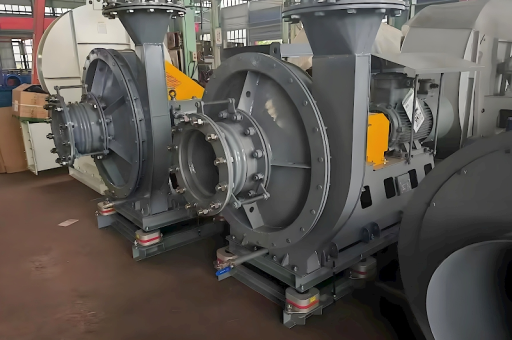
It appears you are looking for a specific type of industrial fan: a Heavy Duty, High Pressure, High Temperature, Cement Kiln Centrifugal Fan.
These are custom-engineered pieces of equipment designed for the most demanding environment in a cement plant: the kiln system (including the preheater, kiln burner, and clinker cooler).
Here is a detailed breakdown of what this fan entails, its specifications, design features, and why it is critical.
Core Application in Cement Kilns
In a cement plant, these fans serve three primary roles, each requiring extreme durability:
- Kiln Induced Draft (ID) Fan: Pulls combustion air and hot gases (up to 400°C / 750°F) through the entire kiln and preheater tower. This is the most critical fan for the process.
- Preheater Fan: Circulates hot gases from the kiln through the cyclone preheater towers to preheat the raw meal.
- Cooler Vent Fan (or Clinker Cooler Fan): Cools the hot clinker (1,400°C / 2,550°F) exiting the kiln by forcing ambient air through the cooler bed. This fan handles moderate temperatures but high dust loads.
Key Specifications & Performance
- Pressure: High Pressure (typically 1,500 to 3,000 mmWG or 15 to 30 kPa). This is necessary to overcome the resistance of the packed material bed (in the cooler) or the preheater cyclones.
- Temperature: High Temperature (Continuous operation at 250°C to 400°C, with surge capability up to 450°C-500°C for ID fans).
- Flow Rate: High Volume (ranging from 100,000 m³/h to over 1,000,000 m³/h depending on plant size).
- Dust Load: Extremely abrasive dust (raw meal, clinker dust). Fan wheels must be designed to resist erosion.
- Motor Power: Very high (often 1,000 kW to 3,000 kW or more).
Critical Design & Construction Features
Because of the aggressive environment, these fans are not standard off-the-shelf units. They require specific engineering:
Impeller (Wheel) Design
- Material: High-strength, abrasion-resistant steel (e.g., S690 QL or Hardox-like liners). For extremely high temperatures, heat-resistant alloys like SA 240 310S or SA 387 P22 (Chrome-Moly) are used.
- Design: Typically Backward-Curved (BC) for higher efficiency and stability. Blades are often wear-lined with sacrificial plates.
- Reinforcement: Heavy-duty, thick discs to prevent failure at high rotational speeds (critical for pressure).
Shaft & Bearings
- Shaft: Large diameter, forged steel, with tight tolerances to handle the weight and thermal expansion.
- Bearings: Spherical roller bearings housed in heavy-duty, water-cooled or thermally isolated pillow blocks. Accelerometers are often installed for vibration monitoring.
- Cooling: The bearing housing must be isolated from the main casing by a "cooling disc" to prevent heat transfer.
Casing (Housing)
- Material: Carbon steel (e.g., IS 2062, ASTM A36) for the body, but internally lined with high-temperature resistant insulation (e.g., ceramic fiber blanket) and a stainless steel inner liner to prevent corrosion from acidic condensates (sulfuric acid from sulfur in the fuel).
- Expansion Joints: The casing and ductwork must include robust expansion joints to absorb thermal movement.
Drive System
- VFD (Variable Frequency Drive): Almost mandatory for modern kiln fans. It allows for precise control of the kiln draft, massive energy savings, and soft starting.
- Coupling: High-torque, flexible coupling (or a fluid coupling for large fans) to smooth out shock loads.
Safety & Monitoring
- Vibration Sensors: Tri-axial vibration probes on each bearing.
- Temperature Sensors: RTDs on bearings and a "temperature runaway" sensor near the impeller to detect overheating.
- Auxiliary Oil Pump: For large bearings, a backup oil pump ensures lubrication during coast-down.
Why is this fan considered "Heavy Duty"?
- Continuous 24/7 Operation: It runs for months or years without shutdown.
- Erosive Environment: The gas carries highly abrasive cement dust.
- Thermal Cycling: The fan must handle rapid temperature changes during kiln start-ups.
- Corrosion: At specific temperatures, sulfur in the fuel can combine with combustion gases to form sulfuric acid, which corrodes standard steel.
- High Inertia: The large impeller is heavy. The drive system must be robust enough to overcome this inertia safely.
Common Challenges & Solutions
| Challenge | Cause | Solution |
|---|---|---|
| Blade Wear | Abrasive dust at high velocity. | Wear plates on leading edges; hardfacing; ceramic lining. |
| Rotor Imbalance | Uneven dust buildup on blades. | Frequent cleaning ports; specialized blade coating to prevent adhesion. |
| Bearing Failure | High heat conduction from shaft. | Water-cooled bearing pedestals; isolation cooling discs. |
| Vibration | Thermal distortion; buildup. | Online vibration monitoring; Auto-balancing systems (rare). |
| Stress Cracking | Thermal fatigue. | Stress-relieved components; flexible expansion joints. |
Leading Manufacturers for this Application
If you are looking to source or specify one, some of the world's top manufacturers specialize in these exact fans:
- FläktGroup / Howden (Now part of Chart Industries) - Global leader in kiln fans.
- TLT-Turbo (Germany) - Specializes in high-temperature ID fans for cement.
- Venti Oelde (Germany) - High-performance centrifugal fans.
- Chicago Blower (USA) - Heavy-duty industrial fans.
- Kruger Ventilation (Europe).
- Zhejiang Shangfeng (China) & Shenyang Blower Works (China) - High-quality, cost-effective options.
- Howden Africa (South Africa) - For regional supply.
Summary for Specification
If you need to write a specification for this fan, you must include:
"Supply of a Heavy Duty, High Pressure, High Temperature Centrifugal Fan for Cement Kiln Application.
- Type: Single Inlet, Double Suction (or Single Suction), Backward Curved Aerofoil Blades.
- Capacity: [XXXX] m³/h @ [XXXX] Pa (or mmWG).
- Gas Temperature: Normal [XXX]°C, Maximum [XXX]°C.
- Gas Composition: Kiln exhaust gas with [X] g/Nm³ dust load.
- Impeller Material: [e.g., Corten Steel with hardfacing] or Stainless Steel.
- Drive: VFD controlled, with water-cooled bearings.
- Compliance: ISO 1940 for balance, API 610 (or similar) for vibration limits."
Would you like help estimating the power requirement or suggesting a specific manufacturer for a given capacity?





