
This article's table of contents introduction:
- Detailed Breakdown of Each Component:
- Putting it All Together:
- Common Applications for this Specific Configuration:
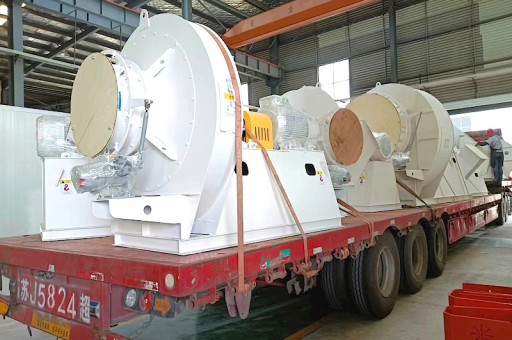
This string of keywords appears to describe a very specific piece of industrial equipment. Let's break down what each term means and how they combine to define the fan.
The Short Answer: This describes a heavy-duty, explosion-proof centrifugal fan used to pull (induce) air or gases out of a system (like a boiler or chemical reactor). It is made of carbon steel, driven by a V-belt system from a motor, and is designed to operate safely in hazardous environments containing flammable dusts, vapors, or gases.
Detailed Breakdown of Each Component:
V-Belt Driving
- What it means: The fan wheel is not directly connected to the motor shaft. Instead, an electric motor sits on a base, and a V-belt (like a heavy-duty rubber belt) connects a small pulley on the motor to a larger pulley on the fan shaft.
- Why it's used:
- Variable Speed: You can change the fan’s speed (RPM) by changing the pulley sizes without changing the motor.
- Overload Protection: The belt will slip (or break) if the fan jams, protecting the motor from burning out.
- Motor Placement: Allows the motor to be placed away from the fan housing, which is critical if the fan handles hot gases.
- Shock Absorption: V-belts dampen vibration from the fan.
Carbon Steel
- What it means: The main construction material (housing, wheel, inlet cone) is carbon steel, not stainless steel, aluminum, or plastic.
- Why it's used:
- Strength: Very strong and durable.
- Cost: Significantly cheaper than stainless steel.
- Limitation: It will rust if exposed to moisture without a protective coating (paint, galvanization). It is not suitable for highly corrosive gases (like acids or chlorine).
Forward (Curved)
- What it means: This refers to the shape of the blades on the fan's impeller (wheel). The blades curve forward in the direction of rotation (like a hamster wheel).
- Characteristics of Forward Curved Fans:
- High Volume, Low Pressure: They move a very large volume of air but cannot generate high static pressure. They are "air movers."
- Quieter Operation: Generally quieter than backward-curved or radial fans.
- Horsepower Curve: The power draw increases as the airflow increases. This is an important safety consideration (you cannot restrict the inlet too much without overloading the motor).
Explosionproof
- What it means: This is the most critical safety specification. The fan is designed and certified to contain an internal explosion without igniting the flammable atmosphere outside the fan. This is NOT just "spark resistant."
- Key Construction Details:
- Heavy Housing: The housing is thick enough to withstand an internal explosion.
- Shaft Seal: A tight seal prevents sparks or flames from traveling along the shaft.
- Spark-Resistant Materials: The impeller is often made of non-sparking material (aluminum, monel) or a carbon steel wheel is coated with brass or runs inside a copper ring.
- Non-Ferrous Ring: A clearance ring made of a non-sparking material is often placed around the inlet to prevent ferrous contact.
- Motor: The driving motor must also be explosion-proof (e.g., NEC Class I, Div 1, Groups C & D for gases; Class II, Div 1, Groups E, F, G for dusts).
- Why it's needed: For environments with flammable gases (fumes from solvents, natural gas) or combustible dusts (coal, grain, wood, chemical powders).
Induced Draft Fan (ID Fan)
- What it means: This defines the fan's function and location in a system.
- Function: It pulls (induces) air or flue gases out of a system (like a boiler, furnace, or dryer).
- Location: It is placed after the process equipment. It creates a negative pressure (vacuum) inside the equipment.
- Condition: ID fans typically handle hot, dirty, often abrasive gases (like fly ash from a coal boiler).
Putting it All Together:
Imagine a coal-fired boiler in a large industrial building or power plant.
- Function: The Induced Draft fan is located at the end of the flue gas path. It pulls the hot, dirty exhaust gas out of the boiler and out of the stack.
- Drive: The fan is spun by a V-Belt from an electric motor. This allows the operator to change the fan speed (and thus the draft in the boiler) by changing the belt pulleys.
- Construction:
- Carbon Steel is the primary material. It's strong enough for the large size required and the heat. It's acceptable because coal flue gas isn't highly corrosive (though it is abrasive).
- Forward Curved blades are chosen because this specific fan must move a very high volume of gas, but doesn't need to fight against extreme back pressure (the stack provides some natural draft).
- Safety: The fan is Explosionproof because coal dust is highly explosive. If the gas entering the fan contains unburnt coal dust and a spark occurs (from a foreign object hitting the wheel), the fan is designed to contain the resulting explosion and prevent it from spreading back into the boiler room or the rest of the ductwork.
Common Applications for this Specific Configuration:
- Boiler Draft Systems (Coal, Oil, Wood Pellet)
- Dust Collection Systems (Explosive dusts like grain, wood, carbon black)
- Chemical Processing (Solvent vapor extraction)
- Kilns and Furnaces
- Fume Extraction in Hazardous Environments
In short: This is a rugged, high-volume, explosion-proof fan designed to pull dirty or hazardous gases through an industrial process, using a belt drive for speed control and motor protection.





