
This article's table of contents introduction:
- The Core Challenge: The Kiln Environment
- Typical Materials of Construction (By Component)
- Detailed Material Properties Required
- Standard Delivery Scope (Typical Bill of Materials)
- Critical Specification Points for Procurement
- Example Delivery Description (For a Purchase Order)
- Common Mistakes to Avoid
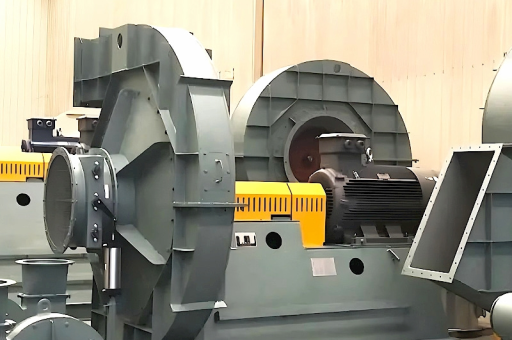
Here is a detailed breakdown of the Materials Delivery for an Industrial Kiln Exhaust Fan (Centrifugal Type). This specification is critical because the fan handles high-temperature, abrasive, and potentially corrosive gases directly from the kiln.
The Core Challenge: The Kiln Environment
Before listing materials, understand the operating conditions that dictate material selection:
- High Temperature: Gas inlet temperatures can range from 200°C (392°F) to over 500°C (932°F) depending on the process (cement, lime, steel, waste incineration).
- Abrasion: Fly ash, clinker dust, and unburnt fuel particles are highly erosive at high velocities.
- Corrosion: Sulfur oxides (SOx), chlorides, and alkalis can form acids (H₂SO₄, HCl) at dew points, especially during startup or shutdown.
- Structural Load: Large impellers (up to 4-5 meters diameter) experience massive centrifugal forces.
Typical Materials of Construction (By Component)
| Component | Standard Material | High-Temp / Abrasion Upgrade | Extreme Duty (Waste-to-Energy/Cement) |
|---|---|---|---|
| Impeller (Wheel) | Corten Steel (ASTM A606 / S355J2W) or Hardox 400/500 | 16Mo3 (P265GH) for 400-500°C | Inconel 625 / Hastelloy X (for corrosion + temp) or Ceramic-Lined Steel |
| Shaft | AISI 4140 (Quenched & Tempered) | AISI 431 (Stainless, high strength) | Inconel 718 (for creep resistance) |
| Housing (Scroll) | Mild Steel (IS 2062 / ASTM A36) with Abrasion-Resistant Liners | Hardox 500 plate (full thickness) | Stainless Steel 310S (for temp) + Ceramic Tile Lining |
| Bearings | Standard SKF/FAG (with high-temp grease) | Water-Cooled Bearing Housing or Oil Mist Lubrication | Split Roller Bearings with Thermocouple Monitoring |
| Inlet Cone | Mild Steel (replaceable wear part) | Stainless Steel 304L (for corrosion) | Ceramic-Faced Cone |
Detailed Material Properties Required
A. Impeller (The Most Critical Component)
- Requirement: Must withstand high centrifugal stress, thermal expansion, and erosion.
- Preferred Material: Q345R or 16Mo3 (Pressure Vessel Steel) for temperatures up to 450°C.
- Failure Risk: If temperature exceeds 500°C, standard carbon steel loses tensile strength rapidly. Use Stainless Steel 310S (0-25Cr-20Ni) or Incoloy 800H/HT.
- Treatment: Impellers are often stress-relieved after welding to prevent cracking.
B. Abrasion Protection (For Cement / Mining Kilns)
- Method 1: Apply Tungsten Carbide or Chrome Carbide hardfacing on the leading edge of impeller blades.
- Method 2: Use Bolted Wear Plates (made of Hardox 500 or Chrome-Moly steel) on the housing sidewalls (the "tongue" area) where the gas velocity is highest.
C. Shaft & Seals
- Shaft Material: Must be heat-treated to handle torque. EN24 (817M40) or AISI 4340 is common.
- Seal Type: Avoid lip seals; use Carbon Ring Seals or Labyrinth Seals with a purge air system (air from the fan discharge or external blower) to prevent hot gas leakage into the bearing assembly.
Standard Delivery Scope (Typical Bill of Materials)
When specifying a "Materials Delivery," include the following components:
- Fan Impeller:
- Backward-curved blades (for high efficiency & non-clogging).
- Material: 16Mo3 / Hardox / Stainless 310S.
- Included: Dynamic balancing to ISO 1940 G6.3 or G2.5.
- Fan Casing (Scroll):
- Heavy-duty carbon steel with reinforced stiffeners.
- Included: Inspection door, drain plug, clamshell design (split housing) for impeller removal without disturbing ductwork.
- Included: Manhole for internal inspection.
- Inlet Box & Dampers:
- Inlet vanes (louver dampers) made of cast iron or stainless steel for flow control.
- Drive System:
- Motor (often IE3/IE4 high-efficiency).
- Shaft coupling (flexible gear coupling).
- V-belt drive (for speed variation) OR Direct drive (via coupling).
- Base Frame:
- I-Beam or channel frame.
- Included: Vibration isolators (spring or rubber).
- Included: Stainless steel shims for alignment.
Critical Specification Points for Procurement
| Parameter | Standard Value | Why it matters |
|---|---|---|
| Temperature Class | T400 (up to 400°C) or T500 (up to 500°C) | Determines yield strength and thermal expansion allowance. |
| Wear Allowance | +3mm to +6mm on blade thickness | Predicts service life in abrasive environments. |
| Corrosion Allowance | 5mm to 3mm | For acidic gas conditions (e.g., kilns burning high-sulfur fuel). |
| Welding Code | EN 1090 or API 650 for structural; ASME IX for pressure parts | Ensures weld integrity at high temp. |
| Pre-weld Treatment | Post Weld Heat Treatment (PWHT) for >35mm plate thickness | Removes residual stress to prevent cracking at high temp. |
| Surface Protection | Silicone-based high-temp paint (up to 600°C) OR Zinc spray | Prevents oxidation during operation. |
Example Delivery Description (For a Purchase Order)
"Supply of Centrifugal Industrial Kiln Exhaust Fan"
- Material: Impeller in 16Mo3 (DIN 1.5415) for operation at 450°C inlet temperature.
- Casing: S355J2+N structural steel, 10mm thick with Hardox 500 liners in the wear zone (5mm thick, bolted).
- Shaft: AISI 4140 heat-treated to 28-32 HRC.
- Bearings: SKF 222 Series spherical roller bearings in water-cooled housings (supplied with inlet/outlet water fittings).
- Protection: Impeller leading edges hard-faced with Stellite 6 (to HRC 40-45).
- Finish: High-temperature silicone aluminum paint (resistant to 600°C).
- Certification: Material certificates per EN 10204 3.1 for all pressure-retaining parts.
- Testing: Over-speed test at 115% of max RPM; Dynamic balancing report.
Common Mistakes to Avoid
- Don't use standard fans: Kiln gases are hot and dirty. Standard centrifugal fans will fail in weeks.
- Don't ignore the 'cold end': The bearing housing must be heat-sinked or water-cooled. Failure of the cooling system is the #1 cause of shaft/bearing failure.
- Don't forget the expansion joint: The fan casing needs a flexible connection (expansion joint) between the fan inlet/outlet and the ductwork to handle thermal growth.
- Material substitution: Never substitute 16Mo3 with standard MS (e.g., A36) at high temperatures. Creep failure will occur.
Final Recommendation: If you are ordering this for a cement plant or steel mill, ask the vendor for a "Heat Resistant" version with a ceramic-lined housing and water-cooled bearing pedestal. For waste incineration, specify Alloy 625 for the impeller. Always provide the exact gas composition, temperature, and dust loading (g/Nm³) when requesting a quotation.





