
This article's table of contents introduction:
- Table of Contents
- Introduction: The Critical Role of Cooling in Industrial Kilns
- What is a Backward Stainless Steel Material Handling Fan?
- Key Design Features: Why Stainless Steel and Backward Curved Blades?
- Application in Kiln Cooling: A Technical Deep Dive
- Comparative Analysis: Backward vs. Forward Curved Fans
- Frequently Asked Questions (FAQ)
- Maintenance & Longevity: Best Practices
- Conclusion: Future Trends in Kiln Cooling Technology
*Optimizing Kiln Cooling: The Engineering Edge of Backward Stainless Steel Material Handling Fans*
Table of Contents
- Introduction: The Critical Role of Cooling in Industrial Kilns
- What is a Backward Stainless Steel Material Handling Fan?
- Key Design Features: Why Stainless Steel and Backward Curved Blades?
- Corrosion Resistance & High Temperature Tolerance
- Aerodynamic Efficiency of Backward Curved Blades
- Material Handling Capabilities
- Application in Kiln Cooling Systems: A Technical Deep Dive
- Forced Draft vs. Induced Draft Systems
- Managing Dust, Particulates, and Thermal Shock
- Comparative Analysis: Backward vs. Forward Curved Fans
- Frequently Asked Questions (FAQ)
- Maintenance & Longevity: Best Practices for Industrial Environments
- Conclusion: Future Trends in Kiln Cooling Technology
Introduction: The Critical Role of Cooling in Industrial Kilns
In high-temperature industrial processes—ranging from cement production to ceramic sintering and metal refining—the kiln is the heart of the operation. However, an equally critical component is the cooling system. Without precise and robust cooling, product quality degrades, refractory linings crack, and energy consumption skyrockets. At the center of this process is the Backward Stainless Steel Material Handling Fan for Kilns Cooling.
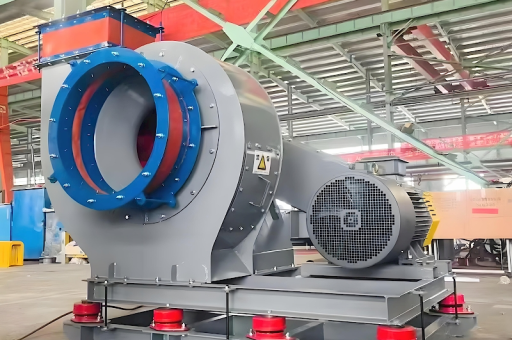
This specialized fan is not merely a ventilation unit; it is a high-performance engineered solution designed to survive the harshest conditions: abrasive dust, corrosive gases, and extreme thermal gradients. Unlike standard fans, this variant combines the aerodynamic efficiency of backward-curved impellers with the durability of stainless steel construction, specifically optimized to handle airborne materials during the cooling phase.
What is a Backward Stainless Steel Material Handling Fan?
To understand its importance, we must first dissect the name:
- Backward Curved Blades: The blades curve away from the direction of rotation. This design generates higher static pressure and lower noise levels compared to forward-curved blades, making it ideal for systems that need to push air against resistance (e.g., through a heat exchanger or a deep bed of clinker).
- Stainless Steel Construction: The fan housing, impeller, and shaft are typically fabricated from grades such as SS304 or SS316L. This protects against corrosion from acidic condensates and oxidation at high temperatures.
- Material Handling Capability: Unlike standard HVAC fans, this fan is designed to pass particulates (dust, ash, small clinker fragments) without accumulating debris or causing erosion.
The primary function is to provide a consistent, high-pressure airflow across the kiln's cooling zone, extracting heat and quenching the product to a specific temperature threshold.
Key Design Features: Why Stainless Steel and Backward Curved Blades?
This section explores the engineering rationale behind the material and blade geometry choices.
Corrosion Resistance & High Temperature Tolerance Industrial kilns often process materials that release sulfur dioxide (SO₂), chlorine, and other aggressive compounds. At elevated temperatures (350°F to 600°F / 175°C to 315°C), these compounds become highly corrosive. Carbon steel fans would experience rapid oxidation and pitting. Stainless steel alloys, however, form a passive chromium oxide layer that resists chemical attack. Furthermore, advanced alloys maintain tensile strength even when the fan is handling hot gases during emergency shutdowns.
Aerodynamic Efficiency of Backward Curved Blades According to fan affinity laws, backward curved blades offer the best efficiency point (BEP) in high-pressure applications. They exhibit a non-overloading power curve. This means that even if the system resistance decreases (e.g., due to a clean filter), the motor will not overload. For kiln operators, this translates to lower energy bills and fewer motor burnouts. The blade shape also reduces turbulence, which is critical when moving semi-hot air laden with fine particles.
Material Handling Capabilities The key to handling materials lies in the blade profile and the housing clearance. Backward curved fans for material handling typically have deeper blades and a larger cutwater clearance. This prevents large particles from getting trapped between the blade and the housing. The stainless steel surface also remains smoother over time compared to painted or coated carbon steel, preventing material adhesion (buildup) that can unbalance the impeller.
Application in Kiln Cooling: A Technical Deep Dive
Forced Draft vs. Induced Draft Systems In forced draft systems, the Backward Stainless Steel Material Handling Fan pushes cold ambient air into the kiln's cooler. In induced draft systems, it pulls hot gas out of the kiln through a heat recovery system. For the cooling phase specifically, forced draft is more common. The fan must overcome the pressure drop of the material bed (e.g., a clinker grate cooler) which can be 15-30 inches w.g.
Managing Dust, Particulates, and Thermal Shock A unique challenge is "thermal shock." If a fan suddenly starts pulling cold air into a hot kiln, the impeller can expand or contract unevenly, leading to cracks. High-quality backward curved fans feature a reinforced center disc and floating shaft seals to mitigate this. The stainless steel impeller is often stress-relieved after welding.
Application Example: In a rotary kiln for cement, the fan draws air through the cooler, quenching the clinker from ~1400°C to ~100°C. Without a robust material handling fan, a 0.5 mm imbalance caused by dust buildup can destroy bearings within 24 hours.
Comparative Analysis: Backward vs. Forward Curved Fans
| Feature | Backward Curved Fan | Forward Curved Fan |
|---|---|---|
| Blade Shape | Curves away from rotation | Curves toward rotation |
| Pressure Generation | High static pressure | Low to medium static pressure |
| Power Curve | Non-overloading (safe) | Overloading (risk of motor burnout at low resistance) |
| Efficiency | High (75-85%) | Lower (60-70%) |
| Dust Handling | Excellent (wide blade spacing) | Poor (blades act as dust traps) |
| Noise | Lower | Higher |
| Cost | Higher initial cost | Lower initial cost |
Conclusion for Kilns: Forward curved fans are unsuitable for kiln cooling due to their poor dust handling and overloading power curves. The backward design is the industry standard.
Frequently Asked Questions (FAQ)
Q1: Why must the fan be made of stainless steel? Answer: Kiln exhaust gases often contain moisture, acids, and hot particulates. Stainless steel (SS304/SS316) resists corrosion far better than carbon steel, ensuring a longer operational life. Carbon steel would rust rapidly, leading to imbalance and catastrophic failure within months.
Q2: Can a backward curved fan handle large chunks of debris? Answer: While designed for material handling, these fans are typically used for dust and small aggregates (e.g., granulated slag). For large lumps, a dedicated "trickle valve" or pre-separator is required upstream. The fan can handle particulate sizes up to about 10mm to 15mm, depending on the model.
Q3: What is the typical temperature range for this fan? Answer: Standard models operate between -20°C and 200°C. High-temperature variants, using thicker stainless steel and special expansion joints, can handle continuous operation at up to 450°C (842°F), which is common in direct kiln cooling applications.
Q4: How does a backward curved fan save energy? Answer: Because the design is more aerodynamic and the power curve is non-overloading, the fan operates at its best efficiency point longer. Compared to an axial fan or a forward curved fan, this can yield energy savings of 15% to 30% in constant pressure applications.
Q5: What maintenance is required? Answer: Key maintenance includes: (1) Regular vibration analysis to detect bearing wear; (2) Inspection of the impeller for balance and erosion; (3) Lubrication of bearings per manufacturer spec; (4) Checking belt tension (if belt-driven). The stainless steel surface should be cleaned if buildup occurs, but it generally requires less cleaning than painted steel.
Maintenance & Longevity: Best Practices
To maximize the lifespan of your Backward Stainless Steel Material Handling Fan for Kilns Cooling, follow these protocols:
- Vibration Monitoring: Install accelerometers. Unbalanced impellers due to dust buildup or erosion are the #1 cause of failure.
- Thermal Barrier: Ensure the fan shaft is equipped with a heat slinger or cooling disc to prevent bearing overheating.
- Drainage: The fan housing should have a drain plug at the bottom to remove condensed moisture that could cause stress corrosion cracking.
- Periodic Rotation (Spares): For critical kilns, keep a spare rotor assembly. Rotate the spare rotor every 6 months to prevent bearing flattening.
Conclusion: Future Trends in Kiln Cooling Technology
The demand for more efficient, durable, and environmentally friendly kilns is driving innovation in fan technology. The Backward Stainless Steel Material Handling Fan is evolving with the adoption of computational fluid dynamics (CFD) for blade optimization, the use of duplex stainless steels for extreme corrosion, and the integration of variable frequency drives (VFDs) for precise cooling control.
While the upfront cost of a high-quality backward curved stainless steel fan is higher than generic alternatives, the total cost of ownership (TCO) is significantly lower due to reduced downtime, lower energy consumption, and longer service intervals. For plant engineers and operations managers, selecting the correct fan for kiln cooling is not a commodity purchase—it is a strategic decision that impacts the reliability of the entire production line.
By optimizing the airflow with a specialized, backward-curved, stainless steel material handling fan, industrial kilns can achieve higher throughput, better product quality, and safer operational conditions.





