
This article's table of contents introduction:
- The Application Context
- Why Use V-Belts for This Application? (Pros vs. Cons)
- Critical Design & Engineering Considerations
- Recommended Drive Specifications
- Conclusion: Is a V-Belt the Right Choice?
This is a very specific and industrial application. Using a V-belt drive to power a material handling fan for a smelting furnace involves a unique set of engineering challenges due to the extreme environment.
Here is a detailed breakdown of the application, its requirements, the advantages/disadvantages of V-belts in this role, and key design considerations.
The Application Context
- Smelting Furnace: This is a high-heat source (often >1000°C / 1800°F) producing intense radiant heat, molten metal splash, and abrasive dust (e.g., coke, flux, metal oxides).
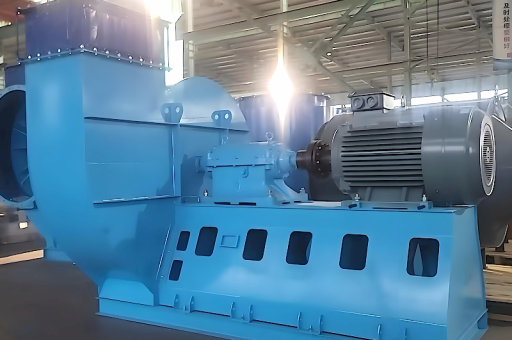
- Material Handling Fan: This is not a comfort ventilation fan. It's a heavy-duty industrial fan designed to move:
- Combustion Air: For the furnace burners.
- Fume/Dust Extraction: To capture toxic gases (CO, SO2, metal fumes) and particulate matter.
- Material Conveying: Sometimes used to pneumatically convey raw materials (e.g., coke breeze) into the furnace.
- Drive Type: V-Belt (Classical, Narrow, or Wedge).
Why Use V-Belts for This Application? (Pros vs. Cons)
| Pros (Advantages) | Cons (Challenges) |
|---|---|
| Shock Load Absorption: Belts slip slightly, protecting the motor and fan from sudden shock loads (e.g., a large piece of slag hitting the fan blade). | Heat Sensitivity: V-belts are rubber/polymer. Extreme radiant heat from the furnace degrades them rapidly (cracking, hardening, slipping). |
| Cost-Effective: Lower initial cost than direct-drive (coupling) or gearbox for medium to high power (50-500 HP). | Dust and Abrasion: Smelting dust acts as a grinding paste, accelerating belt and sheave wear. |
| Tension Flexibility: Easier to adjust center distance and tension compared to chain drives. | Slippage: Under heavy dust loading or belt wear, slippage increases, reducing fan speed (CFM) and potentially causing overheating. |
| Overload Protection: The belt acts as a mechanical fuse. If the fan jams, the belt slips before the motor burns out or the shaft breaks. | Maintenance: Requires regular tension checks, alignment, and replacement. In a hot, dirty environment, this is frequent and difficult. |
| Shaft Alignment Tolerance: More forgiving of minor misalignment between motor and fan shafts than a direct-coupled system. | Space: Requires more space than direct drive for the sheaves and belt take-up. |
Critical Design & Engineering Considerations
For a V-belt drive to function reliably on a smelting furnace fan, the following factors must be addressed in the design.
Heat Management (The #1 Threat)
- Cooling: The fan and belt drive MUST be placed in a forced-air cooled enclosure or a significant distance from the furnace wall. A "hot wall" fan is directly cooled by the air it moves.
- Heat Shields: Install polished metal radiation shields between the furnace and the drive system.
- Belt Material: Do NOT use standard rubber belts. Specify belts made for high heat:
- HR (High Resistance) / HTS: For moderate heat (up to 120°C / 250°F).
- Viton™ (FKM) or Silicone Belts: For higher heat (up to 200°C / 400°F), but these are expensive and less flexible.
- Reinforced Aramid (Kevlar®) Core: For tensile strength in thin, heat-resistant profiles.
- Sheave Material: Use Cast Iron sheaves. They dissipate heat better than steel. Avoid aluminum, which will soften and deform.
Dust and Abrasion Resistance
- Belt Surface: The belt jacket material must be oil- and heat-resistant. Standard F or E rubber jackets will not last. Look for a SBR/Neoprene or CR (Chloroprene) jacket.
- Alignment: Perfect alignment is non-negotiable. Misalignment causes a belt edge to wear rapidly against the sheave flange, creating dust and rapid failure.
- Belt Guards: Must be enclosed but not sealed. They need to be slotted or perforated for ventilation (to release heat) but fine-meshed to keep out large dust particles and sparks. Use a wire mesh screen rather than a solid sheet metal guard.
Fan Load Characteristics
- Fan Type: Most smelting furnace fans are Radial (Paddle Wheel) or Radial Tip fans. These are "high static pressure" fans. They have a "horsepower dip" at low airflow. If the system is dampened incorrectly, the motor can overload. V-belts must be sized for the fan's peak horsepower demand, not just the motor rating.
- Variable Torque: Fan loads are variable torque (T ∝ RPM²). The V-belt drive must be designed for this. A simple constant-torque belt calculation will fail.
- Service Factor: Use a high service factor for the drive.
- Minimum Service Factor: 1.5 to 1.8 (compared to 1.0-1.2 for a clean, constant load).
- Considered "Heavy Duty / Very Severe Duty": Intermittent shock loads, dust, and heat.
Sheave Sizing & Speed
- Ratio: The fan speed (RPM) for material handling is typically low to medium (300-900 RPM). Motor speed is usually 1800 or 3600 RPM.
- Sheave Diameter: The Small Sheave Diameter (on the motor) must be kept as large as possible to reduce belt wrap angle and stress. A small motor sheave in a dusty, hot environment will cause rapid belt fatigue and slipping.
- Number of Belts: Use multiple belts (e.g., 5-8 belts) rather than one very wide belt. This provides redundancy. If one belt fails, the others can limp along (with heavy slip) until shutdown.
Recommended Drive Specifications
| Parameter | Recommendation |
|---|---|
| Belt Type | Classical B, C, or D section. Or Narrow V-Belt (3V, 5V, 8V) for higher power density. |
| Belt Material | HR (High Resistance) or HT (High Temperature) rubber. Avoid standard FR (Fire Resistant) as they often have poor heat aging. |
| Sheave Material | Cast Iron (Gray or Ductile). Pitch diameter > 8 inches for motor sheave. |
| Center Distance | Keep as short as practical to minimize belt length (less expansion from heat), but allow for tensioning slides. |
| Tensioning | Fixed center with spring-loaded idler is better than manual adjustment, as belts sag and stretch as they heat up. |
| Maintenance | Schedule weekly belt tension checks. Use a sonic tension meter (not "pluck and guess"). Change belts as a matched set. |
Conclusion: Is a V-Belt the Right Choice?
Yes, it is a very common and practical choice for this application, but it is inherently high-maintenance due to the aggressive environment.
For best results:
- Alternative: For higher reliability and less maintenance, a Direct Drive (fan impeller on motor shaft) is superior, but requires a special, expensive, high-temperature motor (e.g., with a hollow shaft for cooling).
- Better Alternative: A Shaft-Mounted Gear Reducer with a fluid coupling is the most robust (and expensive) solution for extremely heavy smelting duty.
If using a V-belt is the economic reality: Invest in high-quality, heat-resistant belts, precise cast iron sheaves, and a robust belt guard with cooling vents. Accept that belt replacement will be a regular, scheduled maintenance event (e.g., every 3-6 months depending on heat/dust severity).





