
This article's table of contents introduction:
- Understanding the Core Requirements
- Critical Design Features for this Application
- Material of Construction (Corrosion Resistance)
- Types of Centrifugal Fan Wheels for This Job
- Typical Applications
- How to Specify This Fan (Checklist for your Supplier)
- Major Manufacturers to Contact
- Summary
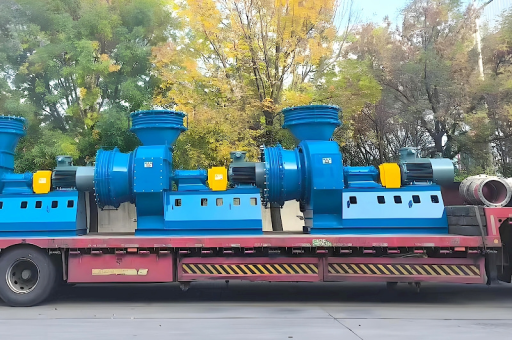
This is a highly specific piece of industrial equipment. You are looking for a Centrifugal Fan (often called a Blower) designed for Material Handling (pneumatic conveying) that is Corrosion Resistant and capable of High Air Flow.
Here is a detailed breakdown of what this equipment entails, the key design features, typical materials of construction, and how to source or specify one.
Understanding the Core Requirements
- High Air Flow: This implies a large volume of air (measured in CFM or m³/h) moved against a system pressure (static pressure). This typically requires a large impeller diameter, a high-speed drive, or a specific fan design (like Airfoil or Backward Inclined).
- Material Handling: The fan must handle particulate-laden air. This means the impeller and housing must be wear-resistant (or designed to be easily repaired) and have large, non-clogging flow paths.
- Corrosion Resistant: The fan must withstand chemical attack (acids, alkalis, salts, moisture, or corrosive gases). This rules out standard carbon steel.
- Centrifugal Fan: The design where air enters axially and exits radially (90-degree turn). This is the standard for high-pressure material handling systems.
Critical Design Features for this Application
A standard fan will fail quickly. Your fan must have:
- Heavy-Duty Construction: Thicker gauge steel than standard HVAC fans.
- Reinforced Impeller: Blades often have a wear plate or liner on the leading edge.
- Shaft Seals: To prevent corrosive dust from entering the bearings (e.g., Teflon lip seals, labyrinth seals, or purge air systems).
- Abrasion Protection: Rubber lining, ceramic tile lining, or replaceable wear plates inside the housing.
- Drain Ports: To allow corrosive condensate to exit without pooling inside the housing.
- Access Doors: For cleaning and inspecting material buildup.
Material of Construction (Corrosion Resistance)
This is the most critical choice. Options from least to most expensive:
| Material | Best For | Limitations |
|---|---|---|
| 304/316L Stainless Steel | Most chemical fumes, moisture, mild acids (e.g., food processing, wastewater). | Poor against chlorides (HCl, bleach). Can be eroded by abrasive powders. |
| Duplex Stainless Steel (e.g., 2205) | High stress + chloride environment. Higher strength than 316L. | Expensive. Harder to fabricate. |
| Fiber-reinforced Plastic (FRP) | Extremely corrosive acids and gases (e.g., HCl gas, chlorine, sulfuric acid mist). | Cannot handle high temperatures (>200°F/93°C) or abrasive materials well. Static charge risk. |
| PVC/PP (Polypropylene) | Low temperature, low pressure, highly corrosive fumes (Plating, lab exhaust). | Brittle, low structural strength. Not for heavy material handling. |
| Hastelloy / Inconel | Extreme chemical environments (e.g., chlorinated organics). | Extremely expensive. |
| Coated Carbon Steel (e.g., Rubber-lined, Teflon-lined, Halar-coated) | Best for abrasive + corrosive materials. | Lining can be damaged by sharp particles, leading to rapid corrosion underneath. |
Recommendation for "High Air Flow Material Handling" with corrosion: The best balance is often 316L Stainless Steel with replaceable wear liners on the impeller and housing. If the material is highly abrasive and corrosive, a rubber-lined steel fan is the standard industrial solution.
Types of Centrifugal Fan Wheels for This Job
The impeller design determines efficiency and handling ability:
- Backward Inclined / Airfoil (BI/AF): Best for High Air Flow + High Static Pressure. High efficiency, but the narrow curved blades can clog with sticky material. Great for clean, dry, corrosive dust.
- Radial Blade / Paddle Wheel: Best for Heavy, Abrasive, Sticky Material. Very rugged, simple blades. High pressure, but lower efficiency. The correct choice if you are moving heavy, sharp particles.
- Radial Tip (RTE): A compromise. Higher efficiency than a radial, but better material handling than an Airfoil.
Typical Applications
You would use this specific fan in:
- Chemical Processing: Conveying plastic pellets (PVC) with corrosive additives.
- Pharmaceuticals: Handling corrosive powders or vapors in a clean room.
- Wastewater Treatment: Conveying sludge or chemicals (e.g., moving air from a scrubber).
- Mining & Metal Refining: Handling ore dust with sulfuric acid fumes.
- Food Processing: Handling salt, sugar, or acidic ingredients (e.g., citric acid dust).
How to Specify This Fan (Checklist for your Supplier)
You need to provide this data to a manufacturer like New York Blower, Cincinnati Fan, Greenheck, Aerovent, or Twin City Fan.
- Flow Rate (CFM / m³/h): How much air do you need to move?
- Static Pressure (in. w.g. / Pa): What is the resistance of your ducts, filters, and cyclone?
- Material Characteristics:
- Name of the material being handled.
- Particle size and shape (powder, granular, fibrous?).
- Is it abrasive? (Sand-like, sharp edges).
- Is it sticky/clogging?
- Concentration (lbs of material per lb of air).
- Operating Temperature (°F / °C): FRP and linings have temperature limits.
- Corrosive Environment:
- List all chemicals (including moisture and temperature).
- Provide the pH level of condensate.
- Explosion Rating: Is the dust combustible (e.g., grain, metal, chemical)? If yes, you need an ATEX or NFPA compliant fan (spark-resistant construction, e.g., aluminum impeller in a steel housing).
Major Manufacturers to Contact
- The New York Blower Company: The industry standard for heavy-duty, custom-engineered fans. They have specific lines for "Material Handling" and "Corrosion Resistant" (FRP).
- Cincinnati Fan: Offers a wide range of "Material Handling" fans in stainless steel.
- Twin City Fan: Excellent for custom engineered solutions.
- Aerovent / Greenheck: Good for commercial/light industrial.
- Dual Co. (Met-Pro): Specialists in FRP and polypropylene corrosive fume exhausters.
Summary
To get the right fan, you almost certainly need a custom-engineered unit, not an off-the-shelf HVAC fan.
The ideal solution for "High Air Flow Material Handling Blower Corrosion Resistant Centrifugal Fan" is likely a Heavy-Duty, Backward Inclined or Radial Blade Centrifugal Fan constructed of 316L Stainless Steel (or Rubber-Lined Steel) with a reinforced shaft seal and an access door for cleaning.
Contact a manufacturer with the specifications listed above to get a quote. Be prepared for a lead time of 12-20 weeks for a true custom build.





