
This article's table of contents introduction:
- Decoding the Terminology
- Summary of the Complete Assembly
- Common Applications
- Key Engineering Considerations
- Conclusion
This is a highly specific piece of industrial equipment. Let's break down what this description means, its common applications, and the engineering considerations behind it.
Here is a detailed explanation of a Carbon Steel Material Handling Fan with a Single Width, Single Inlet (SWSI) Impeller Support.
Decoding the Terminology
-
Carbon Steel: This refers to the material of construction. It's a steel alloy where the primary alloying element is carbon.
- Why Carbon Steel? It's strong, durable, relatively inexpensive, and easy to weld. For handling non-corrosive materials (like wood chips, grain, dust, or metal shavings), it's a cost-effective and robust choice. It's often painted or powder-coated for corrosion protection.
- Limitation: Not suitable for corrosive gases, high moisture, or acidic materials (use stainless steel instead).
-
Material Handling Fan: This is the fan's purpose. It's designed to move airstreams that contain:
- Particulates: Dust, sawdust, grain, cement powder.
- Light Bulk Solids: Wood chips, pellets, trim scrap, granules.
- Fumes & Smoke: Often in industrial environments.
- Key Design Features:
- Heavy-Duty Construction: Thicker gauge steel, reinforced housings.
- Abrasion Resistance: Often includes replaceable wear liners or thicker impeller blades.
- Access Doors (Cleanouts): Essential for clearing blockages.
- Non-Sparking Options: In explosive dust environments, the impeller may be aluminum or other non-ferrous material, though the housing is still carbon steel.
-
Single Width, Single Inlet (SWSI): This describes the fan's aerodynamic design.
- Single Width: The impeller (the spinning wheel with blades) is relatively narrow. Air enters from one side and exits at the periphery.
- Single Inlet: Air enters the fan through a single opening on one side of the housing.
- Performance: SWSI fans are generally more efficient and generate higher pressure than Double Width, Double Inlet (DWDI) fans of the same size, making them ideal for "dirty" air applications where pressure is needed to overcome ductwork and filters.
-
Impeller Support: This is the most important mechanical aspect. It refers to how the impeller shaft is mounted and supported. There are two primary types:
-
Overhung Impeller (OHI): The impeller is cantilevered on the shaft, with bearings located outside the airstream (on the shaft between the housing and the motor).
- Pros: Isolates bearings from dirt and heat.
- Cons: Requires a heavy-duty shaft and bearings to handle the overhung load.
- Common in: Larger, high-horsepower material handling fans where bearing cleanliness is critical.
-
Mid-Span (or Between-Bearing) Support: The shaft is supported by bearings on both sides of the impeller. The bearings are often located inside the housing or in a bearing housing that extends through the side.
- Pros: Excellent for very wide impellers or heavy loads.
- Cons: Bearings are exposed to the dirty airstream (requiring high-quality seals), and the shaft is longer and more complex.
- Common in: Very large, high-static pressure applications.
-
Direct Drive (Motor Mounted on Shaft): The impeller is mounted directly on the motor shaft (no bearings on the shaft itself).
- Pros: Simple, compact.
- Cons: The motor is in the airstream (hot/cold/dirty), and the motor bearings take the full load. Not ideal for heavy material handling.
For "Material Handling" and "Single Width," the most common impeller support is the Overhung Impeller (OHI) style, as it keeps the bearings clean.
-
Summary of the Complete Assembly
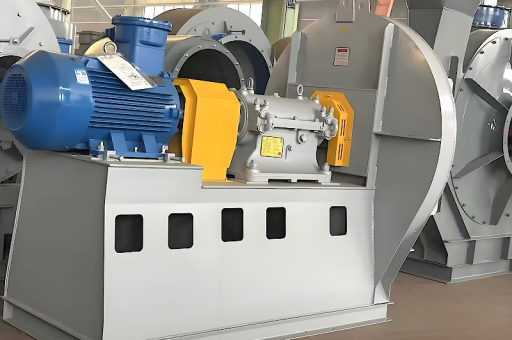
You are describing a fan that looks and performs like this:
- Fan Type: A radial, paddle-wheel, or backward-inclined centrifugal fan.
- Housing: Fabricated from heavy-gauge carbon steel, often with a spiral scroll that accelerates the air.
- Inlet: A cone or bell-mouth entry on one side (single inlet), leading directly to the impeller eye.
- Impeller: A robust, single-width wheel made of carbon steel. The blades are typically paddle (radial) or backward-inclined (BI) .
- Paddle Blades: Best for sticky or stringy materials (e.g., paper trim, grain). Self-cleaning.
- Backward Inclined Blades: More efficient for general dust, wood chips, and bulk solids. Less prone to clogging than forward-curved blades.
- Shaft: A heavy-duty, turned, ground, and polished steel shaft, often supported by two heavy-duty pillow block bearings in a bearing support stand outside the housing.
- Drive: Typically belt-driven (motor outside the airflow, adjustable speed), but can be direct-driven (motor on the shaft).
Common Applications
This type of fan is the workhorse of many industries:
- Woodworking: Dust collection systems for sawdust, shavings, and chips.
- Agriculture: Grain handling, feed mills, pneumatic conveying of pellets.
- Manufacturing: Conveying trim waste, metal shavings, paper trim, plastic regrind.
- Cement & Concrete: Moving cement dust, fly ash, and raw materials.
- Food Processing: Handling grain, flour, seeds, and powdered ingredients.
- Waste-to-Energy & Incineration: Moving flue gases (with wear protection).
Key Engineering Considerations
- Wear Protection: The leading edges of the impeller blades and the housing's "cut-off plate" (the leading edge of the scroll) are often hardened or have replaceable liners. Carbon steel is good, but it wears.
- Balance: The impeller must be dynamically balanced to prevent vibration and bearing failure, especially at high RPMs.
- Seals & Cleanouts: The shaft seal between the housing and the bearing support must keep dust out. The housing needs well-placed access doors for cleaning clogs.
- Speed: Material handling fans often run at higher speeds (1800-3600 RPM) to generate sufficient static pressure to overcome the resistance of ducts, cyclones, and filters.
Conclusion
In short, you have a heavy-duty, carbon steel centrifugal fan designed to handle dirty, particulate-laden air. Its SWSI design with an overhung impeller support makes it efficient, reliable, and well-suited for a wide range of industrial material handling tasks where cost-effectiveness and durability are paramount. It's a classic, proven piece of equipment.





