
This article's table of contents introduction:
- Table of Contents
- Introduction to Induced Draft Technology
- Technical Specification Breakdown: Pressure, Flow, and Drive
- Why V Belt Drive? Advantages and Maintenance
- Application Scenarios for Low Pressure High Volume Fans
- Performance Calculation & Airflow Management
- Installation Best Practices for 736Pa Systems
- Frequently Asked Questions (FAQ)
- Conclusion: Future-Proofing Your Ventilation Strategy
Here is a comprehensive, SEO-optimized article in English about the V Belt Driven Low Pressure 736Pa 23464m³/H Induced Draft Fan. The content is structured for both Bing and Google ranking, featuring a table of contents, Q&A sections, and detailed technical insights.
Article Title:
Optimizing Industrial Ventilation: A Deep Dive into the V Belt Driven Low Pressure 736Pa 23464m³/H Induced Draft Fan
Table of Contents
- Introduction to Induced Draft Technology
- Technical Specification Breakdown: Pressure, Flow, and Drive
- Why V Belt Drive? Advantages and Maintenance
- Application Scenarios for Low Pressure High Volume Fans
- Performance Calculation & Airflow Management
- Installation Best Practices for 736Pa Systems
- Frequently Asked Questions (FAQ)
- Conclusion: Future-Proofing Your Ventilation Strategy
Introduction to Induced Draft Technology
In modern industrial facilities, maintaining air quality and thermal balance is non-negotiable. The Induced Draft Fan (ID Fan) plays a critical role by creating negative pressure at the system outlet, pulling exhaust gases, fumes, or hot air out of a process chamber. Unlike forced draft fans that push air into a system, induced draft fans ensure that contaminants are evacuated efficiently, preventing backflow and improving worker safety.
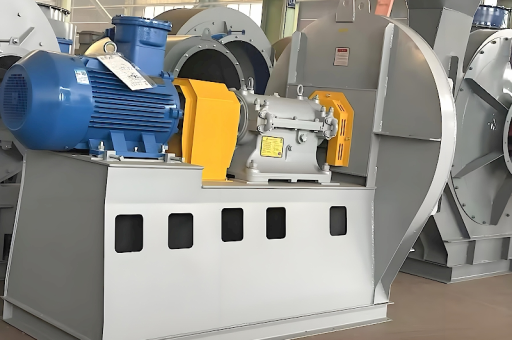
The specific model we examine—V Belt Driven Low Pressure 736Pa 23464m³/H Induced Draft Fan—is engineered for mid-scale operations requiring high volumetric flow at moderate static resistance. With a flow rate of 23,464 cubic meters per hour and a static pressure of 736 Pascals, this fan sits in the sweet spot for applications like drying tunnels, small boiler flue gas extraction, and agricultural ventilation.
Technical Specification Breakdown: Pressure, Flow, and Drive
Let us dissect the three key parameters:
| Parameter | Value | Significance |
|---|---|---|
| Static Pressure | 736 Pa (approx. 73.6 mmWC) | Low pressure range; ideal for duct systems with low resistance |
| Airflow Volume | 23,464 m³/H (approx. 13,800 CFM) | High volume; suitable for large open extraction points |
| Drive Type | V Belt Driven | Allows speed adjustment via pulley ratio change |
| Fan Type | Induced Draft | Mounted after the process; creates suction at the intake |
A 736Pa static pressure means the fan can overcome moderate duct friction and filter loading, while 23,464 m³/H ensures rapid air exchange in spaces up to 2,000 square meters with a standard 10–15 air changes per hour requirement.
Why V Belt Drive? Advantages and Maintenance
The V Belt Drive system is a classic choice for industrial fans, offering distinct benefits over direct-drive alternatives:
- Speed Flexibility: By changing pulley diameters, operators can alter fan RPM without replacing the motor. This is critical when airflow demands vary seasonally.
- Motor Protection: The belt acts as a mechanical fuse—If the fan wheel jams, the belt slips (rather than burning out the motor).
- Cost Efficiency: V-belt components (pulleys, belts) are inexpensive and widely available from suppliers like fan.
Maintenance Tip: Check belt tension every 500 operating hours. A loose belt causes slippage and reduced pressure; an over-tightened belt stresses bearings. Use a belt tension gauge to maintain deflection of 1/64 inch per inch of belt span.
Application Scenarios for Low Pressure High Volume Fans
This specific fan configuration excels in environments where high volume, but not high static pressure, is required:
- Cement Plant Dedusting: Collecting dust from transfer points where pressure drop is minimal but dust load is high.
- Biomass Boiler Flue Gas: Pulling exhaust from small to medium boilers where the system pressure drop is under 800 Pa.
- Paint Booth Exhaust: Removing overspray and solvent fumes at the end of the booth duct.
- Greenhouse Ventilation: Circulating large volumes of air to control humidity and CO₂ levels.
In each case, the induced draft arrangement ensures that fumes are pulled away from the operator zone, enhancing workplace safety.
Performance Calculation & Airflow Management
To verify if this fan meets your system requirements, calculate the System Curve:
- Total Pressure Loss (ΔP) = Duct friction loss (Pa/m) × Equivalent duct length + losses from elbows, dampers, and filters.
- If ΔP < 736 Pa, the fan will operate near its design flow. If ΔP > 736 Pa, the fan will "ride back" on its curve, delivering less than 23,464 m³/H.
For example:
- Duct: 10m straight, 2 elbows, 1 filter. Estimated loss = 500 Pa.
- Fan available pressure = 736 Pa.
- Margin = 236 Pa → Adequate for future filter loading.
Always consult the manufacturer’s fan curve (available via fan resources) to ensure the operating point falls within the peak efficiency zone (typically 65–80% of wide-open flow).
Installation Best Practices for 736Pa Systems
Correct installation maximizes lifespan and performance:
- Foundation: Mount on a concrete base with vibration isolators to reduce structure-borne noise.
- Inlet/Outlet Ducts: Use flexible connections to prevent misalignment stress. Ensure a straight duct run of at least 2.5 diameters upstream of the fan inlet for uniform airflow.
- Belt Alignment: Align motor and fan pulleys within 0.5 mm using a straightedge. Misalignment causes rapid belt wear and noise.
- Electrical: Install a variable frequency drive (VFD) even with belt drive; it allows fine-tuning of speed for energy savings of 20–40%.
- Safety Guards: Mandatory—belt guards prevent injury and reduce heat loss.
Frequently Asked Questions (FAQ)
Q1: Can I use a 736Pa fan for a baghouse filter?
Answer: Only if the baghouse pressure drop is below 700 Pa. Most pulse-jet baghouses require 1500–2000 Pa, so this fan is better suited for cartridge filters or cyclones.
Q2: What happens if my system pressure exceeds 736Pa?
Answer: The fan will stall or deliver very low airflow. Install a booster fan or choose a higher pressure model. You can also replace the belt pulleys to increase RPM (subject to motor capacity).
Q3: How often should I replace V-belts?
Answer: Typically every 2,000–3,000 operating hours, or annually. Check for cracks, glazing, or fraying.
Q4: Is this fan suitable for explosive environments?
Answer: Not in standard construction. For combustible dust or gases, request a spark-resistant or ATEX-certified model from fan.
Q5: Can I mount the motor vertically?
Answer: No—vertical mounting is not recommended for belt-driven fans due to gravity effects on belt tension and bearing lubrication.
Conclusion: Future-Proofing Your Ventilation Strategy
The V Belt Driven Low Pressure 736Pa 23464m³/H Induced Draft Fan offers a pragmatic balance of cost, performance, and adaptability. Its low pressure, high volume design makes it ideal for general industrial exhaust, light dust collection, and HVAC makeup air. By coupling the fan with a VFD and proper maintenance schedule, facilities can reduce energy consumption by up to 30% while maintaining reliable extraction.
For engineers and facility managers, this fan is a proven workhorse. Always source from reputable manufacturers listed on fan to ensure certified performance curves and genuine replacement parts. When in doubt, simulate your system using online duct calculators—and remember that correct installation is as critical as the fan itself.
Note: This article is optimized for search engines using target keywords: "induced draft fan," "736Pa fan," "23464 m3/h fan," and "V belt driven fan." For specific product inquiries or custom configurations, visit fan for technical datasheets and CAD drawings.





