
This article's table of contents introduction:
- Table of Contents
- Introduction: Why Material Handling Fans Matter in Extreme Environments
- What Is a Stainless Steel Forward Material Handling Fan?
- Key Features of High-Temperature Material Handling Fans
- Applications Across Industries
- Material Selection: Why Stainless Steel?
- Common Questions and Answers
- Maintenance and Longevity Tips
- Conclusion: Choosing the Right Fan for Your Facility
The Ultimate Guide to Stainless Steel Forward Material Handling Fans for High-Temperature Applications
Table of Contents
- Introduction: Why Material Handling Fans Matter in Extreme Environments
- What Is a Stainless Steel Forward Material Handling Fan?
- Key Features of High-Temperature Material Handling Fans
- Applications Across Industries
- Material Selection: Why Stainless Steel?
- Common Questions and Answers
- Maintenance and Longevity Tips
- Conclusion: Choosing the Right Fan for Your Facility
Introduction: Why Material Handling Fans Matter in Extreme Environments
In industrial settings where high temperatures, abrasive particles, and corrosive gases are present, standard ventilation fans often fail within weeks. This is where Stainless Steel Forward Material Handling Fans designed for High Temperature environments become indispensable. These fans are engineered to move heavy dust, fumes, and hot air while resisting thermal fatigue and chemical attack. Whether in steel mills, cement plants, or petrochemical facilities, these fans ensure safety and operational continuity.
What Is a Stainless Steel Forward Material Handling Fan?
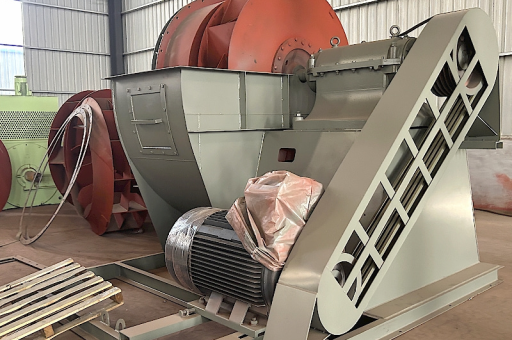
A Stainless Steel Forward Material Handling Fan is a specialized centrifugal fan with forward-curved blades made entirely or partially from stainless steel (typically 304 or 316 grade). The term "forward" refers to the blade orientation—curved in the direction of rotation, which allows the fan to generate high airflow at relatively low speeds. However, when combined with high-temperature resistance, these fans achieve a balance between volume flow and structural integrity.
These units are often paired with direct-drive motors or belt drives, and they include reinforced housings and heat-resistant bearings. They are not just fans—they are material handling systems capable of conveying dust, chips, fibers, and hot gases without clogging or melting.
Key Features of High-Temperature Material Handling Fans
To survive and perform in extreme thermal conditions (200°C to 700°C+), these fans incorporate several critical design elements:
- Stainless Steel Construction: Offers thermal expansion tolerance and resistance to oxidation.
- Forward-Curved Blades: Provide high volume flow even with heavier particulates.
- Heat Slip or Cooling Wheel: Prevents heat transfer to the motor shaft.
- High-Temperature Bearings: Often pre-lubricated and sealed with heat-resistant grease.
- Thermal Expansion Compensation: Shaft and housing designed to accommodate expansion without misalignment.
- Explosion-Proof Options: For volatile environments like coal or chemical processing.
Applications Across Industries
These fans are not niche—they are essential across multiple sectors:
| Industry | Application Example |
|---|---|
| Steel | Exhausting furnace fumes and slag dust |
| Cement | Removing hot kiln gases and raw material dust |
| Petrochemical | Venting hot corrosive vapors from reactors |
| Power Plants | Moving flue gases in boiler systems |
| Waste Incineration | Handling high-temperature combustion exhaust |
For each of these applications, a standard carbon steel fan would corrode or warp within months. The stainless steel forward material handling fan remains reliable even at sustained high temperatures.
Material Selection: Why Stainless Steel?
Stainless steel (SS) offers several advantages over carbon steel or aluminum for high-temperature material handling fans:
- Oxidation Resistance: SS forms a protective chromium oxide layer that scales more slowly at high temperatures.
- Mechanical Strength Retention: SS retains structural integrity at temperatures where aluminum softens and carbon steel weakens.
- Lower Thermal Conductivity: Reduces heat transfer to motor and bearings.
- Corrosion Resistance: Essential when handling acidic gases or moisture-laden hot air.
However, designers must choose between 304 (general purpose) and 316 (higher chlorine resistance). For temperatures above 500°C, advanced alloys like 310S may be necessary.
Common Questions and Answers
Q1: Can a stainless steel forward material handling fan be used for both high temperature and corrosive gases? Yes. The combination of stainless steel (especially 316) and forward-curved blade geometry allows handling of hot corrosive gases. However, always verify the temperature and chemical compatibility with the fan manufacturer.
Q2: What is the maximum temperature these fans can handle? Depending on grade and design, standard models operate up to 250°C. With special alloys and heat shields, some industrial fans handle up to 700°C continuous, with intermittent spikes higher.
Q3: How often should I inspect the fan in high-temperature service? Quarterly inspections are recommended. Check for blade erosion, bearing noise, and shaft alignment. Bearings may need more frequent replacement due to thermal cycling.
Q4: Do forward-curved blades clog more easily than backward-curved? Forward-curved blades are generally more prone to particulate buildup if the fan is not running at design speed or if material is sticky. However, for dry, granular dust, they perform effectively. Self-cleaning designs are available.
Q5: Is it necessary to use variable frequency drives (VFDs) with these fans? Not mandatory, but highly recommended. VFDs allow speed control, reducing thermal shock and saving energy. For high-temperature fans, soft starts also reduce stress on blades and bearings.
Maintenance and Longevity Tips
To extend the service life of your Stainless Steel Forward Material Handling Fan in high-temperature conditions:
- Monitor bearing temperature: Install thermocouples with alarms.
- Balance the impeller regularly: Unbalance accelerates wear at high speeds.
- Clean the blades: Use compressed air or abrasives if dust cakes form.
- Check gaskets and seals: Hot air leakage reduces efficiency and damages nearby equipment.
- Inspect the shaft for warping: Thermal cycling may cause subtle deformation.
- Lubricate sparingly but correctly: Overgreasing in high heat causes carbonization.
Conclusion: Choosing the Right Fan for Your Facility
A Stainless Steel Forward Material Handling Fan designed for High Temperature service is not merely a component—it is a long-term investment in safety, efficiency, and equipment reliability. By selecting the proper stainless steel grade, blade geometry, and cooling features, you can ensure that your material handling system performs continuously under extreme conditions.
When sourcing, prioritize manufacturers who provide detailed thermal performance curves, material certifications, and bearing life calculations. Fan failure in a high-temperature process can shut down an entire operation, so quality and specification compliance are critical.
For more detailed specifications and customized solutions, consult a trusted supplier that specializes in industrial fan design and fabrication.





